A narrow cut, open to the sky, with the spoil from it heaped along one side.
At about twenty past three on the afternoon of Tuesday, October 6, 2026, one wall of that cut came in.
The man at the bottom was not covered over. He was standing in it, dirt to the chest, arms free.
He could talk. He watched the first crews arrive. He stayed awake for all of it.
Getting him out took a little over three hours.
So why does a conscious man you can see take that long to lift?
Why 3,000 pounds will not let go
Soil is heavier than it looks, and it does not behave like a blanket lying on someone.
Federal safety material puts a single cubic yard at nearly 3,000 pounds, roughly the weight of a car. The volume packed around a man standing chest deep is several of those.
But load from above is not the difficulty. The difficulty is load from every side at once.
Loose soil presses against every square inch of a body and holds by friction. Pull on his arms and you are not lifting dirt off him, you are dragging him up through it, and all of that resistance travels through his spine.
Which is why the first rule is never pull. The material has to come away first, handful by handful, until he is simply standing in a hole again.
And the digging cannot be rushed, because a wall that has failed once will fail twice, and the second one buries the rescuers too.
13 feet down against a foundation
The address was the 9600 block of Falls Bridge Lane, in Potomac Village, Montgomery County, Maryland.
A single family home with work underway at the outside of its foundation, the kind of job that opens a narrow slot hard against a basement wall.
Fire crews put the man about 13 feet below grade.
That depth is what turns a bad afternoon into a technical problem. A cut deeper than a person is tall has no stable shape of its own, and the earth beside it is only waiting for a reason.
The spoil pile makes it worse. Everything taken out of the hole sits next to the hole, loading the exact ground that has to stay where it is.
The house was the one thing there already braced.
65 rescuers and 3 different descriptions
The documented record is thinner than the event, and it is worth separating from the retellings.
The county fire service was dispatched around 3:20 in the afternoon. Its spokesman logged more than 65 rescue workers on scene, including a technical rescue unit sent as mutual aid from across the river in Virginia.
A trauma center field team stood at the edge with the patient assessed and his vitals watched throughout, which is not routine for an extraction.
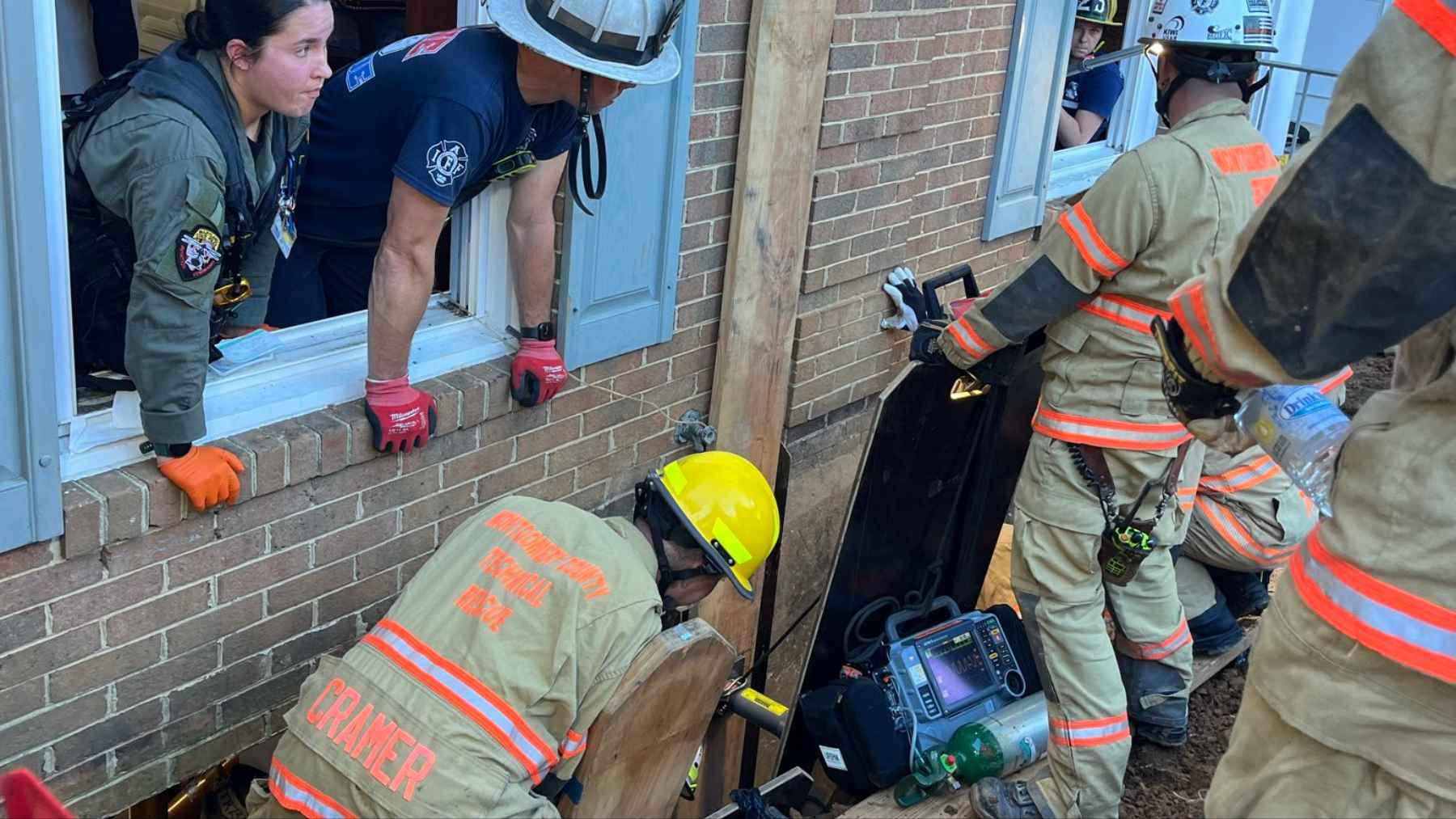
Crews worked from the inside. They broke through the basement wall and the foundation behind it using shovels and buckets, then ran vacuums to pull out the loose material.
He was clear at about half past six, serious but stable, and flown out by a state police helicopter.
Outlets put the burial at waist, chest and armpits. Nobody measured it.
A 5 foot rule and a 13 foot hole
What nobody has published is why the wall came in.
Federal rules require a protective system in any trench deeper than 5 feet, and there are four accepted ways to do it, in the way that a failed span or a soft riverbed reads later as a solved case.
Cut the walls back to a slope, step them in benches, brace them with shoring, or drop a steel box into the cut and work inside it. This hole was more than twice the trigger depth, and the local coverage said nothing about which of them was in use.
No cause has been released. His name, his age and his employer are unpublished, and the county account carries nothing on it.
That silence is not evasion. It is the ordinary pace of an inspection.
What is established is only the depth.
The 3 hours that were the right answer
The instinct at a scene like this is that faster is better.
It is the reverse. Most of those three hours bought the one thing that mattered, which was not producing a second patient, and the route that worked went around the problem instead of straight at it.
Nobody dug down to him. They went through a door, down a staircase and sideways through a wall that was already holding the ground back.
The house did the shoring.
He walked into that hole in the afternoon and left it by air.
A trench collapse is the jobsite failure where the ground itself is what must be beaten.
Read the whole thing?
Get the week's signal, not the noise
Our sharpest reporting on energy, climate and nature — free, once a week.