The breakfast rush was already underway when the floor began to move.
Bottles came off the shelves at a restaurant a few miles south of the epicenter.
In Willits, a gift shop’s inventory ended up scattered across the floor.
A grocery store went dark and taped its doors shut.
And more than 100 miles away, phones buzzed in pockets where nobody felt a thing.
So how did one moderate rupture reach that far?
A shallow rupture concentrated very strong shaking over five miles down
The rupture broke about five miles down, shallow by California standards, roughly seven miles north of Redwood Valley in inland Mendocino County. The shallower a quake, the less the seismic energy spreads out before reaching the surface, so ground shaking is more intense than a deeper event of the same size would produce. That is why a magnitude 5.6 managed to throw goods off shelves across a wide stretch of the North Coast.
Shaking fanned out from the epicenter toward Willits, Ukiah and the coastal city of Fort Bragg, where workers also felt the building move. The Geological Survey estimates that roughly 80,000 people experienced moderate to very strong shaking, while around 10 million felt only weak to light shaking. People reported feeling the quake more than 100 miles away.
That combination, shallow depth paired with an enormous footprint of barely perceptible motion, is what pushed the state’s alerting system into action across half of Northern California.
Broken glass in Willits and bottles down within seconds in Calpella
At a restaurant a few miles south of the epicenter in Calpella, an employee said the shaking knocked bottles from shelves. One worker described the moment this way: “I had just turned the open sign on and went back into the kitchen.” In Willits, inventory was strewn about and broken inside a gift shop.
Early reports indicated at least one 12 kilovolt power line came down across a roadway in Willits. Outages affected roughly 8,000 customers in Mendocino County, and a Safeway in Willits was taped off and closed after losing power. Because the quake struck during the morning rush, it caught small businesses and commuters in the middle of ordinary routines.
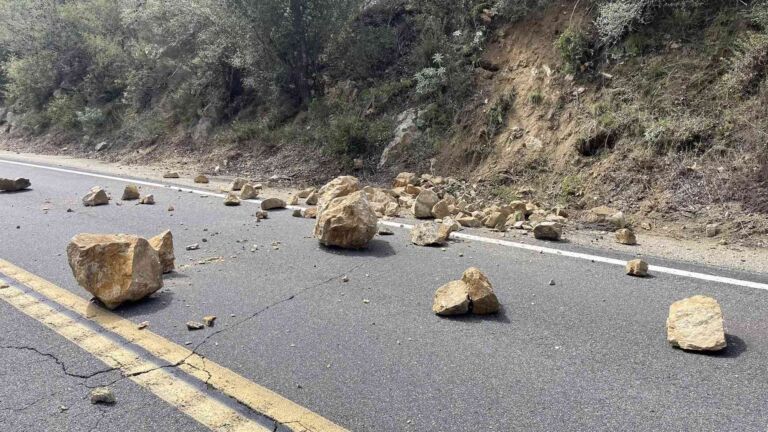
Even so, the county sheriff’s office reported some injuries but no deaths. County inspections found no major damage to public infrastructure, utilities or the landscape around the epicenter, leaving no major structural failures on the books.
Nearly 657,000 alerts went out through a single phone app
The Governor’s Office of Emergency Services said nearly 657,000 earthquake record breaking alerts were sent through the MyShake app after the quake. That app is only one delivery channel. The governor’s office said more than one million Northern Californians received an alert from the state’s early warning system, and a USGS official said the MyShake tally itself was likely to end up “well over a million” once final numbers came in.
The speed came from the detection side. A project scientist said the ShakeAlert system detected the quake within five and a half seconds, with an initial magnitude estimate of 5.7 and a location that was “essentially spot on.” Alerting is aimed at intensity 3, or weak shaking, a threshold that included Sacramento for this event, which is why so many people got a warning for ground motion they never noticed.
A similar sized quake in Southern California produced the same pattern. The MyShake app distributed 693,044 alerts for the magnitude 5.2 earthquake near Julian in San Diego County, a subset of 7.5 million alerts sent for that event. So the digital footprint of a moderate quake routinely dwarfs the area where anything actually rattles.
A magnitude 2.5 aftershock arrived seven minutes later
A magnitude 2.5 aftershock followed at 8:17 a.m., roughly seven minutes after the mainshock, centered in the same spot at a much shallower depth. Three aftershocks of magnitude 2.5 or greater arrived within the first hour, and at least 35 aftershocks above magnitude 1.3 were logged in the first six hours.
None came close to the mainshock, which is the normal decay pattern rather than a warning of something larger. The USGS forecast put the chance of at least one magnitude 3 or greater aftershock in the following month at 14 percent, magnitude 4 or greater at 2 percent, and magnitude 5 or greater at under 1 percent.
Crews spent the day checking roads, bridges and older buildings for cracks that are not always visible at first glance.
The fault beneath this patch is capable of a magnitude near 7
This was not an unknown structure. The quake struck along the Maacama fault, a long vertical fracture running between Santa Rosa and Laytonville, which a USGS seismologist described as a closely studied fault capable of producing far larger earthquakes, “probably up to north of a magnitude 7.” Initial reports tied the event to the Maacama, though a geologist said afterward that it occurred near, but not directly on, the fault.
What made it unusual was its size for that zone. It was the largest quake on that system in about 75 years, and the biggest in a region that is not on a major fault in nearly nine decades. The county’s draft hazard mitigation plan models a scenario near magnitude seven point four on the Maacama Garberville fault, the same system.
Shallow ruptures on strike slip faults punch above their magnitude, a pattern echoed by the shallow fault that moved sideways under Panama. For Mendocino County, this one mostly delivered a dry run, and a story about the morning the valley floor rolled beneath the coffee cups.
Read the whole thing?
Get the week's signal, not the noise
Our sharpest reporting on energy, climate and nature — free, once a week.