Agricultural farms take up a lot of space.
So do solar farms.
It is easy to assume the two must have separate locations.
But one German project is challenging these assumptions with a new idea.
They’re testing whether solar panels and crops can share the same ground.
So can one field produce both power and food?
Germany is placing solar panels in a mining area and adding crops to the mix as well
Near the town of Bedburg, in the Rhenish mining area, a field of around 7 hectares is doing more than one job.
As a demonstration project, it is testing out agrivoltaics, or Agri-PV.
This means producing electricity and agricultural crops on the same land.
The company wants to examine how plants and solar panels interact, if at all.
It plans to do so over many years and many different weather conditions.
Since 2024, more than 6000 solar modules have been producing electricity there in an unconventional manner.
With a peak capacity of 3.2 megawatts, they’ve been making enough to power the equivalent of 1,044 homes.
That’s a lot of power.
That’s not all, though, as in between the lines of solar panels, something else is being produced.
Germany shows us there is more than one way to use a field
Because both solar power and agriculture use up space, the goal is to combine them as efficiently as possible to save space.
The usual assumption is that every hectare covered with solar panels is a hectare that cannot grow food.
But this project, run by RWE, is testing three different layouts that challenge this idea.
The first layer has upright, rigid solar panels.
The second has solar panels on a movable axis on a tracker system, following the sun from east to west.
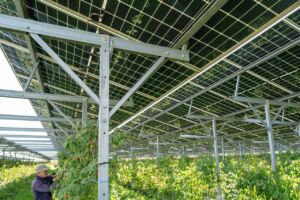
The third layout has solar panels raised on a pergola-type frame.
In layouts one and two, crops like wheat and barley are grown between the rows of panels.
In the third layout, raspberries are grown in pots.
These crops are being harvested by local farmers and either turned into flour for baking, used in breweries, or sold for consumption.
Backed by scientists and funded by the state of North Rhine-Westphalia, it seems to be set up for success.
What the first year’s harvest showed
One year into the project, the results are encouraging.
In the first two layouts, crop yields were comparable to those of another reference area.
Researchers even observed better protein content.
The CEO of RWE Renewables Europe and Australia, Katja Wünschel, says the yields match those of conventionally managed locations, without the multi-use land.
RWE says that so far, the project has shown that power generation and farming can work on the same land.
The reason for an almost matched yield lies in the soil. The moisture remained even across the soil, including beneath the panels.
They didn’t block much rainwater, and their shadows also allowed for reduced evaporation. This combination means a positive impact on plant growth.
Layout three, with the raspberries, also showed good results.
The panels actually helped protect the crops from storms and too much direct sunlight, producing healthy plants.
What made this layout even easier to use was the pergola frame.
The pergola-type frame could be used to hold a watering system, making farmers’ lives easier.
Similar pilot projects are being tested in places like New Jersey, as the shared land idea spreads to America too.
RWE plans to keep the project going over many years, with various crops and through various seasons. If the pattern of healthy crop yields continues, this could mean a new way of farming and producing electricity. Agrivoltaic projects are becoming popular, and this one is even studying whether bees can live alongside solar panels too.
Read the whole thing?
Get the week's signal, not the noise
Our sharpest reporting on energy, climate and nature — free, once a week.