Most of the dinosaurs that we know today fall under one of two groups, meat-eaters and plant-eaters.
A recently described dinosaur in North America does, however, appear to blur this line of thought.
The new dinosaur is estimated to have been approximately the same length as a turkey.
However, an examination of its skull suggests it may have relied heavily on a single food resource. That food appears to have been fruit.
Its skull raised a much bigger question
The newly named Infernogallus jamesi was discovered in the Hell Creek Formation, home to many fossils of T. rex and Triceratops.
Although Infernogallus lived alongside some of the largest dinosaurs ever identified, it weighed only approximately 12 kg as an adult.
Additionally, the discovery is unique in that the fossil provides a nearly intact skull, which is extremely rare for this particular family of dinosaurs.
Upon completing its first full skull, researchers noted that the structure of the head contained differences regarding the positioning of the head bones and jaw bones compared to other dinosaurs.
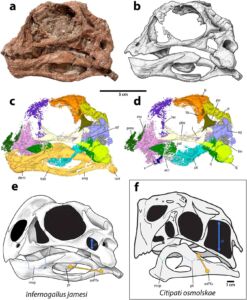
CT scans conducted on the skull showed that part of the roof of the dinosaur’s mouth, or palate, curved downward into the oral cavity.
Those structures supported muscles involved in chewing. This changed the movement from an upward-and-downward pattern to a side-to-side pattern.
While this type of arrangement was uncommon among non-bird dinosaurs, it appeared to be linked to a specialized feeding strategy.
The closest living comparison was unexpected
As researchers pondered what types of food would require such an adaptation, comparisons to modern-day birds became useful.
In fact, researchers determined that the arrangements and configurations of the muscles resemble those used by certain types of fruit-eating parrots, a finding detailed in Nature Communications.
Similar to those parrots, Infernogallus is believed to have possessed the ability to crush soft foods using extensive mastication before consuming them.
Complex ridges and grooves located within the beak area likely functioned as a means to break down food during the process of chewing.
Fruit may have arrived at exactly the right time
Evidence collected by researchers led them to conclude that the skull was particularly well-suited for breaking down fleshy fruits and avoiding the seeds associated with them. The findings were detailed in Nature Communications.
According to information released by the Royal Ontario Museum, flowering plants and their fruits diversified greatly during the Late Cretaceous period.
At almost the same time that flowering plants began to produce more fruit, caenagnathids underwent their greatest diversification.
These events suggest that new food sources may have played a major role in shaping evolutionary changes among dinosaurs.
A dietary preference could have reshaped ecosystems
If Infernogallus indeed obtained all or most of its nutrition through eating fruit, then its significance goes beyond just a nutritional aspect.
Fruit-eating animals play critical roles in dispersing seeds away from parent plants and depositing them elsewhere.
The discovery of Infernogallus presents a possible scenario where some dinosaurs performed similar functions for plant reproduction.
However, it will allow researchers to consider additional ways in which dinosaur communities interacted with each other in terms of food webs.
Rather than merely consuming plants, some dinosaurs may have participated in interactions with plants that shaped community composition.
The dinosaur world may have been more complex than assumed
The discovery further emphasizes how much still remains unknown about how dinosaurs lived their lives.
Despite being discovered in one of the world’s best-studied fossil localities, Infernogallus suggests the fossil record may still contain undiscovered dietary and behavioral specializations.
For several decades, discussions of dinosaur diversity have largely focused on how many species existed. Infernogallus highlights a different possibility.
Some dinosaurs may have occupied ecological roles that scientists did not know existed.
If a small fruit-eating dinosaur could remain hidden in such a well-studied ecosystem, other specialized lifestyles may still be waiting to be discovered.
Read the whole thing?
Get the week's signal, not the noise
Our sharpest reporting on energy, climate and nature — free, once a week.