Snow fell for three days straight over the western Austrian Alps.
It piled soft and deep across a slope two friends had just dropped into.
Neither of them came out on his own.
A search dog found one of them the next morning, seven and a half feet under the settled debris.
He was alive, his body cooled to a temperature at which most hearts stop.
So what let him last that long?
A trapped breath became his entire oxygen supply
When the slab avalanche stopped moving, snow packed in around the 24 year old snowboarder until he could not free himself. Doctors who studied the case found that his ski goggles had slipped over his mouth and nose during the fall, holding open a small space in front of his face, and that this space connected to a much larger air pocket around a rock near the ground.
Without a pocket like that, a completely buried person whose airway is packed with snow suffocates quickly, as the first snowboarder did.
With one, the exchange of gas through the snowpack slows to a trickle, but it does not stop. That trickle is why the survival mechanism was not toughness or luck alone. It was an open airway and a few spare cubic inches of breathable air, replenished just slowly enough to keep him breathing until the cold took over the job of keeping him alive.
Two and a half feet of fresh snow fell overnight above him
Rescuers worked into the night, but poor visibility and high avalanche danger forced them to suspend the search at 11:30 p.m., and another two and a half feet of snow fell before morning. The regional avalanche danger that day stood at 4, high, on the five step European scale.
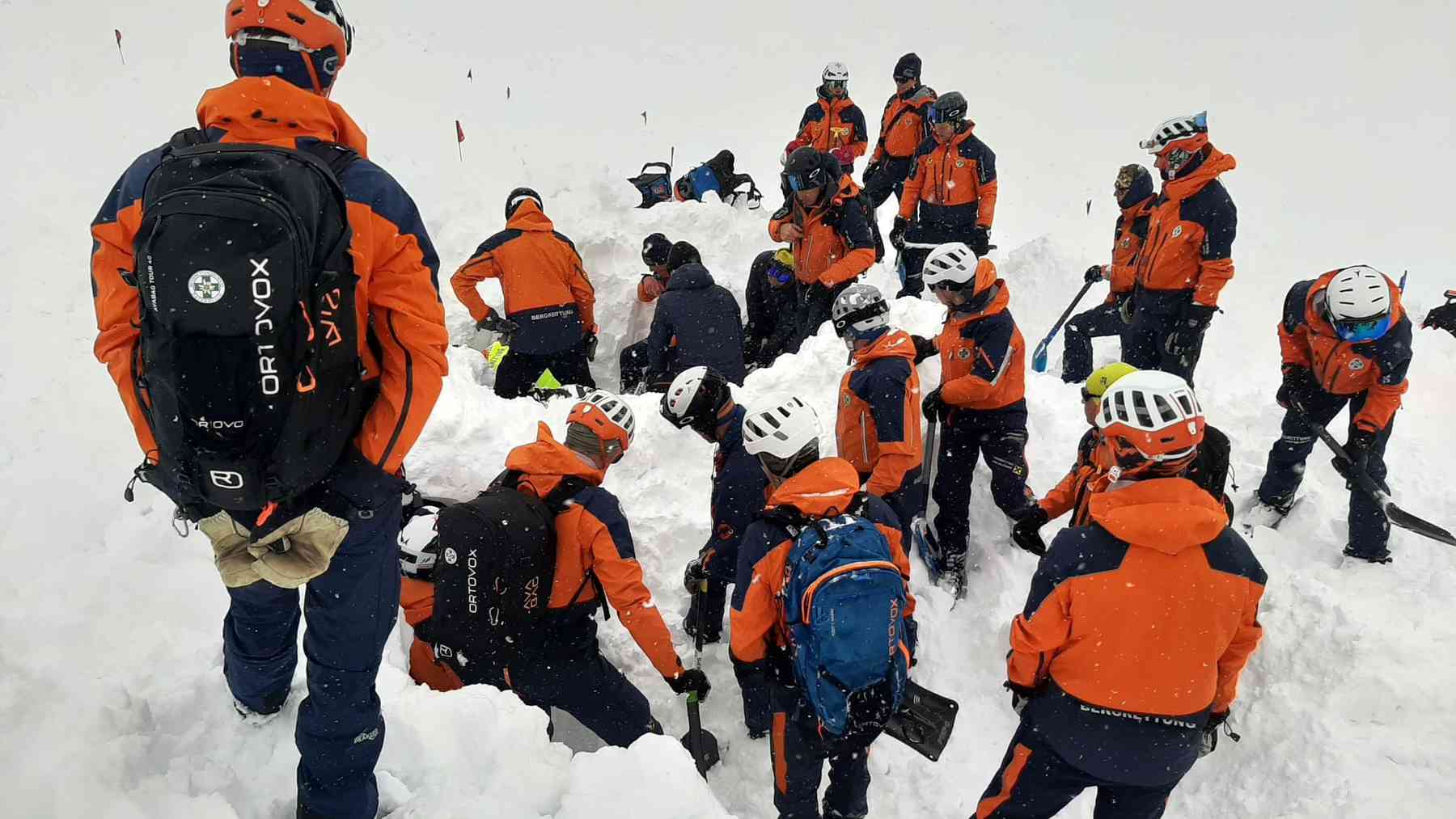
Crews resumed at 7:30 a.m. An avalanche dog located the first snowboarder three hours later, his airway blocked by snow, and found the second man ten minutes after that, a full 20 hours after the slab released.
His body had spent that entire stretch acting less like a person and more like a sealed container shedding heat into the snowpack around it, a cooling nobody chose, nobody controlled and nobody could have timed.
A core temperature of 75.4 degrees greeted doctors
At the scene, a thermometer placed in his ear read 72.5 degrees Fahrenheit, a reading usually associated with cardiac arrest. His heart was beating about 35 times a minute, and he was responsive but restless and poorly coordinated rather than lucid.
The accident happened in 2000, and the case report describing it was not published by the anesthesiology team at the Medical University of Innsbruck until more than two decades afterward. They called it the third longest critical avalanche burial reported at that point.
In intensive care his measured core temperature bottomed out at 75.4 degrees, deep inside what emergency medicine classes as severe hypothermia. Rewarming through continuous hemodialysis raised his core body temperature by roughly 1.8 degrees an hour, and he regained consciousness at around 86 degrees. He left intensive care after four days with no sign of brain injury, though a subtle nerve disturbance in both legs persisted.
A six percent drop in oxygen demand bought him time
The same cold that threatened his life also appears to have helped preserve it. As core temperature drops, the body’s oxygen demand falls with it, by roughly 6 percent for every 1.8 degrees Fahrenheit lost on the estimate used in hypothermia medicine, meaning his brain and heart needed far less fuel than they would at a normal 98.6 degrees.
That slowdown is the same principle surgeons use when they deliberately cool a patient before certain operations. In his case nobody engineered it.
The avalanche did, pressing him into a natural cold store that bought his organs time while his cardiac rhythm slowed into the kind of bradycardia doctors usually treat as an emergency. A single case cannot separate how much the air and how much the cold contributed, and the report treats the large air pocket as the precondition for everything that followed.
Two other burials lasted over 40 hours and 25 hours
The report counted only two people known to have survived a longer burial in open terrain, a woman in Italy who lasted 43 hours and 45 minutes and a 59 year old man in Canada who lasted 25 and a half hours, both decades earlier.
The list has since grown. Physicians in the Italian Alps later documented a 53 year old skier buried for nearly 23 hours whose core temperature fell to 73.6 degrees and who recovered.
That makes a rare recorded case worth reading in full, since each new report refines what rescue teams search for and how long they keep looking. Researchers have also studied extended isolation in very different settings, from sealed caves to a controlled heat chamber, each probing how far a resting human body can be pushed before it fails.
Reports like this one exist so that rescue physicians can plan for the outlier. An open airway and a trapped breath of air can matter more than brute endurance. Nobody plans for 20 hours under snow, which is exactly what makes the body’s persistence so hard to look away from.
Read the whole thing?
Get the week's signal, not the noise
Our sharpest reporting on energy, climate and nature — free, once a week.