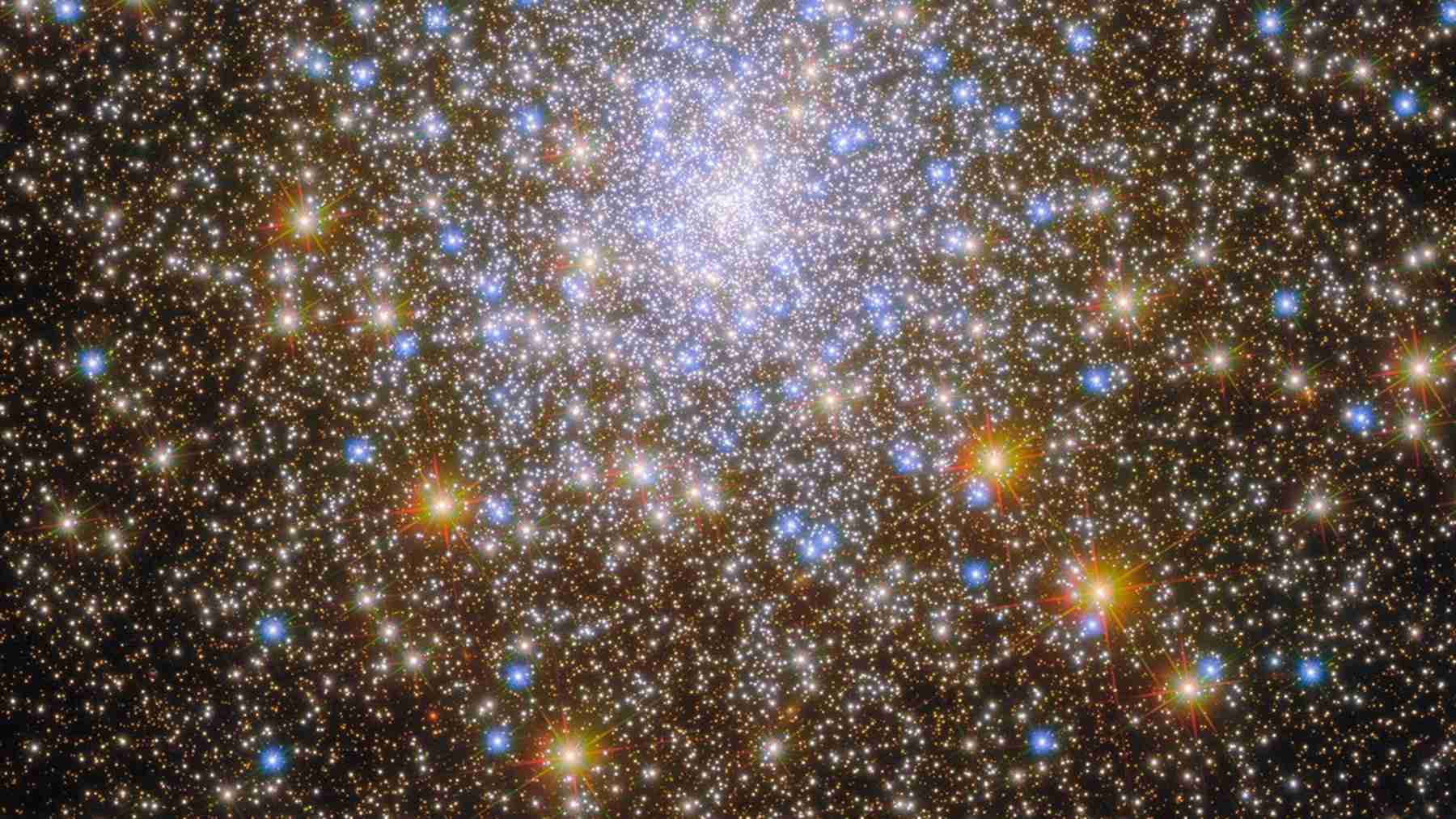
Hubble’s latest portrait of Messier 30 is a striking one: a dense, glittering sphere of hundreds of thousands of stars, suspended in space some 27,500 light-years away. At between 11.5 and 13.5 billion years old, these stars are nearly as ancient as the universe itself.
But beyond the spectacle, astronomers are finding something unexpected. The cluster’s orbit may hold clues not just about how it formed — but about whether it ever truly belonged to the Milky Way at all.
A cosmic time capsule, 27,500 light-years away
Messier 30 takes its name from Charles Messier, the 18th-century French astronomer who cataloged it alongside other hazy objects that could be mistaken for comets through the limited telescopes of his era. It sits in the constellation Capricornus — roughly spherical, packed with stars numbering from tens of thousands to millions.
Globular clusters like M30 orbit on the outskirts of galaxies, within a vast, diffuse region called the halo. The Milky Way hosts at least 150 of them. Their estimated ages — between 11.5 and 13.5 billion years — place them among the oldest structures in the observable universe, formed when the cosmos was still in its earliest stages.
How star clusters taught us where we live
Long before modern space telescopes existed, globular clusters were already doing scientific work. More than a century ago, astronomer Harlow Shapley used a particular type of variable star within these clusters to measure their positions and distances across the galaxy.
His findings reshaped astronomy. They showed that the Sun doesn’t sit at the center of the Milky Way — the galactic center actually lies toward the constellation Sagittarius, a single insight that changed how we understand our place in the cosmos.
Shapley’s distance calculations were off, leading him to conclude our galaxy was roughly twice its actual size. Still, the framework he built — using globular clusters as reference points for galactic structure — established a tradition astronomers continue to build on today.
Time capsules — or stolen relics?
Because globular clusters are so ancient, those that formed inside the Milky Way act as frozen records of the galaxy’s early chemistry. They preserve conditions from billions of years ago, offering a window into what the young galaxy looked like before stars had time to significantly enrich surrounding gas with heavier elements.
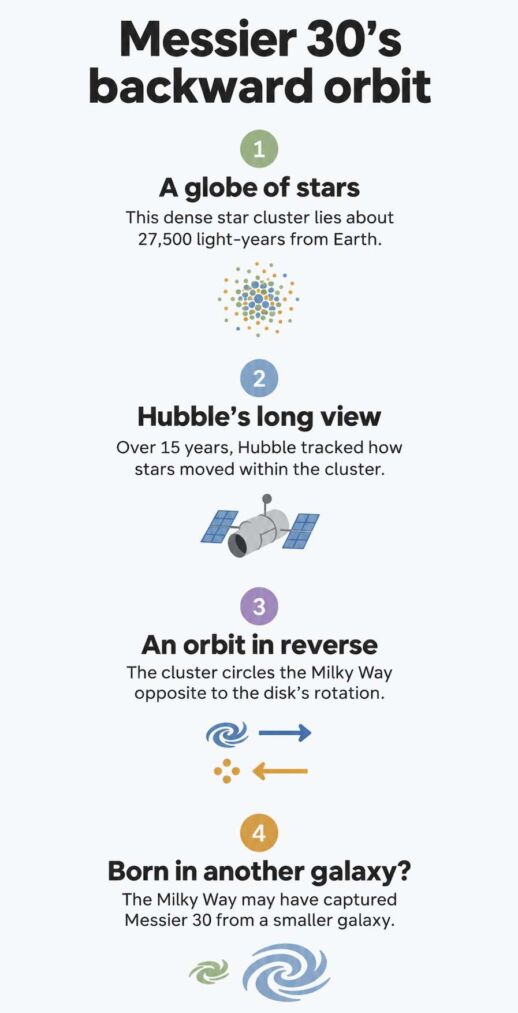
M30, though, complicates the story. Researchers have found that it — along with many other globular clusters — orbits in the opposite direction from the way the Milky Way spins. That retrograde motion is a significant red flag.
When an object moves against a galaxy’s rotation, it suggests it didn’t originate there. The leading interpretation is that the Milky Way may have gravitationally captured these clusters from smaller galaxies in the distant past — meaning some of what we consider the galaxy’s oldest building blocks may actually be imports, relics of mergers stretching back billions of years.
Three programs, one extraordinary image
The image of M30 released now didn’t come from a single observation. It’s the product of three separate Hubble observing programs conducted over more than 15 years, each targeting different wavelengths of light.
The first program used the Advanced Camera for Surveys to capture M30 in red and near-infrared light, revealing stars down to just 20% of the Sun’s mass. A second program returned with the Wide Field Camera 3, collecting bluer light — data essential for studying “blue straggler” stars and investigating multiple distinct stellar populations within a single cluster. Both programs together laid the observational groundwork for what came next.
A third program revisited these clusters, tracking how different stellar populations moved over the 15 years since Hubble first observed them. That long-baseline motion study is only possible because of Hubble’s longevity and its remarkable ability to resolve fine details in distant objects.
What M30 still has left to tell us
The composite image synthesizes all three programs into a single portrait spanning ultraviolet, visible, and near-infrared wavelengths. Each band unlocks different information — about temperature, age, chemistry, and the dynamics of stellar populations that formed and evolved under different conditions.
Ongoing analysis of how stars in clusters like M30 move and what they’re made of continues to sharpen the timeline of the Milky Way’s assembly. A single cluster, revisited over decades, keeps yielding new layers of meaning.
An object 27,500 light-years away, older than Earth by billions of years, is still teaching us who we are and where we came from — and possibly reminding us that our galaxy’s story includes chapters borrowed from its neighbors.
Read the whole thing?
Get the week's signal, not the noise
Our sharpest reporting on energy, climate and nature — free, once a week.