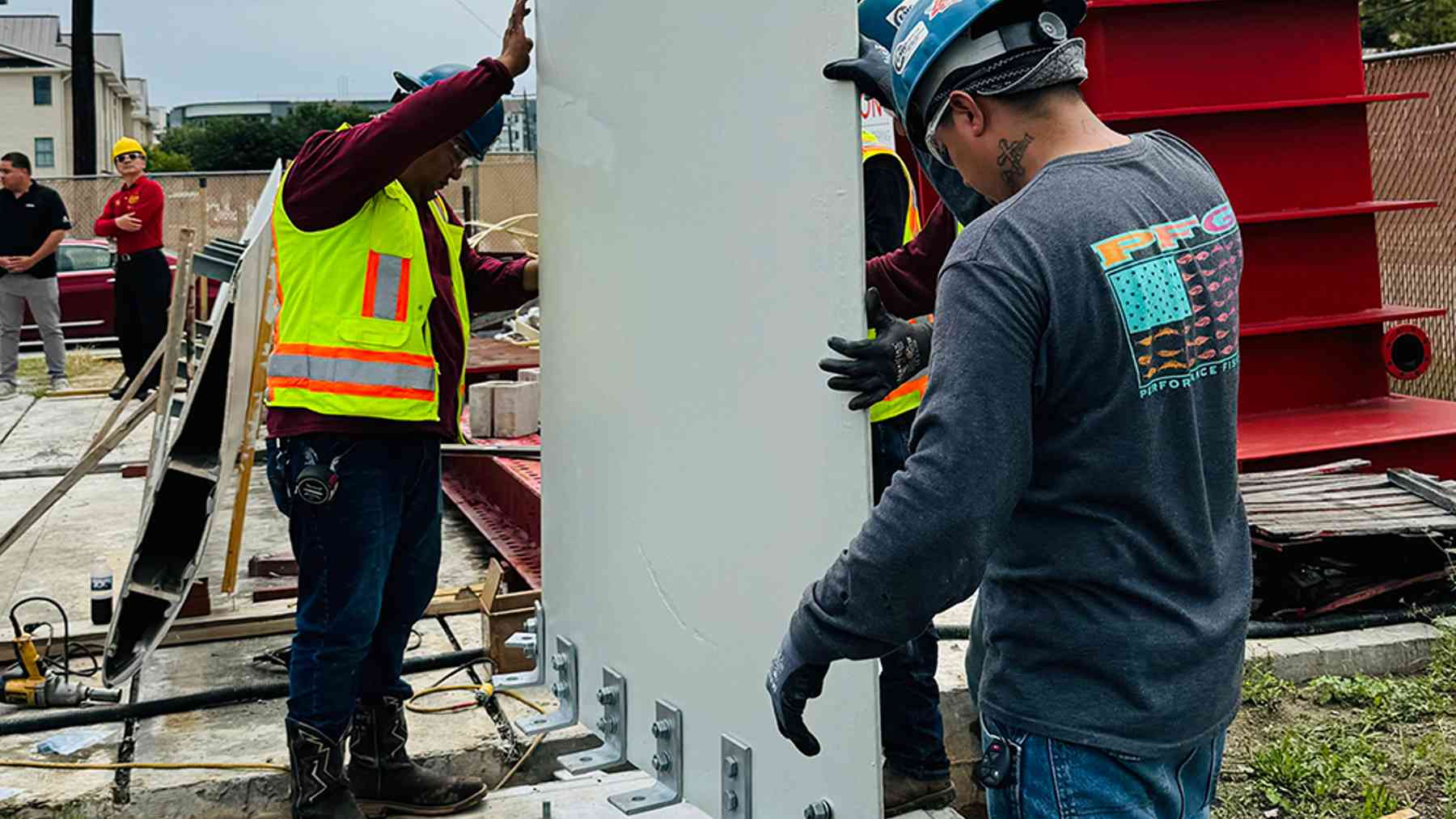
A crane holds a long pale curved shape over a lot in Houston while workers walk it down onto bolts set in concrete.
It is the wrong shape for a sign post, because it was never meant to be one.
The weather came later. A derecho on the sixteenth of May, 2024, then Hurricane Beryl on the eighth of July.
Gusts went past 100 miles an hour, and the thing is still standing.
Nobody expected the material inside it to be worn out either.
Which is the part worth asking about. Why is a twenty year old blade still strong?
Why 1 retirement has nothing to do with wear
Start with why the blade came down, because the answer is not fatigue.
Blades leave service when the machine under them gets repowered. A bigger rotor on a taller tower earns more, so the whole nacelle goes and the blades go with it.
The laminate is simply along for the ride. It was built for a service life it has not finished, and nothing in the turbine’s economics cares about that.
Then look at the new job. A sign gantry carries panels and wind, and the load barely changes from one hour to the next.
The blade spent two decades under reversing bending, millions of cycles of flap and edge, through rain and ultraviolet and ice.
Next to that, holding up a sign is a rest.
1 blade, 40 feet wide, 18.5 feet of clearance
The hardware is specific, and the details matter more than the idea does.
The team started from a retired GE37 blade supplied by a composites recycler in Knoxville, Tennessee.
They went after the spar caps, the thick unidirectional strips running the length of a blade that carry most of its bending load.
Those strips became the columns and the horizontal member of a full scale overhead sign structure.
Overhead signs were picked on purpose and not because they were easy. They have to satisfy national highway design requirements, so a blade that clears that bar clears most gentler jobs.
The prototype is described as roughly 40 feet wide, with 18.5 feet of roadway clearance underneath it.
Watch that word. The trade account says wide, while most coverage says spans.
25 foot sections bent until they broke
The evidence is mechanical, and it was gathered in the usual order.
Small coupons first, then full scale bending tests on 25 foot blade sections, loaded until they failed.
Tension in the spar caps came out approaching 90 ksi and compression around 54, which is most of what the material started life with.
The failure mode is the part that belonged in the headline. The sections gave way gradually and predictably instead of letting go all at once.
Glass laminate behaves that way because it holds thousands of separate fibers. Breaking a few of them hands the load to the rest instead of running a crack across the section.
Finite element models were then built and calibrated against those tests rather than run on assumptions alone.
And the connections, not the blade, turned out to be the hard problem.
What 248 metric tons does not add up to
Here is where the numbers need handling.
The write ups credit each structure with avoiding an estimated 248 metric tons of carbon dioxide, in the way that a park footbridge or the tonnage ahead turns into a clean headline.
That figure does not reconcile easily. A steel sign gantry of this size carries something like ten tons of steel at roughly two tons of carbon dioxide per ton, which lands near twenty, and the trade account publishes no method behind the bigger number.
The 73 percent is narrower than it reads too. That is a material cost, not a built cost, and it sits apart from the engineering that made the joints work.
Even the credit is unsettled. The trade write ups name one lead researcher, while the local report credits a mechanical engineering professor and a second faculty member.
One prototype is also one prototype.
What the next 4 million tons will meet
Scale is the only reason any of this matters.
Nearly 4 million tons of American blade material is expected to need end of life handling by 2050.
Against that, a sign gantry consumes one blade, and the country does not put up many sign gantries in a year.
What the prototype actually settles is narrower and more useful than the carbon line. A retired blade can meet highway design requirements, it fails gracefully, and the obstacle is the bolted joint rather than the composite.
A turbine blade is a structure that outlives the business case for the machine it hung on.
Somebody still has to build the bracket.
Read the whole thing?
Get the week's signal, not the noise
Our sharpest reporting on energy, climate and nature — free, once a week.