

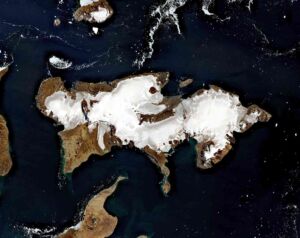
From space, Vega Island looks like something staring back at you. Locked in the remote Weddell Sea east of the Antarctic Peninsula, its glaciers, rock outcrops, and moraines trace the unmistakable profile of a grinning skull — a nunatak for an eye socket, a lateral moraine curling into a mouth, the Bahía del Diablo Glacier forming a jawbone.
Satellite images captured in October 2026 show the skull has changed. Snow that typically blankets the island is gone across large stretches, replaced by darker, bare ice. Something about the winter that just passed was different — and the glaciers are showing it.
A skull stares back from the Weddell Sea
Vega Island sits in one of the most isolated corners of the Southern Ocean, locked in the Weddell Sea east of the Antarctic Peninsula. From space, it’s hard to look away. A nunatak punches through the ice to form a hollow eye socket, and a lateral moraine curves beneath it like a grinning mouth. The Bahía del Diablo Glacier stretches below as a jawbone. Together, they form a skull profile that faces toward Devil Island, as if keeping watch across the frozen sea.
NASA’s Landsat 9 satellite captured the island twice in recent years. The March 2025 image shows it as it typically appears at the start of austral autumn — snow coating the ice as expected during the region’s wettest month. The October 2026 image tells a different story: large stretches of bare, darker ice exposed where snow should be. The skull’s features remain, but they look rawer, more weathered.
A winter that left the glaciers exposed
The bare ice in that October 2026 image traces back to the winter that preceded it. Above-average temperatures — particularly in June — are partly responsible, according to glaciologist Mauri Pelto of Nichols College. The exposed ice reflects limited new snow accumulation over winter, a deficit made worse by sublimation and wind scouring. “The winter season was no treat for these glaciers,” Pelto said.
In a typical Antarctic winter, fresh snowfall builds a reflective white layer across the ice — one that insulates the surface and shields it from the solar energy arriving with spring. In 2026, that layer was largely absent, leaving bare ice that behaves very differently once the sun returns.
Dark ice, faster melt: why the coming season matters
Snow reflects a large proportion of incoming solar radiation back into the atmosphere. Bare, dark ice absorbs significantly more of it. As austral spring lengthens the days and the sun climbs higher, that difference in absorption accelerates surface melt through a self-reinforcing process known as the ice-albedo feedback.
Pelto noted that even modest relief could help. “Even a thin cover of new snow from a spring storm would be helpful in the short run,” he said. His description of what exposure means for the skull’s appearance is precise: “When entombed in snow and ice, the skull is preserved. But when exposed to melt, it weathers away, which will lead to a changing jawline and expanding eye socket.” One season of unusual bare-ice conditions is already a meaningful signal — particularly when placed against the longer record.
Decades of retreat: what the satellite record shows
Scientists have tracked Vega Island’s ice for decades. A 1982 study provided the first comprehensive mapping of the island’s glaciers, drawing on early Landsat imagery, aerial photographs, and topographic maps to catalog 29 glaciers across four ice caps with protruding rocky cliffs and outlet glaciers.
Of those 29, Bahía del Diablo Glacier has been the most closely watched — monitored continuously since the austral summer of 1998–1999. The data show an overall decline in mass over that period. Satellite imagery from recent decades documents ice loss across multiple other glaciers on the island, with increasing areas of exposed bedrock appearing where ice once held. The bare-ice conditions of October 2026 fit into a pattern of gradual retreat the satellite record has been quietly documenting for years.
A place with a history of survival — and loss
Long before any scientist pointed a satellite at Vega Island, it figured into one of Antarctic exploration’s more harrowing chapters. The Swedish Antarctic Expedition of 1901–1903 set out to study the geography, geology, climate, and wildlife of the eastern Antarctic Peninsula. The party eventually split into three groups, each isolated through a brutal winter, and their ship was crushed by pack ice, stranding them further.
Cape Well-met — located on what the skull’s profile would call its forehead — became the site of a joyful spring 1903 reunion between two of those groups. An Argentinean expedition later rescued the survivors. The island that once tested the limits of human endurance is now itself undergoing a slow transformation. The skull’s face, preserved in ice for well over a century, may not look the same in another hundred years.
Read the whole thing?
Get the week's signal, not the noise
Our sharpest reporting on energy, climate and nature — free, once a week.


