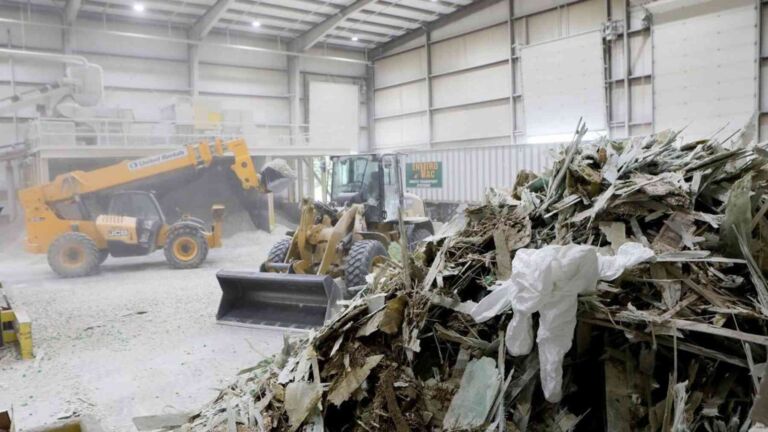
A shadow line runs across a tomato canopy where a dark film on the glazing stops and clear roof begins.
Leaves on the shaded side sit a little cooler. The fruit on both sides looks much the same.
The vines went in on the fifth of March, 2020, and the last of ten harvests came on the seventh of July.
By the end the shaded plants had turned far more fruit out of every unit of light.
That sounds like a free lunch, and it is not one.
Which leaves the question worth starting from. How can taking light away raise anything?
Why 1 leaf quits before the sun does
A leaf is not a bucket. It is a production line with a fixed speed.
Light arrives at reaction centers that can only process so many photons a second. Once those are busy, the surplus stops becoming sugar and starts becoming heat the plant has to shed.
In a desert greenhouse at midday the sun runs far past that line for hours. The extra is not banked for the evening, it is simply wasted on arrival.
So a roof that removes some of it may remove nothing the plant was using.
That also explains why the gain shows up as a ratio rather than as a bigger harvest. Fruit per unit of light rises because the denominator fell, not because the numerator grew.
The plant did not get better. The accounting did.
551 square feet on a 30 by 48 foot house
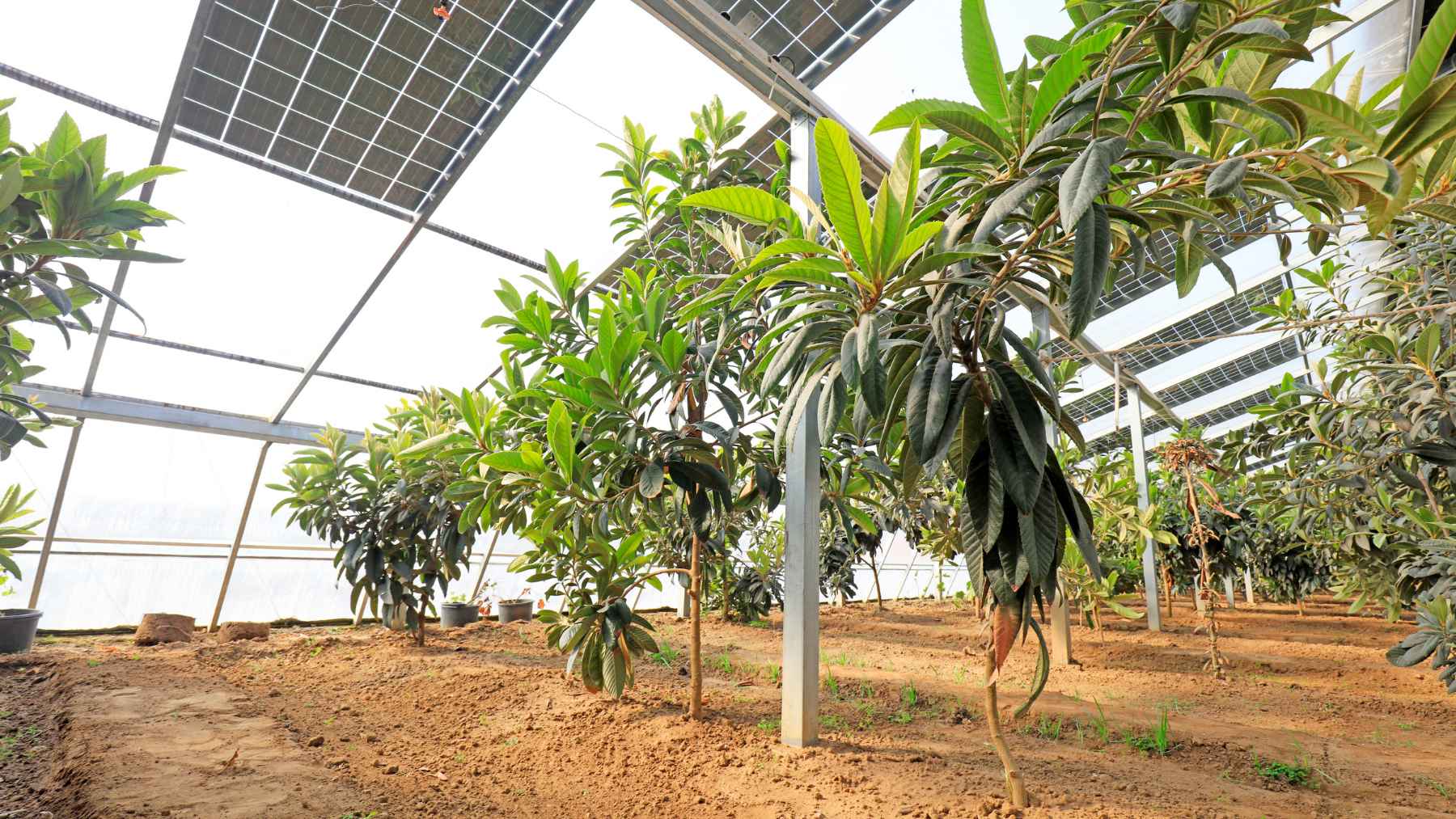
The hardware is not the blue silicon anyone pictures.
The film is organic, flexible enough to lie along a curved arch, and tuned by its dye chemistry to absorb hardest where a leaf cares least.
Plants run mostly on red and blue. Green is the band they reflect, which is why a leaf looks green at all.
The greenhouse measures about 30 by 48 feet, with sidewalls a shade under 6 feet and a ridge near 16.
The house belongs to a university research center on the edge of the city, which is why every part of it carries instruments.
Film went on at 551 square feet, covering roughly 39 percent of the roof area rather than half.
Then it grew. On the eleventh of June a second pair of arrays took it to 689 square feet.
10 harvests and an 11 percent gap
The measurements are straightforward and the paper publishes all of them.
Across the whole season the film cut light in the useful band by about 37 percent.
Total fruit came in at roughly 5.0 pounds a square foot under the film against 5.7 pounds in the control, a deficit near 11 percent.
The crop was a grafted greenhouse tomato, the same cultivar on both sides, transplanted on the same day and picked on the same schedule.
The early harvests carried that gap. After the fourth of ten, weekly yield, fruit count and fruit size were no longer significantly different.
Midday canopy temperature held steadier under the film, with the control canopy running several degrees warmer on the hottest days.
And fruit per mole of light came out at 21.4 under the film against 10.1 in the control.
What a shade net on the control changes
That last pair of numbers is where the story needs handling.
The control was not a shaded row. It stood in open desert sun for the first three months, in the way that a glazed greenhouse or a solar orchard turns into a clean result.
On the eleventh of June the growers put a 30 percent shade net over it, and the control’s own figure climbed to 18.2 against the film’s 21.4, which the field trial reports plainly.
Most of the doubling was the unshaded comparison, not the solar film.
The film also converted under 2 percent of what it caught, a figure from earlier work rather than from this season.
Shade cloth costs almost nothing.
Where 10 percent is already enough
The electricity question was answered somewhere else entirely, and by a computer.
A separate modeling study put a greenhouse at energy neutral in Arizona while blocking only 10 percent of the useful band, and at 20 percent in North Carolina, while the model gave Wisconsin up to 46 percent of demand and no neutrality at all.
None of those numbers came from Tucson, and no crop was grown in that study.
Both papers also sit six and seven years back, which is worth saying out loud.
Put the two together and the useful reading is narrow. In a place with surplus sun, a modest amount of blocking buys the power, and the plants barely notice.
A solar film is a shade cloth that also pays a bill.
The shade was always the easy part.
Read the whole thing?
Get the week's signal, not the noise
Our sharpest reporting on energy, climate and nature — free, once a week.