There is more to learn about the skinks of Australia.
These large spiny-tailed lizards stand out for both their size and their tendency to live in family groups for years.
As far as scientists knew, they had already identified what separated one group from another.
But the lizards themselves were starting to suggest otherwise.
Although populations across Australia looked remarkably similar, a closer look hinted that some had been following entirely separate evolutionary paths.
Something wasn’t fitting in Western Australia anymore
Most of the confusion revolved around the Western Australian populations.
On paper, they fit into well-established categories.
But distance alone wasn’t sufficient to raise questions regarding those categories.
The only way for scientists to know if these populations were indeed genetically independent was through evidence. And that evidence came from an unlikely source.
Genetic evidence raised a much larger question than expected
DNA testing provided the initial clue. Genetic analysis identified four distinct lineages among the skinks.
One separation occurred between the Eastern Australian populations and three Western Australian populations.
Genetic variation occurs independently of morphological variations.
If these four lineages were truly separate lineages, we would expect them to show such variance in their morphology.
The lizards needed to agree with the genetics
But getting the lizards to confirm that was not going to happen easily.
As more specimens were collected and analyzed, however, reliance on similarities decreased.
Different populations consistently showed differences in body features and scale patterns.
Even more important, those differences appeared in exactly the same locations as the genetic divisions.
At this point, both lines of evidence pointed towards telling the same story, according to the study published in Zootaxa.
One group stood apart more distinctly than the others.
One population kept separating itself from the rest
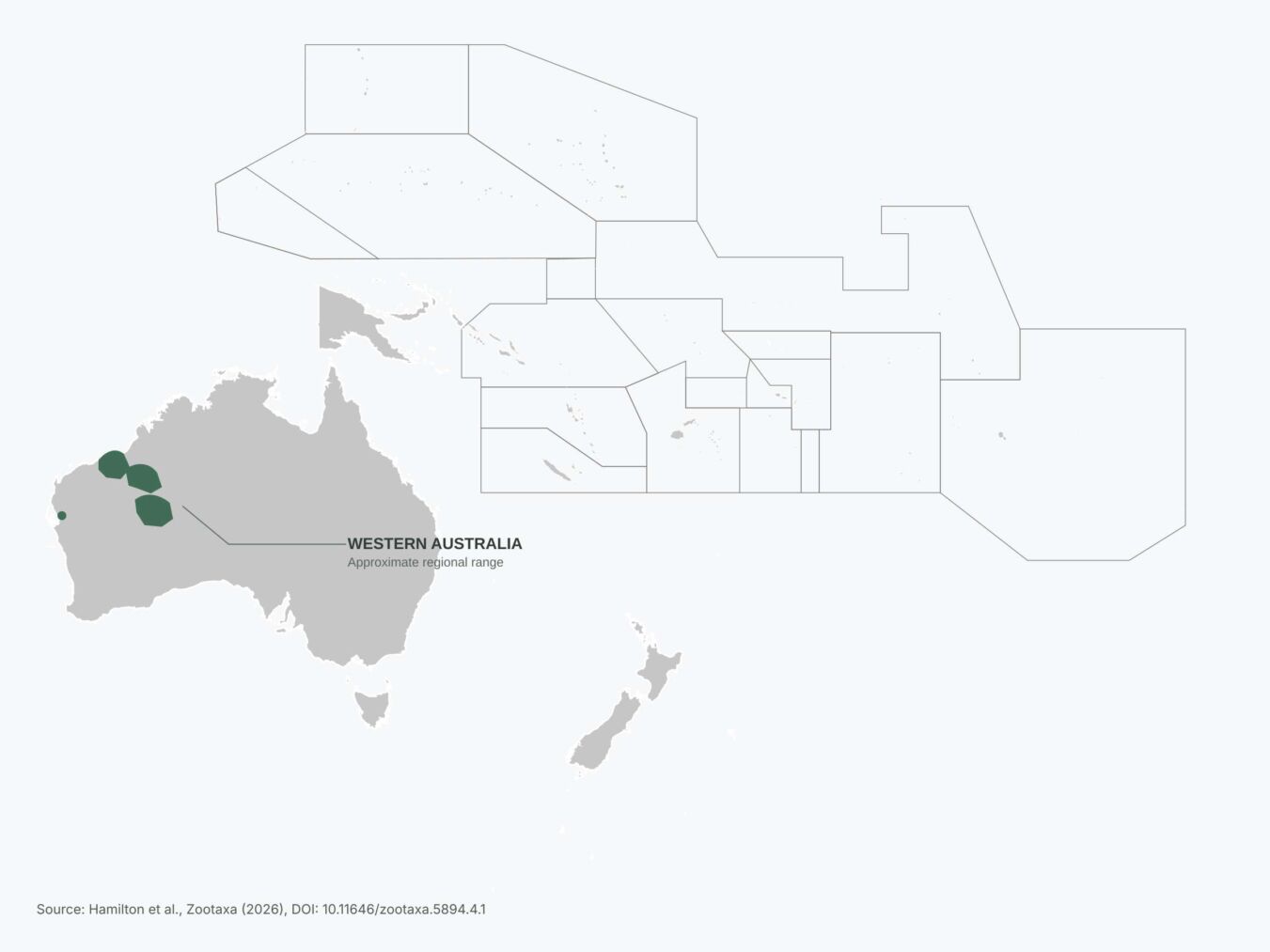
This population inhabited rock outcrops in the Upper Murchison region and surrounding parts of the Yalgoo region.
They were noticeably darker than neighboring populations and occupied a geographically isolated region northeast of other Western Australian populations. Neither their coloration nor DNA fit into established categories.
The remaining question was where they belonged. The answer was simple.
They formed a species that had not previously been formally described. Researchers designated it Egernia umbra.
Finding one species forced a bigger rethink
But before this group could officially become a new species, other aspects of the skink family tree needed to be updated.
The classification changes extended to the Eastern Australian populations, which were promoted to full species designation as Egernia zellingi.
At the same time, several of the Western Australian forms underwent refinements of their geographic range boundaries and descriptions.
However, historical gene flow around Shark Bay obscured some of the distinctions between the various western forms of skinks.
Therefore, researchers felt compelled to retain parts of the previous subspecies designations while revising the broader taxonomic classifications.
Ultimately, the revised classification presented a more complex picture than prior classifications.
The discovery could leave some skinks more exposed
However, that complexity has implications that go far beyond taxonomy.
When a population is classified as its own species, it can no longer benefit from the security afforded by membership in a larger group.
Those kinds of concerns are especially relevant for Egernia umbra and possibly some associated western populations who inhabit relatively limited ranges.
Factors contributing to that vulnerability include habitat alteration and fragmentation, damage to rocky habitats, predation by introduced predators, and illegal collection and trade.
Perhaps an equally important implication of this research is that if one distinct lineage remained undiscovered for so long among familiar-looking reptiles in remote Australia, then there may be additional discoveries awaiting scientists elsewhere.
Read the whole thing?
Get the week's signal, not the noise
Our sharpest reporting on energy, climate and nature — free, once a week.