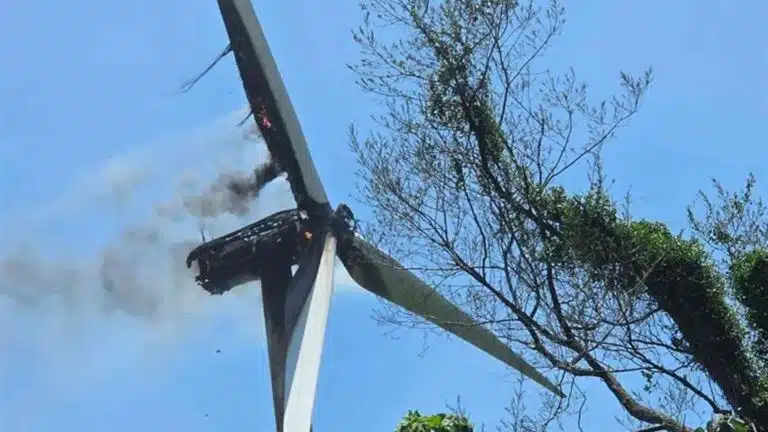
The visual impact of turbines is easily noticeable on the ground. However, a hunting eagle high above a landscape sees things very differently.
Many large soaring raptors tend to visually focus downwards as they search for prey.
As a result, rotating turbine blades may not immediately attract the bird’s attention.
DTBird is a technology that detects approaching birds and emits warning signals once those birds enter pre-defined zones around a turbine.
If the warning signal causes the bird to avoid the turbine prior to reaching the spinning blades, then the technology should function as intended.
Some birds may not notice the danger ahead
Turkey Vultures, hawks, and Golden Eagles are examples of raptor species that collide with wind turbines.
It has been established through previous studies that these raptors have difficulty processing the movement associated with a wind turbine blade while visually focused upon an object below.
Sound presents one potential means for obtaining the bird’s attention prior to entry into a hazard zone.
The first results suggested birds were reacting
DTBird continuously surveys the space surrounding a turbine.
Upon detection of a target whose size exceeds a certain threshold, the DTBird system can activate a warning signal.
Once the bird continues toward the turbine, more intense warning and deterrent signals can be activated.
Among Golden Eagles identified in California, 79%, and among those identified in Washington State, 61% demonstrated behavior consistent with a reduction in likelihood of entering the rotor-swept zone.
Turkey Vultures and Buteos exhibited similar trends.
One test separated sound from the spinning blades
The second test provided evidence regarding which component of the deterrent was causing the reaction, either the warnings sounded by the DTBird system or the spinning turbine itself.
Those results indicated that a considerable number of birds were responding to the warnings, rather than simply to the turbine.
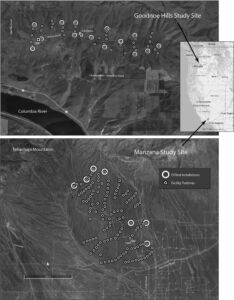
At the Washington site, both systems that warned birds away from turbines and those that did nothing were tested side-by-side in a study published in the Journal of Raptor Research.
This testing allowed researchers to directly compare the two environments in terms of bird behavior.
Control test pointed to the warnings rather than the turbines
The results demonstrated that, overall, the use of audio warning signals increased the effectiveness of deterring birds from entering the rotor-swept zone approximately twice overusing only the spinning turbines.
In addition to increasing the rate of effective deterrence, there was also an approximate 38-percentage-point decrease in birds that displayed no visible response.
When the deterrents were turned off, 65% of birds did not react. With deterrents sounding, 27% displayed no response.
Location and environmental conditions shaped the results
While the results were not uniform across all sites examined, and although California and Washington produced differing response rates overall, responses tended to be higher at the California location.
Golden Eagles, Turkey Vultures, and Buteos responded to different levels depending on variable wind speeds during testing.
The exact reasons for these variations remain unclear and may include factors such as local topography, wind speeds during testing, and species-specific behavioral characteristics.
Future wind farms may have another tool available
It is important to note that the intent of this research was not to eliminate entirely the possibility of birds colliding with wind turbine blades.
Instead, the goal was to reduce the chances of birds reaching the most dangerous areas around turbine blades.
A majority of both Golden Eagles and other large raptor species displayed avoidance behaviors in response to the warnings.
Successful use at multiple locations would strengthen the case for automated warning systems.
Such systems could become another tool for reducing collisions involving eagles and other large raptors.
Read the whole thing?
Get the week's signal, not the noise
Our sharpest reporting on energy, climate and nature — free, once a week.