
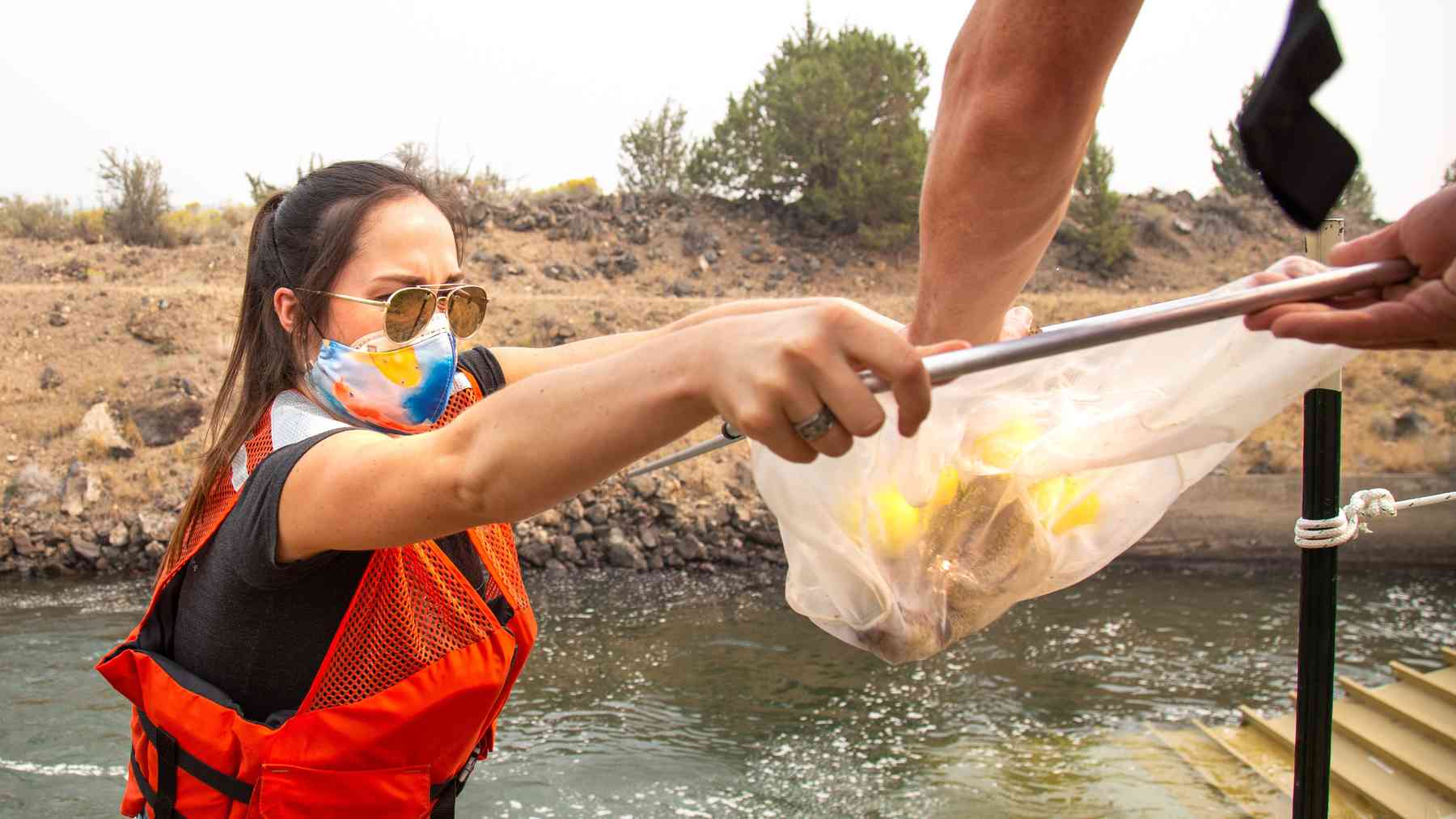
A narrow canal cuts through dry central Oregon farmland, moving water nobody looks at twice.
At one point the channel drops, and the water falls into a squat powerhouse.
Inside, a metal runner less than seven feet across is turning.
A rainbow trout nearly two feet long goes in with the flow.
Moments later it is swimming in the water below, unmarked.
So what is happening inside that housing that lets a fish survive the trip?
Thick blunt blades change how a strike actually feels
Most hydropower runners use thin, sharp edged blades built to spin fast and pull every bit of energy out of moving water, and that same thinness is what tends to cut or crush a fish caught in the flow. The runner at the center of this story inverts that logic. Its blades are thick at the leading edge, with a forward slant running from the hub out toward the tip.
That geometry changes what a strike does. A fish meeting a blunt, slanted edge takes something closer to a glancing shove than a clean hit.
Engineers track the effect through a fish length to blade thickness ratio, and the thicker the leading edge is relative to the fish, the gentler the encounter tends to be. The runner also turns with only a handful of blades instead of the many found in conventional machines, a design built around the fish moving through it rather than only the water.
A working Oregon canal became the real world test site
The design did not stay on a drawing board. It went into a Deschutes River Basin irrigation canal near Madras, Oregon, where the water already fell through an existing drop structure.
Nothing new had to be dammed or diverted. The machine simply took energy from a fall the canal was making anyway, and it has fed power to the central Oregon grid since it was installed.
The canal setting mattered for a second reason. It gave researchers a full scale machine running under real operating conditions, not a scale model in a tank, which is why the site has since been used repeatedly as a fish passage proving ground.
Sixty trout in September led to a much bigger run of 186
The first campaign ran in late September. Biologists released 60 adult rainbow trout, roughly 8 to 15 inches long, into the flow above the intake and recovered all 60 alive below the machine, with no passage related injuries found on inspection.
A later campaign at the same canal pushed the size range much further, sending 186 trout, the largest close to 21 inches, through the same 6.2 foot runner.
Immediate survival in that larger run was 98.6 percent, and the team found no meaningful difference between turbine passed fish and a control group. Crews also used sensor fish and balloon tag instruments to record the physical forces inside the runner, so pressure and strike data could be read against what the live animals showed. Both rounds were later published together in a scientific journal, which reported survival above 99 percent for the trout tested, and a federal summary of the earlier round records the same outcome for all 60 trout that passed through.
Eels held for 48 hours made the same kind of trip
Trout were not the only species tested, though the eel work happened somewhere else. In a recirculating turbine test facility, 131 American eels between roughly 13 and 26 inches long were passed through a smaller 1.8 foot version of the same runner shape, operating under about 33 feet of head.
Survival was 100 percent at 48 hours, with no major internal or external injuries found after that 48 hour holding period meant to catch delayed damage. A subset of the eels was X rayed to look for breaks the eye would miss.
The authors noted that eel survival through conventional turbines has been reported anywhere from 40 to 95 percent. Separate testing with juvenile alewife through a small runner of the same family found high immediate survival and full survival after a two day hold, another sign that fish shape is not the only thing deciding the outcome.
One canal test leaves bigger rivers still an open question
None of this means every turbine on every river should be swapped out tomorrow. The Oregon results cover hatchery rainbow trout at one compact machine at one site, and the eel results come from a laboratory rig. Researchers have framed the work as a demonstration rather than a guarantee for every species or plant size.
Bigger rivers, species like sturgeon and salmon smolts, and much larger conventional runners all raise questions a single canal cannot answer. Water engineering has a long habit of surprising its designers, as a dam beside a northern Finnish city has shown.
Even so, what the canal showed is that the old assumption, that a fish entering a turbine intake is as good as gone, does not hold for every machine. A reworking of blade geometry turned an irrigation drop into a passage that trout nearly two feet long swam through intact.
Read the whole thing?
Get the week's signal, not the noise
Our sharpest reporting on energy, climate and nature — free, once a week.


