

Every year, more than 10 gigatons of carbon leave the sunlit surface of the ocean carried downward by marine snow — billions of drifting particles of dead organisms, mucus, and microscopic debris. Yet only a fraction of that carbon ever reaches the deep seafloor, where it can stay locked away for centuries.
Scientists have long struggled to explain what separates the particles that make it from the ones that don’t. A new study from Scripps Institution of Oceanography suggests the answer may come down to something unexpectedly simple — and surprisingly gooey.
A constant snowfall in the dark
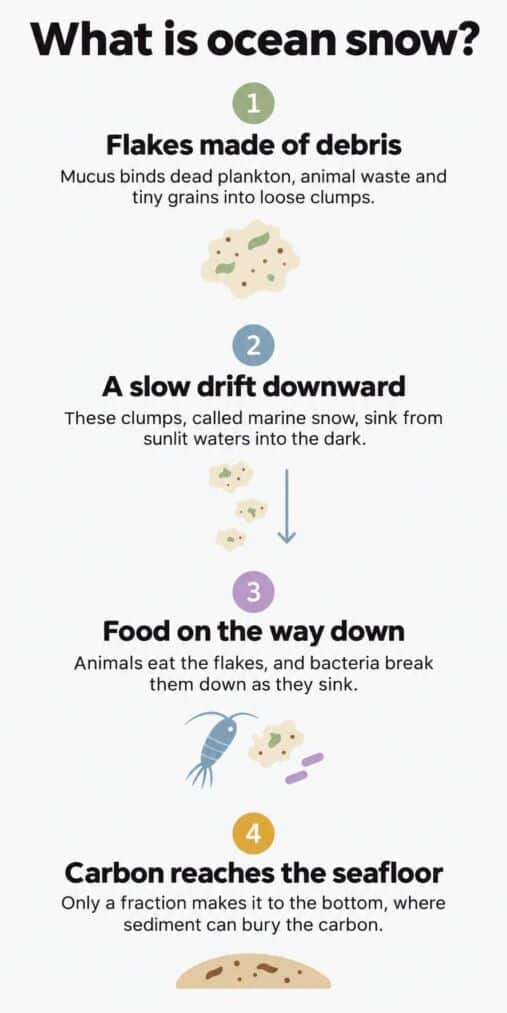
Marine snow is exactly what it sounds like — except stranger. Each particle is a loose clump of mucus, animal feces, dead plankton, silt, and cellular debris, slowly drifting toward the seafloor. These particles form continuously in surface waters and take weeks to complete their descent through the water column.
Together, they pull more than 10 gigatons of carbon out of surface waters every year, carrying it away from the atmosphere and into the deep — making marine snow one of the ocean’s most important carbon-removal mechanisms. But only about 2 gigatons of that carbon actually reach depths where it can stay locked away for centuries. The rest gets broken down along the way.
Four years to see inside a single particle
In 2021, Bryce Inman — then a postdoctoral researcher at Scripps Institution of Oceanography — set out to study what he calls “the muscoscape.” The goal: observe, for the first time, how individual bacteria physically interact with the mucus inside marine snow particles.
That had never been done before. Inman and his colleagues, including microbiologist and professor emeritus Farooq Azam, spent four years trying to crack the problem. Multiple approaches failed. Their eventual solution, developed in 2025, combined 3D confocal microscopy with specially designed fluorescent molecules that made the internal structure of mucus visible for the first time. The imaging technique is described in a companion study published in Nature Communications.
Why gooier particles sink deeper
Not all marine snow is the same. Each particle contains its own mix of organic and inorganic material, giving it a different viscosity — a different degree of thickness and stickiness. When Inman’s team looked inside individual particles, they found bacteria preferentially colonize the outer, less viscous regions. The denser, stickier interior is much harder to penetrate.
Inman described the mechanism plainly: “Think of it like a worm in an apple — the flesh is easy to penetrate, but the core is tough to chew through.” Particles with a stickier composition resist bacterial breakdown longer, sinking to greater depths before fragmenting. Less viscous particles get consumed faster, releasing their carbon too shallow for long-term storage.
Six times more carbon — and what that means for the climate
The headline result is striking. Based on lab experiments and computer simulations, the Scripps team estimates that highly viscous marine snow can deliver more than six times as much carbon to the deep ocean as less viscous particles. The findings were published October 8 in the journal Science.
Carbon that reaches sufficient depths becomes isolated from the atmosphere for hundreds to thousands of years. That makes viscosity a genuinely meaningful variable in Earth’s climate system — one that models of the ocean’s biological carbon pump hadn’t previously accounted for. As Inman put it, “How far marine snow can sink is a surprisingly complicated problem, and we have added another — very gooey — piece to the puzzle.”
Beyond the ocean: slime as a universal habitat
The imaging technique revealed something else entirely. Mucus has a complex internal landscape — bulges, crevasses, structural variation — all of it shaping how bacteria behave at scales smaller than the microbes themselves. “There are bulges, crevasses, all this sort of structure to it that we really had no idea about at a scale smaller than bacteria,” Inman said. “This is the first time we’re really examining this physical habitat.”
The implications reach well beyond oceanography. Bacteria-mucus interactions drive processes in coral reefs, kelp forests, plant root systems, and the human digestive tract. Researchers can now start asking questions about bacterial behavior in mucus environments that simply couldn’t be asked before — across ocean science, medicine, and ecology.
Read the whole thing?
Get the week's signal, not the noise
Our sharpest reporting on energy, climate and nature — free, once a week.


