
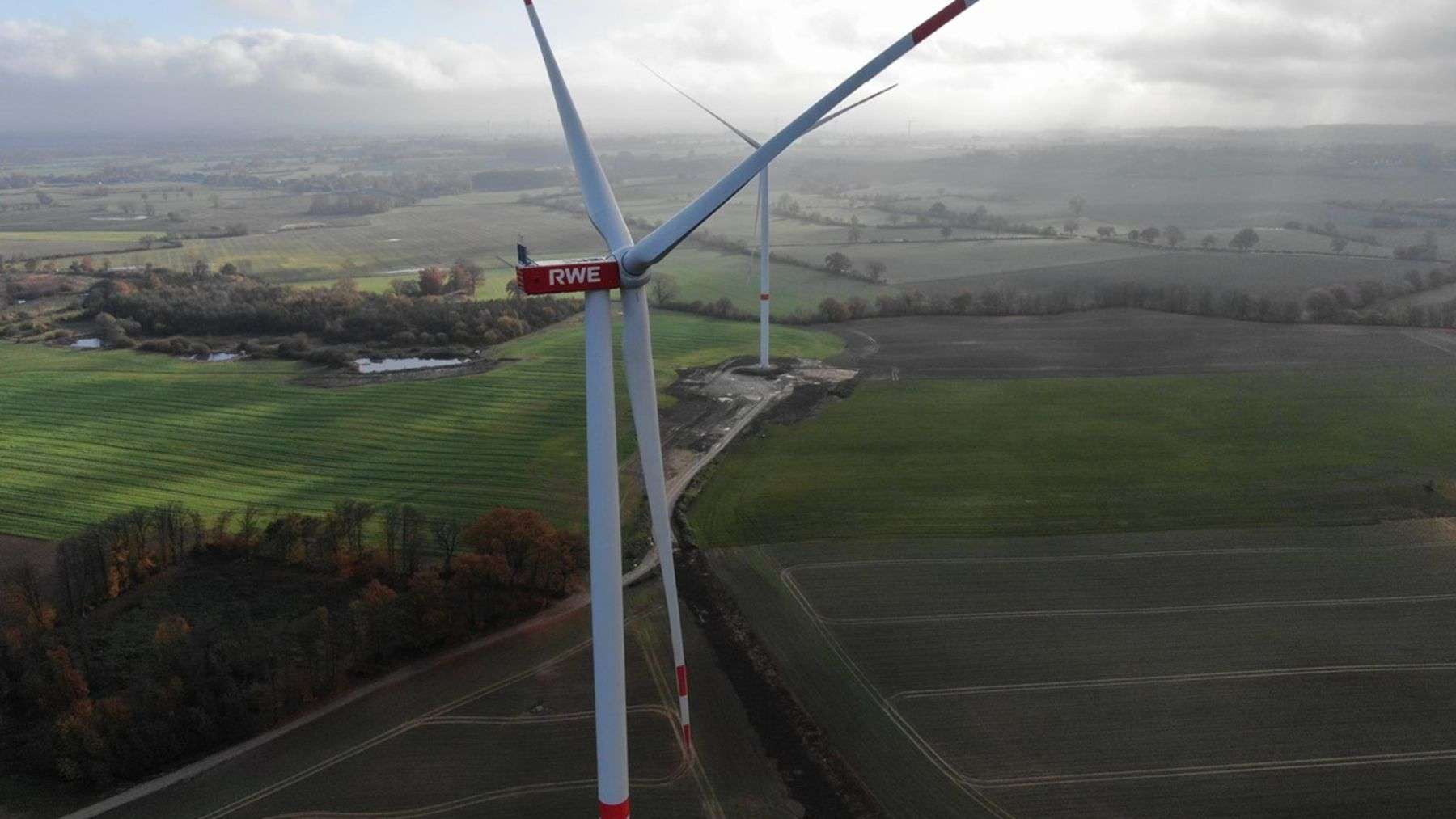
A wind farm will lose two turbines, but it will not lose any power at all.
In fact, its power will increase fivefold.
At Lasbek, in northern Germany, RWE is set to do what sounds impossible.
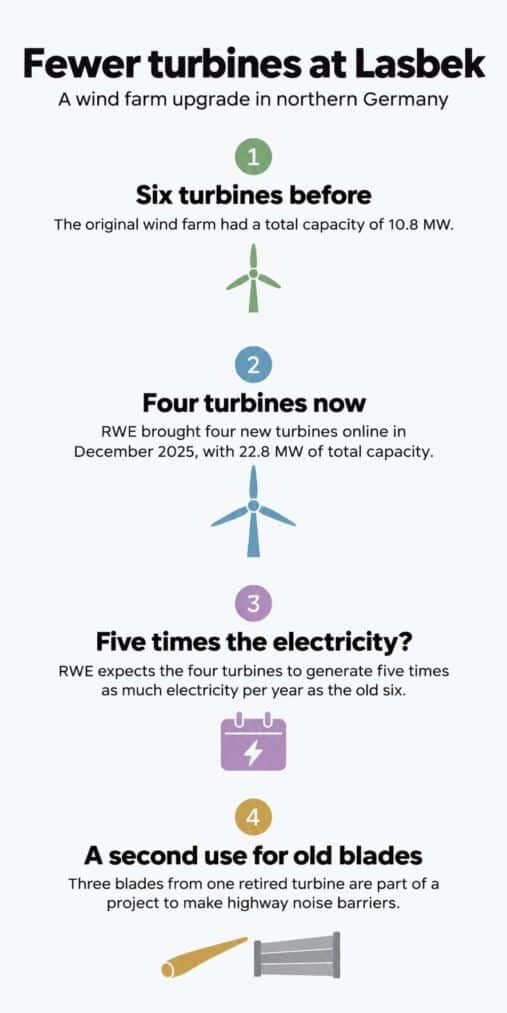
Four turbines will replace a previous six, and the electricity generation will only rise.
How can fewer machines produce so much more energy?
Six turbines will turn into four
Lasbek is located in the Stormarn district of Schleswig-Holstein. In December 2025, RWE announced it would take two of the six turbines away.
But in this case, four will not be equal to less than six.
The original six turbines have a combined capacity of 10.8 MW. Over a period of one year, all six of the original turbines will be gone.
Four brand new ones will remain.
The project, known as repowering, is estimated to have the capacity to supply 18,000 homes.
The wind farm will be given a new lease on life.
Katja Wünschel, leader of RWE Renewables Europe & Australia, says the project has great potential.
The old turbines will not just be thrown away
As with any reconstruction project, the removal of the six turbines will leave a lot of discarded material.
Or would have been discarded material. Except in this case, RWE says the remaining components will not just become trash.
Some of the material left behind will be repurposed for other wind farms.
Some parts will be kept in a warehouse as spares for RWE.
The rotor blades in particular will have their own special repurposing path.
RWE will give some of the old blades of one turbine to BladeReUse, a research project at the Karlsruhe Institute of Technology.
This project studies how blades, with their robust and durable materials, can be reused in the most sustainable and efficient way possible.
The main use in the project is an interesting one.
The rotor blades are to be used as noise barrier walls along motorways.
Since most turbines reach the end of their service life after 20 to 30 years, this repurposing could really bring down blade waste.
So the old blades will be reused, and RWE says the wind farm will produce about five times as much electricity.
Where the fivefold increase comes from
Part of the answer is the turbines themselves.
The six old turbines have a combined capacity of 10.8 MW, which is about 1.8 MW each.
The four new turbines will have a combined 22.8 MW, which is about 5.7 MW each.
So each new turbine will be roughly three times as strong as an old one.
But that is not the same as fivefold.
Four stronger turbines add up to only about double the total capacity (22.8 MW against 10.8 MW).
The rest of the jump has to come from how much electricity the turbines actually produce over a year, not how big they are on paper.
A massive increase in power from Lasbek
But this is still a massive increase, and not just for the wind farm.
Nearby municipalities will be able to receive up to €124,000 per year while the wind farm is in operation, which ends up being about €100,000 more than before.
By making wind farms pay the local community, the people are therefore more willing to accept turbines.
In other areas, people are not so happy about wind farm construction.
This money can be used to support schools, day care centres and other important institutions.
RWE says this wind farm is the start of a wider effort to optimize power around Germany. So are fewer, larger turbines the future of upgrading wind farms? Lasbek suggests they can be, but the evidence is still in its early stages. Other wind farms are also making incredible steps in improving what they can do.
Read the whole thing?
Get the week's signal, not the noise
Our sharpest reporting on energy, climate and nature — free, once a week.


