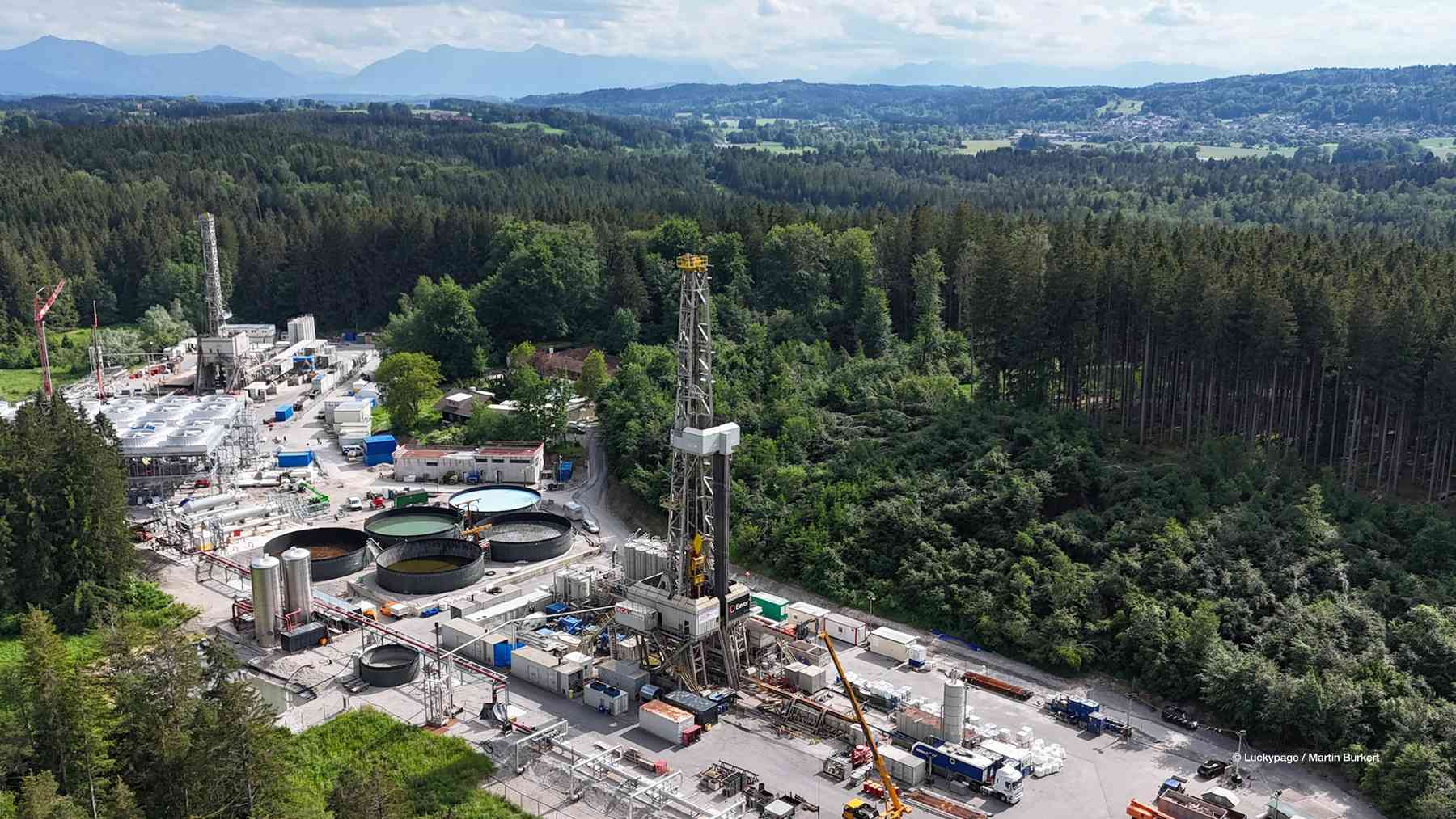
A drill rig sits on a gravel pad outside a small Bavarian town.
Pipe goes straight down for nearly three miles.
There is no steam plume, no sulfur smell, no hot spring anywhere nearby.
The rock down there is simply hot and bone dry, the kind of ground that used to make geothermal engineers walk away.
Crews sealed a loop of pipe into that rock and let it sit like a buried radiator.
So how does a sealed pipe pull power from rock that holds no usable water?
A closed loop pulls heat without touching groundwater
Conventional geothermal power only works in places where naturally hot water sits inside permeable rock close enough to the surface to tap. Engineers spent decades chasing that narrow combination, and when it wasn’t there, some tried to manufacture it by fracturing rock and injecting fluid, a method that has occasionally triggered small earthquakes near populated areas.
The closed loop design sidesteps both problems.
Crews drill a long sealed pipe shaped like a fork into hot rock, then circulate a contained fluid through it. That fluid never touches the surrounding rock or groundwater, picking up heat by conduction through the pipe walls and carrying it to a turbine at the surface.
Nothing is produced out of the formation and nothing is injected under pressure to crack it open. The developer describes the result as a standardized system that does not rely on rare geological hotspots or hydrothermal resources, functioning instead as an engineered underground radiator built deep in the crust.
Twelve laterals fan out underground like the tines of a fork
The project sits at Geretsried, a town in Bavaria roughly 25 miles south of Munich. Each loop begins as two vertical boreholes that fan out into horizontal branches at depth, steered sideways at almost a right angle and then connected in pairs.
The finished shape underground looks less like a simple pipe and more like a buried root system, built to maximize how much hot rock the fluid can brush against. Heat moves only through the steel and the sealed walls, so the geometry is the whole machine.
For the first loop, crews drilled two vertical wells and sidetracked six horizontal wells from each, a total of twelve laterals. Each well reached a total depth of about 13,894 feet through limestone and dolomite, with reservoir temperatures between 300 and 340 degrees Fahrenheit, and the laterals run roughly two miles apiece. That is tens of miles of sealed pipe in one completed loop, not a single tidy line.
Gross output stalled far below the four loop target
In December 2025, a Canadian geothermal developer became the first company to deliver electricity to a commercial power grid using a fully closed loop system, at its Geretsried facility in Bavaria. German industry reporting put the early figure at roughly 0.5 megawatts reaching the grid from one operating loop.
The company’s own technical update is more sober. A few months after power deliveries began, it disclosed that the site had achieved between 0.5 and 2.0 megawatts of gross generation, with practically no power delivered to the grid. Thermal production from the first loop runs around 8.5 megawatts thermal, which the firm says is exactly as expected at about 1.3 megawatts thermal per lateral pair.
The full site was planned around four of these loops. Phase one was intended to deliver about 8.2 megawatts of electricity and roughly 64 megawatts of thermal output for district heating. Three of those four loops remain undrilled.
A fenced pad instead of a sprawling industrial site
None of this requires draining a reservoir the way hydropower does, or leaning on the quagga mussel crusted intake hardware divers have pulled from places like Lake Powell, where decades of water infrastructure have reshaped entire ecosystems underwater.
The surface footprint stays modest for a different reason. Because the infrastructure sits underground and there is no water treatment at the surface, the above ground component needs comparatively little space. Company authored grid modeling has put the land savings far higher, but those are figures from a record breaking continent wide scenario, not a measurement taken at this gravel pad.
Because the loop seals the fluid away from the rock, there is far less exposure to the underground tremors that have dogged enhanced geothermal projects elsewhere. That is the same caution engineers apply when stress testing anything new, the way labs pushed a retired turbine blade to its breaking point before trusting the result.
Rigs pulled back with three loops still waiting
None of this means closed loop geothermal is finished technology. In October 2026 the company announced it was temporarily withdrawing its drilling rigs and delaying the second loop, a move reported in detail by trade press covering the German project.
It said it needed time to improve the commercial structure of the project, including a firm heat offtake agreement, before continuing. The firm maintains that the core physics of the concept have now been proven, and that Geretsried is the first successful demonstration that a full scale closed loop system can generate both heat and electricity.
The gap between that claim and the megawatts actually metered is the part the rest of the industry is reading closely. For a town that spent years as a stalled drilling site where conventional hydrothermal wells never found usable water, a sealed loop doing what water never could is still a modest kind of vindication.
Even the drilling got faster as crews learned the job. The fifth and sixth lateral pairs were finished in an average of 16.5 days, against 54.5 days for the first four.
Read the whole thing?
Get the week's signal, not the noise
Our sharpest reporting on energy, climate and nature — free, once a week.