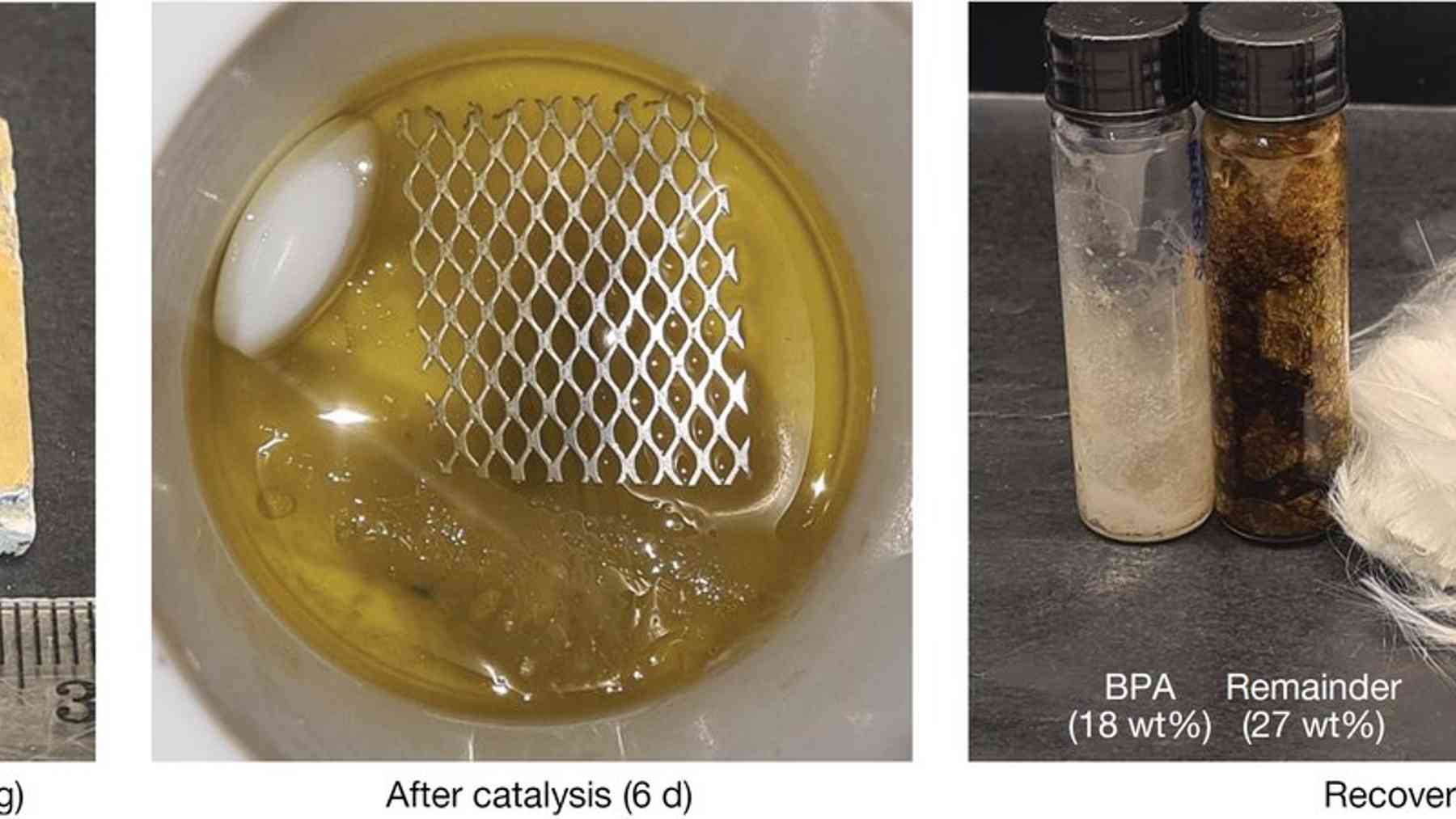
A square of hard composite sits at the bottom of a glass flask.
It was cut from a real Vestas wind turbine blade, the kind that spins for about twenty years before anyone has to decide what happens to it.
In a Danish laboratory, chemists dropped that chunk into a pale yellow liquid.
Nothing exploded, nothing fumed, nothing needed a blast shield.
The flask simply sat there, warm, while the chemistry worked.
What came out the other end was not sludge.
A catalyst snips one bond and the rest of the resin lets go
For years the standard ways of dealing with a dead turbine blade were blunt instruments. Grinding one down keeps the fiberglass but wastes the resin, and burning the composite in a low oxygen furnace frees fibers at the cost of weakening them.
Harsher routes break the matrix apart but leave polymer fragments that cannot be recast into new resin. So a team at Aarhus University in Denmark, led by chemistry professor Troels Skrydstrup with postdoctoral researcher Alexander Ahrens, went looking for something more selective.
Their method aims at the carbon, oxygen bonds sitting next to bisphenol A, the backbone unit of the epoxy, and uses a ruthenium catalyst together with isopropanol and toluene, two common laboratory solvents. The catalyst drives a cleavage cascade rather than digesting the whole matrix into unusable pieces.
How the catalyst does that, step by step, is still a proposed cycle backed by monitoring experiments rather than a settled picture of every intermediate. What came out of the flask is not in dispute.
A real blade chunk came out as clean fibers and a reusable chemical
The test subject was not a synthetic sample built for the occasion. The researchers ran their method on a chunk cut from the outer shell of a decommissioned Vestas blade, supplied through the project’s industry partners.
What was left afterward was nearly spotless fibers plus the recovered building block of the resin, with the metal mesh embedded in the blade separated out as well. That second product matters almost as much as the fibers.
The resin broke down into bisphenol A, the base chemical epoxy makers start from, which means an epoxy producer could in principle use it to make fresh resin instead of buying more petrochemical feedstock. Not everything comes back, since part of the matrix ends up as oligomers that cannot be recycled.
Skrydstrup described the work as “the first publication of a chemical process that can selectively disassemble an epoxy composite.” That is a claim about method, not about tonnage.
Three days loosens the fibers, six days finishes the job
Ahrens told Chemistry World that it is “a slow process, so it takes around three days,” during which the polymer comes apart. The team tested the technique on commercial materials including a piece of wind turbine blade.
After three days it had visibly separated into loose fibers, with half safely recovered. The university reported that after six days of catalysis the blade piece had broken down into intact glass fibers and bisphenol A, alongside that unrecyclable oligomer fraction.
The conditions themselves are unremarkable: a ruthenium precatalyst, isopropanol in toluene, and heat at 320 degrees Fahrenheit. For the largest run reported, a plate of decommissioned blade weighing about a fifth of an ounce went into an autoclave holding roughly ten fluid ounces.
The findings appeared in the journal Nature in 2023, and Aarhus University, with the Danish Technological Institute, filed a patent application on the process. The trade title Electronics Weekly put the share of the composite’s mass readied for reuse at roughly 70 percent.
43 million metric tons of blade waste is still coming
Even a clean method has a catch, and this one sits in the catalyst. Ruthenium is a rare, costly metal, and the reaction needs so much of it that the university itself says the method is not scalable as it stands.
A single blade can weigh tens of thousands of pounds, a long way from a test piece in a flask. That gap echoes problems this desk has tracked elsewhere in offshore wind infrastructure, where small overlooked components quietly limit what looks like a finished fix, the same way barnacles cut the fatigue life of undersea cables nobody was watching.
Meanwhile the waste keeps accumulating regardless of how the chemistry shakes out. The Nature paper puts the total at 43 million metric tons of decommissioned blades by 2050.
Some of that material is already being cut apart and sorted for simpler components, even while the resin problem stays unsolved.
A patent filing marks the next step, not the finish line
What happened in that flask is a laboratory result, not a factory line. Scaling a record breaking but costly soak with an expensive catalyst up to thousands of blades a year will take cheaper chemistry, real engineering, or both.
The group says it is still working on improvements. Still, the material in those vials changes what counts as possible.
A composite long treated as permanently locked together came apart using two ordinary solvents and a metal catalyst, and the fibers came out usable. For a blade problem that mostly ends in a landfill trench, that is a hopeful crack in a very stubborn wall.
Read the whole thing?
Get the week's signal, not the noise
Our sharpest reporting on energy, climate and nature — free, once a week.