

Offshore wind farms must contend with wave motion, saltwater, and strong winds. However, off the west coast of Finland, there is another issue to consider.
In the winter, the Gulf of Bothnia will freeze, causing an issue for offshore wind turbines that are expected to stay put for decades whilst producing electricity.
The solution wasn’t to make the turbines more robust, but to make the foundations act like miniature icebreakers.
A promising location for offshore wind power
There are many great benefits to having offshore wind power along the coast of Finland.
The area has very strong winds, and many areas have shallow waters and solid ground beds. This makes it an ideal location to install wind turbines offshore.
Tahkoluoto offshore wind farm was one of the most ambitious projects in the country.
A pilot wind turbine was installed and started running in 2010, followed by 10 larger turbines—though this location does come with some unique challenges.
Then the frozen sea creates a new problem
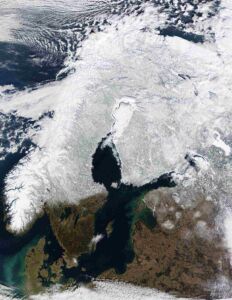
As it gets cold in the winter, the seas in the Gulf of Bothnia will freeze.
The wind turbines are very exposed in Tahkoluoto. There is no island chain to help take the brunt of ice movement.
This means floating blocks of ice can come straight for the wind turbines, so every aspect of the design needs to handle ice movement.
A different type of foundation was the answer
One of the challenges was that the bedrock near Tahkoluoto is very shallow.
This meant it was not ideal to use the common monopile foundations. A new concept was needed.
Instead of using a design that had been previously used for other environments, a gravity-based foundation was used by Suomen Hyötytuuli.
This helped solve two issues. The foundations could support the wind turbine while also helping with ice in the winter.
The shape of the foundation changed everything
The most unique feature of this project can be seen at the bottom of each wind turbine, where the foundations are cone shaped.
As ice moves towards the foundations, it hits the sloping surface and is redirected upwards.
The ice will flex and eventually crack apart, meaning the structure doesn’t take the full brunt of the ice. Each foundation essentially acts like an icebreaker ship.
This simple concept means the wind turbines can be placed in a location that would normally be a much bigger risk due to winter conditions.
Solving the ice problem was only the beginning
Despite solving the issue of ice, there are still many challenges to having an offshore wind farm in Finland.
A lot of the construction work is done during certain seasons.
Major offshore work can only be done when the sea is open. This can mean multiple open seasons to construct the wind farm.
Maintenance can also be an issue. Careful planning is needed to access the wind turbines when the sea freezes.
The port facilities also need to be able to accommodate these unique conditions.
Meanwhile, the wind turbines need to be able to run in an environment that regularly changes between open and frozen.
The lessons are still shaping offshore wind
This project proved that offshore wind power doesn’t have to be limited to areas with mild sea conditions.
Those same waters that once posed a major engineering challenge are now home to the world’s first offshore wind farm designed for harsh ice conditions. Knowledge from this project has helped plan for the future.
An expansion to the wind farm has already been planned, and offshore wind technology is continuing to advance.
Turbines now have much larger capacities than those installed at Tahkoluoto. The whole industry is continuing to develop at a fast rate.
Overall, the main message from offshore wind turbines off the frozen coast of Finland is that the real challenge wasn’t the wind—it was the ice.
The solution was to make every turbine foundation act like an icebreaker well before winter.
Read the whole thing?
Get the week's signal, not the noise
Our sharpest reporting on energy, climate and nature — free, once a week.


