
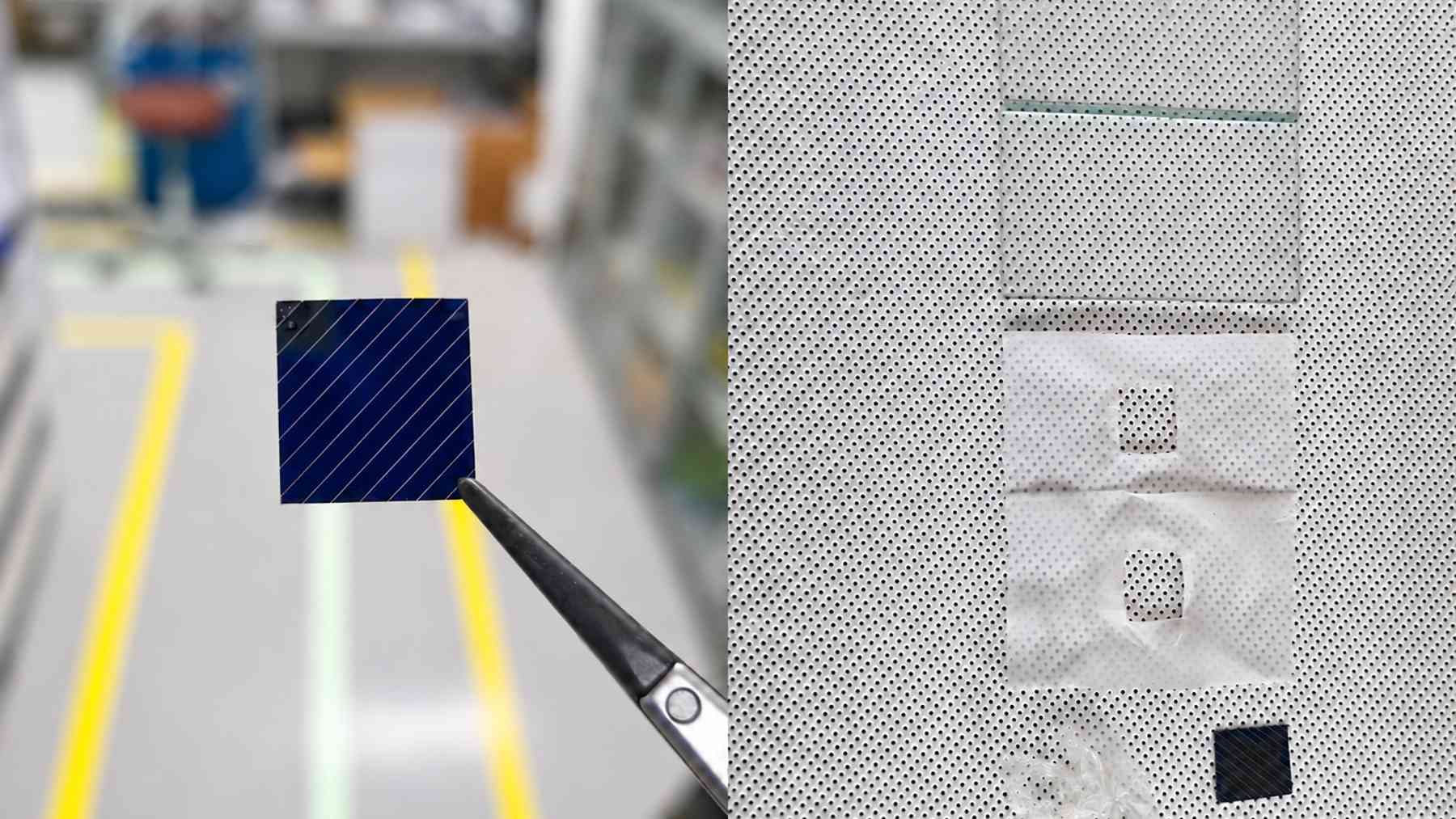
A small glass test panel hangs in a lab jig, no bigger than a dinner plate.
Below it sits a coil of copper tubing, cold and unremarkable.
Someone flips a switch.
Within seconds the layers come apart on their own, glass on one side, a silicon cell on the other, almost as if the sandwich had never been glued at all.
For a material built to survive decades of sun and rain without budging, that kind of split is not supposed to happen this fast.
So what pulled it apart so completely?
A magnetic field does the work that heat and acid could not
The trick is not a new glue or a stronger blade. It is a copper induction coil carrying an alternating current, generating a magnetic field that reaches straight through the glass and heats the metal inside the cell itself. The method heats the solar cells’ metallic electrodes directly through electromagnetic induction, warming the cell from the inside out rather than baking the whole panel from the outside in.
That distinction matters more than it sounds. Induction heating created a temperature difference of more than 360 degrees Fahrenheit between the cell and the glass, a gap that triggered localized decomposition of the encapsulant right at the cell interface while the glass stayed comparatively cool.
Conventional recycling ovens heat an entire panel until the encapsulant breaks down everywhere at once. That is slow, and it tends to give back a mix of broken material rather than whole components. A coil that targets only the metal turns a long bake into one focused pulse of heat.
Five seconds beats hours, with no residue left behind
Corresponding author Yonghwan Lee said the team was surprised by how quickly and cleanly the silicon cell separated using the new technique and modified module design. “In our fastest test, the module layers separated in just 5 seconds,” he said, describing a cell recovered intact with no visible polymer residue on its surface.
No chisel, no solvent bath, no multi hour soak.
The samples were suspended with the cells facing downward to let gravity finish the job the moment the interface let go. In that configuration the cells detached in roughly 14 seconds, and the redesigned modules cut the time down much further.
99.8 percent of the module mass came back intact
The headline number is the share of material the process actually saved. The process recovers up to 99.8 percent of module mass, including glass, silicon cells and encapsulants, with negligible losses during separation. That is a sharp break from the industry default, where panels are crushed together and the cell is usually sacrificed to save the glass.
The hardware behind that figure is modest. The team used a self cooled copper induction coil operating at 270 to 300 kHz to heat the cell’s metal contacts, triggering localized decomposition at the cell and encapsulant interface. Simulations of induction heating in the cells and of heat transfer through the surrounding layers came first.
The researchers then suspended the small test modules in a custom support jig and applied induction heating at coil currents of 100, 150 and 200 amps. The redesigned modules separated in 18.6 seconds at 100 amps, 8.3 seconds at 150 amps and 5.4 seconds at 200 amps. The work appeared in Communications Materials, from a team at South Korea’s Korea Electronics Technology Institute and Australia’s University of New South Wales.
A second method and a design shift point the same way
The coil is not the only route researchers are testing on materials engineered never to come apart. At Washington State University, researchers soaked wind turbine blade material in a mild solution of zinc acetate and recovered glass fibers and resins in good enough condition to add directly to thermoplastics, producing composites with up to 70 percent recycled glass fiber. The university’s account of that work describes the process in full.
What ties these approaches together is a shift in thinking about the product itself, not just the process that tears it apart. Panels built with glass on both sides, where a cell sits between two sheets instead of one sheet and a plastic backing, are already becoming more common because they hold up well outdoors. That same structure is what makes the coil trick work, much as solar panels paired with turbines in Spain showed how small design shifts can unlock gains nobody banked on.
Full sized panels are still years from this treatment
Everything so far has happened on small test modules, not the full sized rooftop panels most American homeowners would recognize. Moving from a lab coil to a line processing thousands of full sized panels a day is a far bigger engineering problem, involving larger coils and higher currents.
Even so, the direction is encouraging. Lee has described the aim as a module built for easy teardown at the end of its life, with induction heating separating the layers and recovering nearly all of the original mass, glass, silicon cell and polymer encapsulant included.
With older methods topping out well short of complete recovery, a coil that needs only seconds and keeps nearly everything intact is a genuinely hopeful place to start, much like the small rotor that behaved like a far larger turbine, even if the road from a workbench to a recycling plant still runs through years of scaling up.
Read the whole thing?
Get the week's signal, not the noise
Our sharpest reporting on energy, climate and nature — free, once a week.


