Two remote island groups, barely a dot on most maps, sit roughly 800 kilometers southeast of New Zealand in the open South Pacific. Together, they hold the entire global population of Erect-crested penguins — one of the world’s least studied endangered seabirds.
When researchers launched the first comprehensive drone survey of the species in decades, they expected a unified picture of how these penguins were doing. What they found instead was something far harder to explain: two populations, separated by a few hundred kilometers of ocean, living in completely opposite realities.
Two islands, one species, two completely different stories
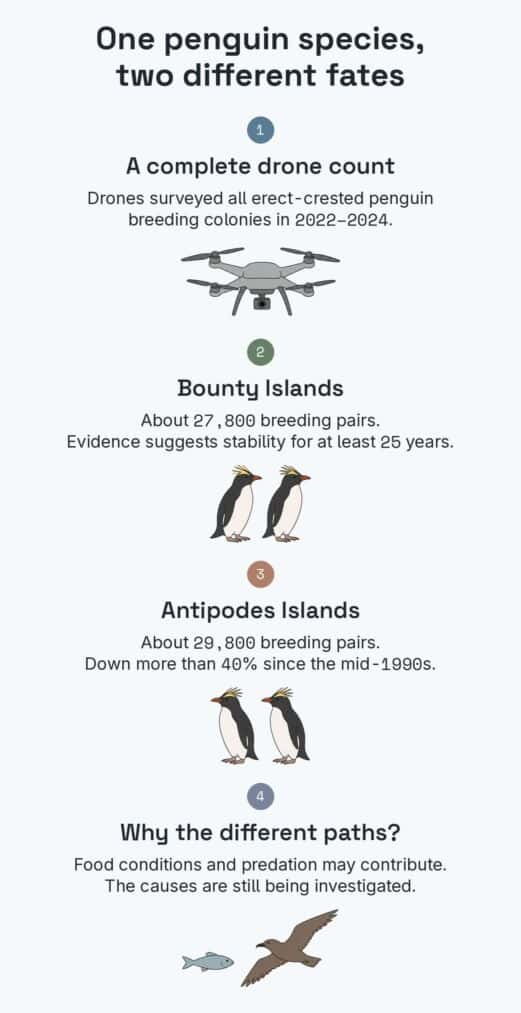
The Bounty and Antipodes Islands rank among the most isolated places on Earth — rarely visited, rarely studied, and home to the entire global breeding population of Erect-crested penguins. Between 2022 and 2024, a University of Otago-led team conducted the first complete drone survey of every colony across both island groups.
The numbers were surprising. The Bounty Islands, just 50 hectares in total, hold roughly 27,800 breeding pairs. The Antipodes Islands — 40 times larger and historically considered the species’ stronghold — hold about 29,800. Nearly equal populations on wildly unequal land.
Historical records going back to the mid-1990s show the Bounty Islands population has stayed essentially flat for 25 years. The Antipodes population, over that same period, has fallen by more than 40%. Same species. Same ocean. Completely opposite trajectories.
Predators, storms, and a vanishing neighbor
Understanding why the Antipodes population is shrinking means looking at several pressures — and how they reinforce each other.
Skuas, native subantarctic birds, naturally prey on penguin eggs and chicks. Large, dense colonies offer collective defense: more eyes, more bodies, more noise. But as the Antipodes colonies have contracted, that communal protection has weakened. Smaller groups are easier to pick apart, which accelerates fragmentation, which weakens defense further.
A second factor may have intensified this cycle. Eastern Rockhopper penguins once shared the Antipodes Islands in substantial numbers. Their population collapsed during the second half of the 20th century — likely driven by warming ocean waters — and fewer than 1,000 breeding pairs remain there today.
Co-author Dr. Klemens Pütz suggests skuas may have redirected their attention toward Erect-crested penguins as Rockhoppers disappeared. Increasingly powerful storms have also triggered landslides that fragment colonies and leave birds more exposed, consistent with broader Southern Ocean climate trends. Each pressure compounds the others, creating a feedback loop that’s hard to interrupt.
Ocean highways: why where penguins travel matters
The divergence doesn’t end on land. After breeding season, the two populations head in very different directions, according to the study published in Plos ONE.
Antipodes penguins migrate considerable distances into the Antarctic Polar Frontal Zone — a remote feeding ground that may offer less reliable food availability. Bounty Islands penguins stay closer to home, in more sheltered waters that could provide more consistent foraging conditions. These aren’t minor differences in commute length.
They expose each population to fundamentally different environmental pressures, even though the birds belong to the same species. The Bounty Islands penguins may simply be living in a more forgiving neighborhood — at sea as well as on shore.
‘Schrödinger’s Penguin’: when looking closer reveals two answers
The research team gave this paradox a name: Schrödinger’s Penguin. The reference is to the famous thought experiment in which a cat inside a sealed box is imagined to be simultaneously alive and dead — until someone opens the lid.
As Dr. Mattern points out, the penguin situation inverts the original concept. With Schrödinger’s cat, opening the box resolves the uncertainty into a single answer. With Erect-crested penguins, it revealed not one answer, but two. “Once we actually opened the metaphorical box and looked, we found there wasn’t one state at all, but two,” Dr. Mattern says.
Viewed as a single species from a distance, the penguins appeared to share one fate. Only by examining each island group separately did the dramatic divergence become visible. Aggregated data, the study suggests, can quietly bury the story happening underneath.
A conservation classification that could backfire
Erect-crested penguins are currently listed as Endangered on the IUCN Red List — but that classification is based on population estimates from the 1970s that were significantly inflated. The new survey data tell a more complicated story.
The Endangered designation still fits the declining Antipodes population. If both populations are averaged into a single global assessment, however, the species’ overall threat level could actually improve to Vulnerable. That sounds like good news. It isn’t.
A more favorable ranking could reduce scrutiny on the Bounty Islands — the species’ last secure stronghold — at a time when industrial fishing still poses real risks there. As Dr. Mattern puts it, a single improved threat ranking is like putting the lid back on Schrödinger’s box: a convenient illusion in place of the protection these birds actually need. When conservation policy relies on species-wide averages, individual populations in genuine crisis can disappear from view — not because anyone stopped caring, but because the numbers were never designed to show them in the first place.
Read the whole thing?
Get the week's signal, not the noise
Our sharpest reporting on energy, climate and nature — free, once a week.