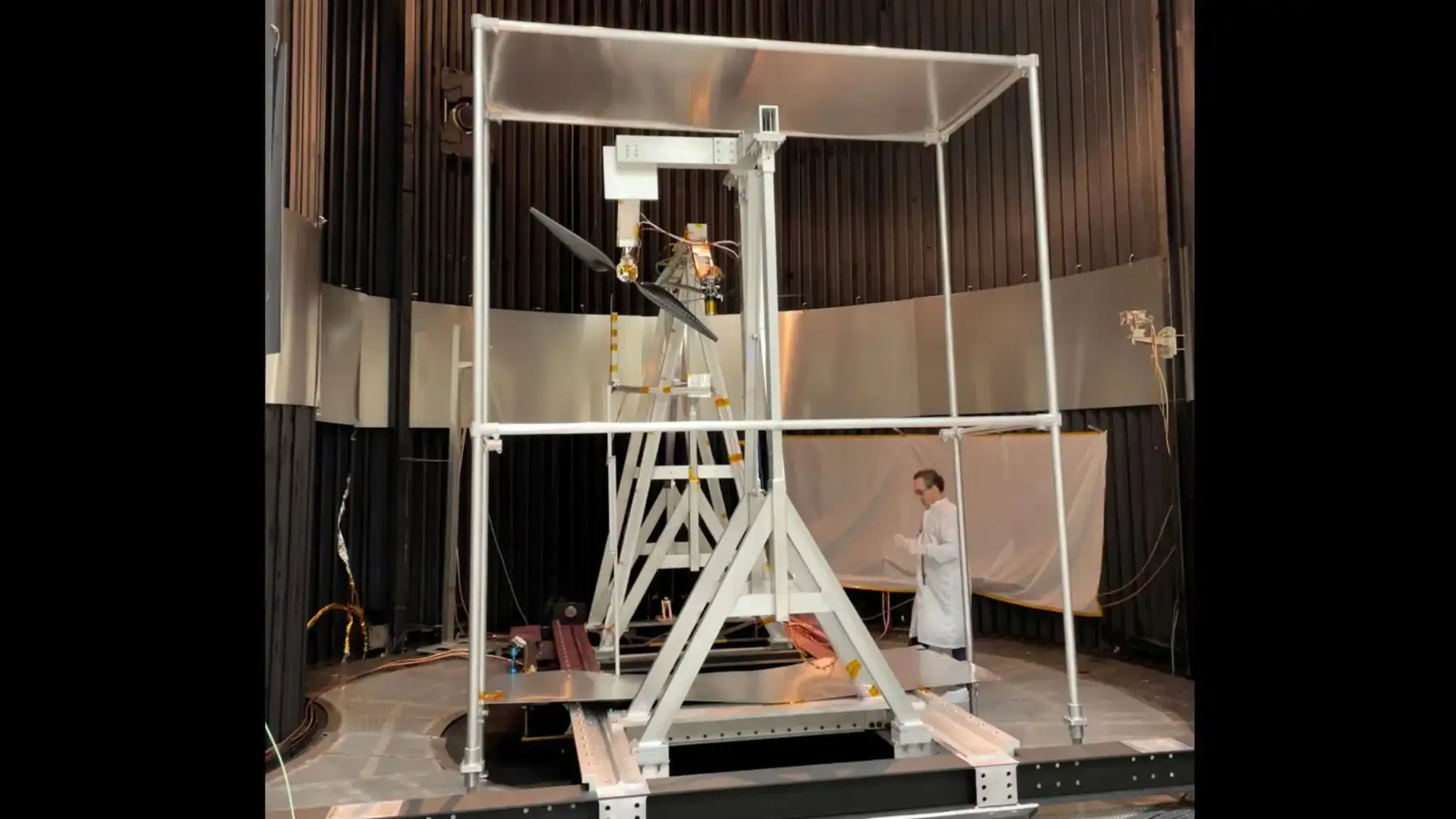
Inside a reinforced chamber at NASA’s Jet Propulsion Laboratory, engineers watched a set of experimental Mars helicopter blades accelerate past a threshold their predecessors were never allowed to approach — the speed of sound. The walls had been lined with sheet metal. The control room was just yards away. A camera tracked every revolution.
Flying on Mars is already one of aerospace’s most punishing challenges. Every fraction of a Mach number is hard-won — and until now, crossing Mach 1 was considered too unpredictable to risk.
Why lifting off on Mars is so brutally hard
Mars doesn’t make anything easy — especially flight. Its atmosphere is roughly 1% as dense as Earth’s, which means rotor blades have far fewer air molecules to push against with every revolution. The only way to compensate is to spin faster, and spinning faster means blade tips creep toward the speed of sound.
That threshold arrives sooner on Mars than on Earth. Sound travels at only about 540 mph on the Red Planet, compared to 760 mph at sea level here — a gap explained by colder temperatures and a predominantly CO₂ atmosphere. Engineers face a compressed window: extreme RPM is needed to generate lift, but Mach 1 is closer than it would be at home.
Ingenuity’s team managed this by maintaining a deliberate buffer. Blade tips were held at Mach 0.7 with no wind — enough headroom that an unexpected gust wouldn’t push them into the unpredictable transonic zone.
Ingenuity’s legacy — and its limits
When Ingenuity lifted off on April 19, 2021, it became the first powered, controlled aircraft to fly on another world. A historic achievement — but the helicopter was designed to answer one question: can we fly on Mars at all? It wasn’t built to do science.
Over 72 flights, its composite-skinned foam rotors were capped at 2,700 RPM, a ceiling that kept the blades safely clear of transonic instability. Conservative by intent, according to Science Daily.
NASA’s ambitions have since grown considerably. The agency now needs aircraft that can carry sensors, advanced batteries, and scientific payloads — a fundamentally different engineering challenge. More capability means more mass, and more mass demands more lift than Ingenuity was ever asked to produce.
Inside the supersonic rotor tests at JPL
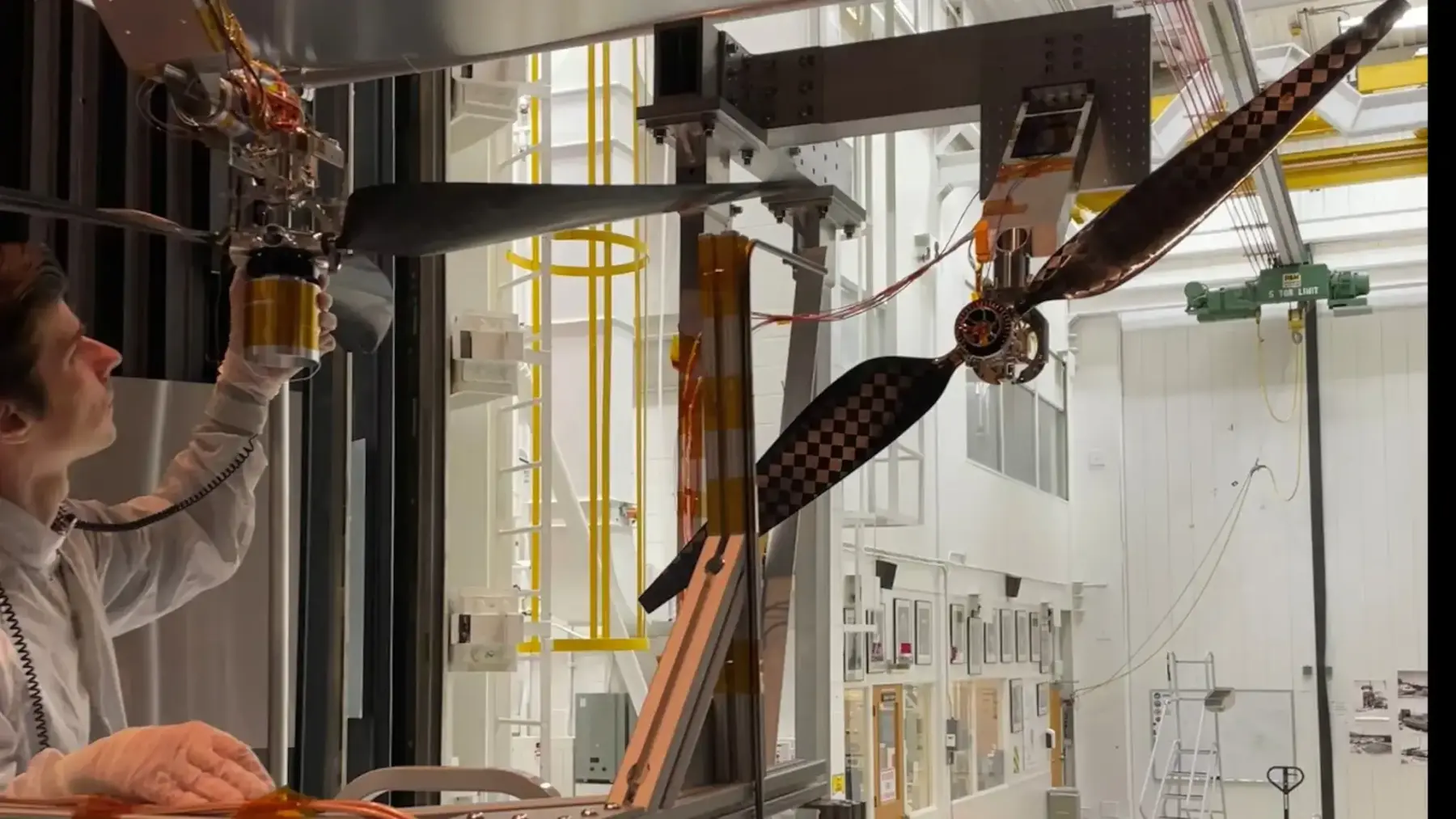
To find out whether next-generation blades could handle higher speeds, engineers turned to JPL’s 25-Foot Space Simulator. Air was removed, carbon dioxide was introduced to recreate Martian atmospheric density, and part of the interior was reinforced with sheet metal in case a rotor shattered under supersonic stress.
The rotor systems were developed and manufactured by AeroVironment in Simi Valley, California. Engineers ran 137 test runs in total, incrementally pushing RPM higher while a fan introduced simulated headwinds — a methodical approach that pushed the system a little further each run, monitored the data, and watched for the point where things might go wrong.
Breaking Mach 1 — and what the data showed
The three-bladed rotor reached 3,750 RPM. At that speed, blade tips hit Mach 0.98 — just short of the sound barrier. Then engineers switched on the fan.
With headwinds applied, blade tips surpassed Mach 1.08. The blades survived intact, and that survival was the critical result: proof the design could handle supersonic conditions without catastrophic failure. The performance gain was substantial — operating in the supersonic regime delivered a 30% increase in lift capability over the previous operating envelope. A two-bladed design intended specifically for the SkyFall mission was also tested successfully, reaching near-supersonic speeds at 3,570 RPM before headwinds pushed it past the barrier.
“We thought we’d be lucky to hit Mach 1.05, and we reached Mach 1.08 on our last runs,” said Shannah Withrow-Maser, an aerodynamicist from NASA’s Ames Research Center and member of the test team. “We’re still digging into the data, and there may be even more thrust on the table.”
SkyFall and the road to Mars in 2028
Engineers working on SkyFall have already folded the test results into the project’s performance specifications. The mission is designed to deliver three next-generation helicopters to Mars in December 2028.
That 30% lift boost translates directly into mission capability. Heavier instruments become viable, larger batteries extend flight duration, and terrain that rovers simply can’t reach — steep canyon walls, unstable slopes, subsurface features accessible only from above — becomes fair game for aerial investigation.
The data may not be fully mined yet. Researchers suggest additional thrust potential could still be extracted from the 137-run dataset, which would push the performance ceiling for Mars rotorcraft higher than even these tests revealed. What comes next is a design process built on hard evidence rather than conservative estimates. The sound barrier on Mars has been crossed — the question now is how much further the next generation of aircraft can go.
Read the whole thing?
Get the week's signal, not the noise
Our sharpest reporting on energy, climate and nature — free, once a week.