When a black hole tears a star apart, the violent flash of light it produces — a tidal disruption event — is supposed to mark the heart of a galaxy. That’s where supermassive black holes live, and that’s where astronomers have always expected to find them.
TDE 2025abcr didn’t follow that rule. The flare erupted far from the center of its host galaxy, in a place where no black hole was supposed to be. Now, the James Webb Space Telescope and the Keck Observatory have trained their instruments on this misplaced burst of light — and the findings may reshape how astronomers think about black holes and where they roam.
When a star meets its end — usually at the galactic core
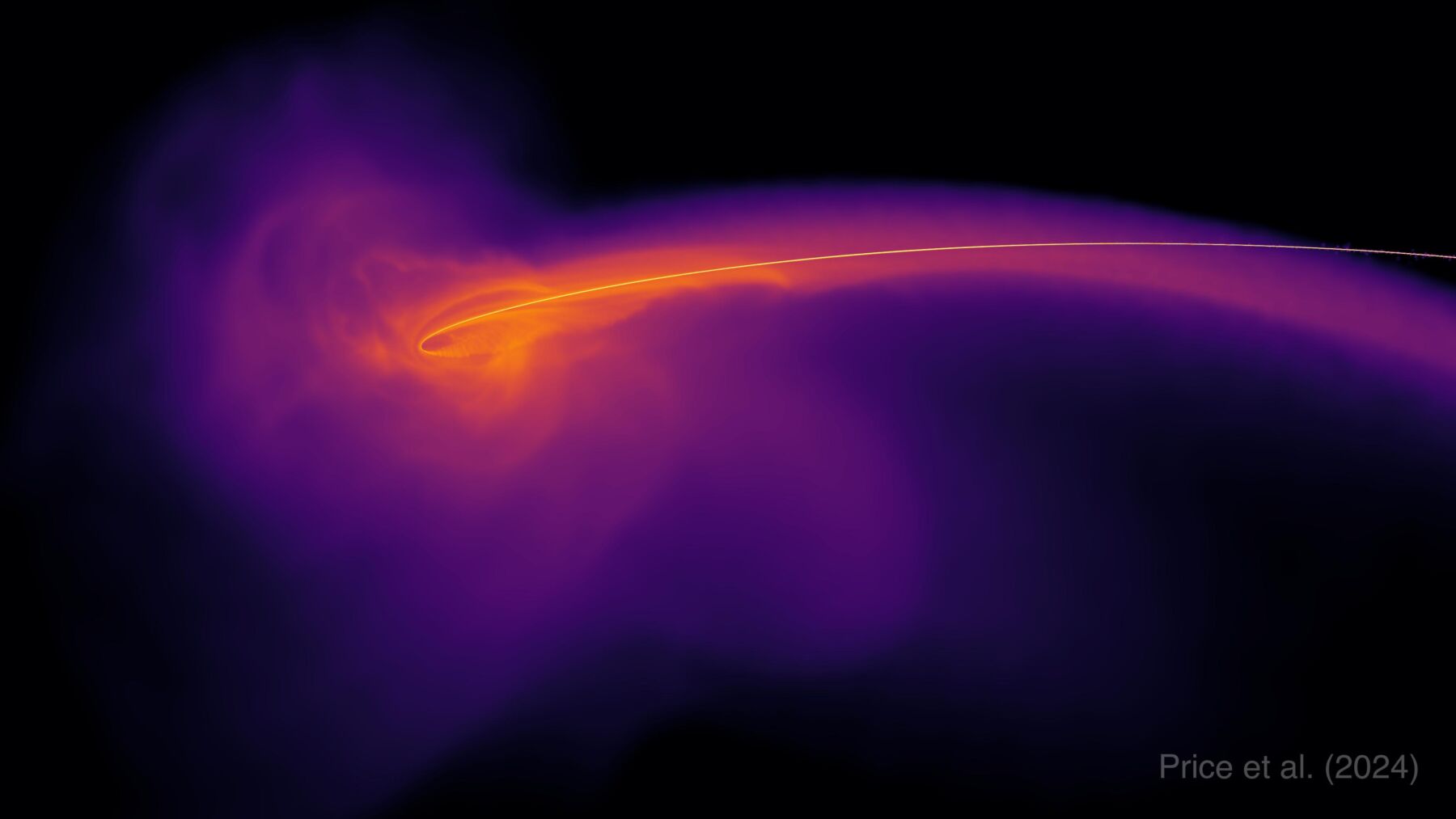
A tidal disruption event happens when a star wanders too close to a massive black hole. Gravity stretches and shreds the star — a process astronomers call “spaghettification” — and the debris forms a swirling stream of superheated gas that releases an enormous burst of radiation, briefly outshining entire galaxies.
Because supermassive black holes sit at the centers of nearly all large galaxies, TDEs almost always appear at galactic nuclei. These flares carry information about a black hole’s mass, spin, and surrounding environment, offering a rare window into objects that are otherwise dark and silent. No laboratory could replicate what each TDE provides as a natural experiment.
TDE 2025abcr: a flare in the wrong neighborhood
TDE 2025abcr stood out immediately. Its flare appeared well away from the center of its host galaxy — an “off-nuclear” position where a massive black hole simply wasn’t expected. Confirming that offset required precise astrometry and careful cross-referencing with the host galaxy’s structure, but the positional displacement was clear enough to flag the event as genuinely unusual.
Ruling it out as a supernova or an unpredictably flaring active galactic nucleus required spectroscopic data and multi-wavelength photometry. That’s where JWST and Keck came in, providing the spectral coverage and sensitivity needed to characterize the event and eliminate alternative explanations.
What JWST and Keck revealed about the evolving reprocessing layer
A key finding involves what researchers call a “reprocessing layer.” When a black hole tears apart a star, the resulting debris forms a shroud around the event, and high-energy radiation from the inner accretion region gets absorbed and re-emitted at lower energies — including in optical and infrared wavelengths, as explained in arXiv.
This layer wasn’t static. It evolved over time, affecting how the event appeared across wavelengths. JWST’s infrared sensitivity proved critical, probing cooler, more distant parts of the reprocessing layer that ground-based instruments couldn’t reach. Together, the spectral and photometric data confirmed the event’s TDE nature and revealed a system actively reshaping itself as the disruption progressed.
A black hole far from home — possible explanations
Why would a massive black hole exist far from a galactic center? Galaxy mergers can displace black holes, leaving them to wander through stellar fields. Gravitational recoil — a kick delivered when two black holes merge and emit asymmetric gravitational waves — can push one well off-center.
There’s another possibility: TDE 2025abcr may have involved an intermediate-mass black hole embedded in a dense star cluster. These objects occupy a mass range between stellar-mass and supermassive black holes, and their demographics remain poorly understood. X-ray and radio observations could help pin down the black hole’s properties and its relationship to the host galaxy.
What this means for the search for wandering black holes
Off-nuclear TDEs may be one of the only reliable ways to find black holes that aren’t actively feeding. A wandering black hole sitting quietly in a stellar field produces no detectable signal — until a star gets too close.
That brief, violent flare is the black hole announcing itself. JWST is uniquely positioned to catch these announcements: its infrared capabilities let it see through dust and probe host galaxies at distances where off-nuclear offsets are otherwise impossible to measure. A larger sample of such events could transform what astronomers know about black hole demographics and galaxy merger histories. Upcoming wide-field surveys are expected to surface more displaced black holes — one shredded star at a time.
Read the whole thing?
Get the week's signal, not the noise
Our sharpest reporting on energy, climate and nature — free, once a week.