Astronomers searching for planets around a nearby star expected to find a faint, telltale wobble — the subtle gravitational signature of a world tugging at its sun. What they found instead was something far messier: a star moving in ways that no single planet could explain.
The culprit turned out to be a companion star. DG CVn, about 59 light-years away, is actually a pair of red dwarfs locked in orbit around each other. Both stars were broadcasting detectable radio waves — a rare coincidence that gave astronomers something remarkable: 18 years of precise, individual tracking data for each star, gathered using the Very Long Baseline Array.
A planet hunt that found something else entirely
DG CVn first caught astronomers’ attention during a survey scanning nearby stars for planets. The method is straightforward in principle: watch for a star’s subtle back-and-forth motion, caused by a planet’s gravitational pull. DG CVn was moving — but far too much, and in patterns too complicated for any planet to produce.
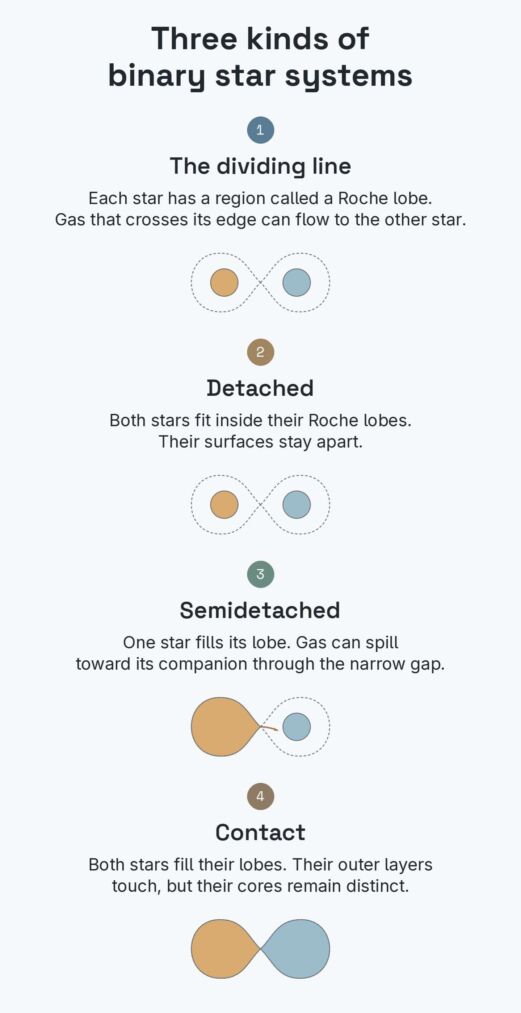
That complexity pointed to a companion star. The two red dwarfs are locked in a mutual orbit, and their combined gravitational dance was responsible for the unusual motion. Lead researcher Paul Boven, of JIVE and Leiden Observatory, noted the team was fortunate: they had already developed tools capable of interpreting those motions when they first heard about the system.
The system sits roughly 59 light-years from Earth and is estimated between 30 and 150 million years old — practically a teenager in cosmic terms.
Why two radio-loud red dwarfs are so rare — and so useful
Most stars emit only faint natural radio waves. Some red dwarfs break that rule dramatically. When a red dwarf rotates rapidly, the churning inside generates powerful magnetic fields that drive intense flares — bursts of energy spiking in both radio and X-ray wavelengths.
DG CVn contains at least one confirmed flare star, and previous observations showed its radio emission can surge sharply following powerful X-ray outbursts. The system also harbors a complex periodic variable (CPV) star showing persistent, repeating changes in optical brightness. Researchers still don’t know which star displays which behavior. Crucially, both emitted detectable radio signals — meaning each could be tracked individually, an opportunity that rarely presents itself.
Eighteen years of sky: how the VLBA pinned down two moving stars
The research team built their dataset from two sources: archival observations from the VLBA and the Green Bank Telescope covering 2007 to 2010, plus seven new VLBA observing sessions conducted between 2023 and 2025. Together, the data yielded 27 precise position measurements across 18 years.
The VLBA is a network of 10 radio telescopes spread across North America, from Hawaii to the Virgin Islands, functioning as a single Earth-sized instrument. Optically, the two stars appear too close to separate with conventional telescopes — radio astrometry was the only realistic path forward. “DG CVn is a beautiful example of what precise radio astrometry can reveal,” said co-author Jay Blanchard of NSF NRAO. “By following these two stars over many years, we can see their orbital motion directly.”
Orbital mechanics: masses, distance, and a very tight ellipse
The measurements revealed an orbit completing every 4.511 years along a stretched ellipse. At closest approach, the two stars pass within just 0.59 astronomical units of each other — closer than Earth is to the Sun.
Using parallax, the team pinned the system’s distance at 59.3 light-years. That figure, combined with observed orbital dynamics, allowed them to calculate each star’s mass: DG CVn A carries about 39% of the Sun’s mass; DG CVn B, about 36%. The results represent some of the most precise dynamical mass measurements ever made for a binary system of this type.
Planets squeezed out — and a blueprint for finding new ones
Those repeated close passes had real consequences for planet formation. Young stars are surrounded by disks of gas and dust — the raw material for planets. DG CVn’s stars swing within 0.59 astronomical units of each other, and that gravitational disruption would have truncated both disks early on, cutting off the process before it could finish.
A planet orbiting just one star would need an orbital period shorter than roughly 23 days to remain stable; one circling both stars together would need an orbit of at least 36 years. Neither scenario suits the worlds astronomers typically search for.
The technique itself, though, opens doors. Future observatories including the Next Generation Very Large Array (ngVLA) and the Square Kilometre Array (SKA) could extend this approach far more widely. “We hope to make measurements precise enough to detect planets in orbit around such radio-loud dwarfs,” said JIVE chief scientist Huib van Langevelde. When the ngVLA and SKA join the VLBI network, he added, even more precise measurements across a far wider range of stars should become possible.
Read the whole thing?
Get the week's signal, not the noise
Our sharpest reporting on energy, climate and nature — free, once a week.