The wave in the flume is barely as tall as a shoebox.
It rolls down 342 feet of concrete channel toward a small ring floating at the far end.
The ring tips, dips, and rights itself.
Somewhere inside it, a generator begins to turn.
A power reading starts to climb.
That climbing line answers a question wave engineers have been chasing for years.
A hidden plate below the ring does the actual work
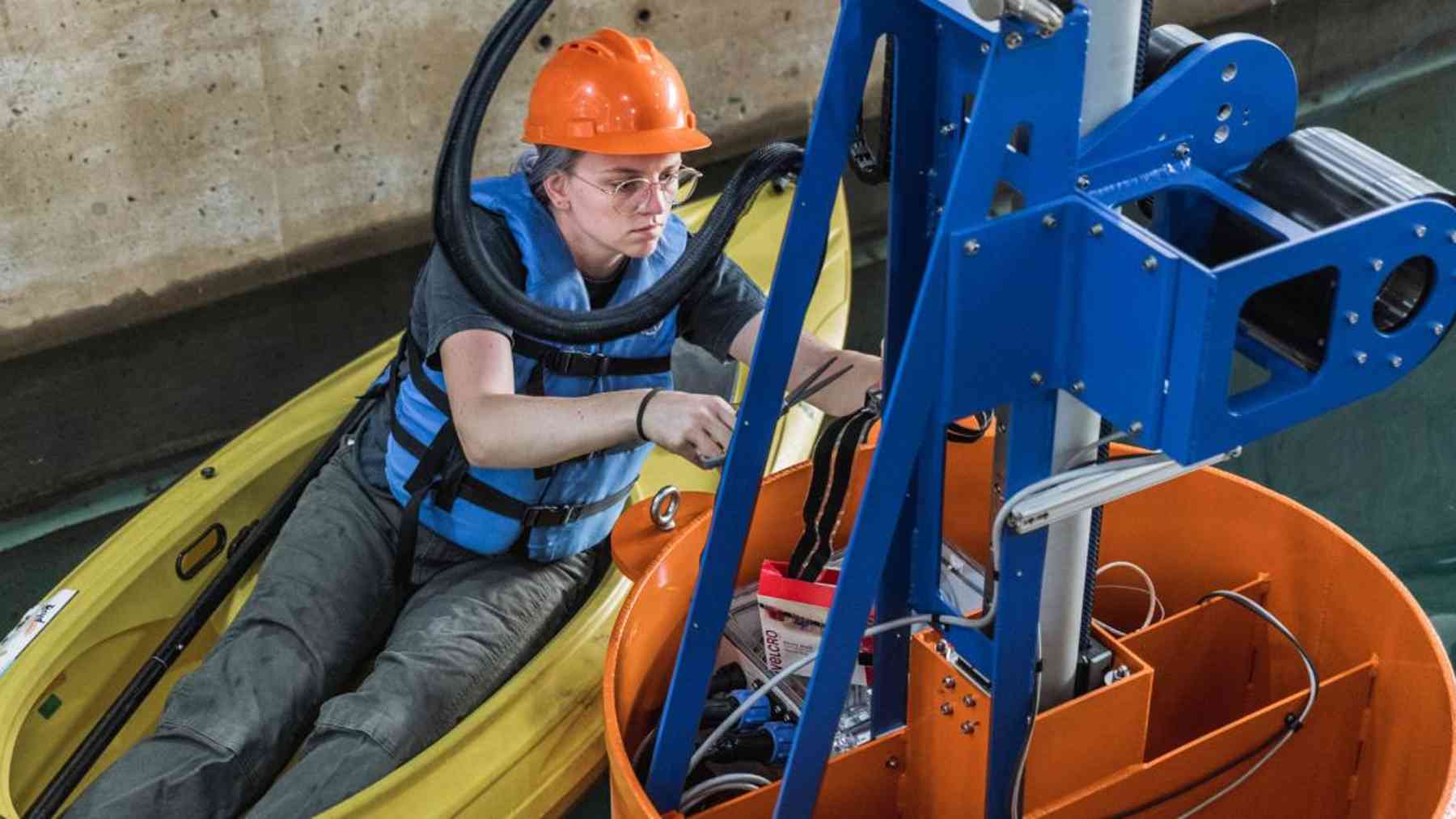
The device is called LUPA, short for Laboratory Upgrade Point Absorber, and it is built from two parts that barely seem to notice each other. The top piece is a floating ring about three feet wide that houses the motor, generator, and electronics, while below it a heave plate hangs at the bottom of a spar roughly twelve feet tall, sitting in water that moves far less than the surface above.
That gap between restless and calm is the whole trick. As the ring rises and falls with each wave, it moves relative to the plate beneath it, and a record breaking simple mechanism turns that relative motion into shaft rotation at the generator.
The prototype produces 40 watts in waves about six inches high that pass every two seconds, according to Oregon State University’s College of Engineering. Forty watts will not run a household, but the goal was proving the relationship holds steady enough for engineers elsewhere to trust the same math at a much bigger size.
342 feet of flume stand behind the test data
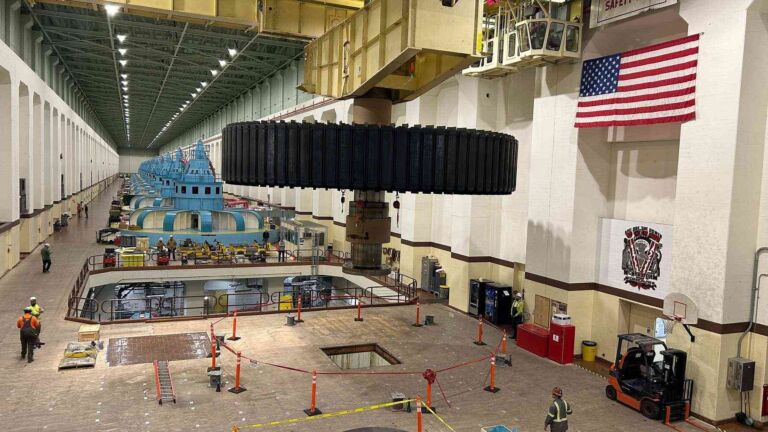
The testing happens in the Large Wave Flume at the O.H. Hinsdale Wave Research Laboratory in Corvallis, Oregon, a channel 342 feet long and 12 feet wide that the university calls the largest of its kind in North America. A self leveling wave maker at one end pushes water down the channel in programmed strokes, so researchers can repeat the same wave again and again.
Engineer Bryson Robertson leads the project, with graduate student Courtney Beringer among the researchers who build, adjust, and instrument the hardware between runs. The complete unit weighs more than 880 pounds.
That is heavy enough that moving it in and out of the water is its own small operation.
A model one twentieth the size of a 66 foot machine
LUPA is not meant to generate power on its own. It is a one twentieth scale model based on a utility scale wave energy converter sized for PacWave, the open ocean test site about seven miles off Newport, Oregon, and everything measured in the flume gets scaled up mathematically to predict how the full machine would behave in real swells.
At full size, the numbers grow fast: a full scale LUPA would measure roughly 66 feet across, wider than a tennis court is long, floating in the open Pacific. The lab version lets researchers test ideas cheaply before any of that steel gets cut.
It runs in three configurations, the float locked to heave only, both bodies free to heave, and a moored setup free in all six degrees of freedom. Engineers also tested a multi axle power takeoff whose damping could be swept from zero to about 7,000 newton seconds per meter within a single wave test to find the setting that pulled the most watts.
A short flume campaign replaced years of guessing at sea
Much of the uncertainty work came from a concentrated window rather than a long ocean deployment, which is exactly the appeal of a controlled channel. One OSU campaign with Sandia National Laboratories ran from late October into early November, rerunning identical waves while changing one variable at a time.
Robertson’s group describes LUPA as an open source tool meant to lower the barrier for anyone entering marine energy research, rather than a device built to be sold.
Engineering drawings, bills of materials, numerical models, and processed test data from the Oregon runs are posted publicly in the federal marine energy data repository, so a graduate student with wave tank access can build a copy. Shared methods are reshaping other corners of offshore energy too, where a drone inspects spinning turbine blades without stopping them.
One free blueprint now travels well beyond Oregon
Because the design and its numbers are public, LUPA was built to serve as a baseline case that other teams can compare their own results against. Groups testing different point absorber shapes get a documented, repeatable reference instead of a black box, the same way a crash test lab shares its dummy data.
That openness matters most for an industry still settling basic questions that other renewables worked out decades ago. Wave energy remains far behind wind and solar in deployed capacity, and shared test data is one of the cheapest ways to narrow that gap.
Forty watts in a flume is a long way from powering a coastal town, and no full scale converter has sent power ashore from PacWave yet.
Even so, a small ring in a concrete channel has already done something useful: it gave a young industry a shared, documented starting line.
Read the whole thing?
Get the week's signal, not the noise
Our sharpest reporting on energy, climate and nature — free, once a week.