

Solar panels are usually installed at an angle to absorb the most sun.
On a flat roof in northern Norway, a different arrangement is being used.
In September 2025, a company called Over Easy Solar announced a rooftop solar installation of vertical panels in Tromsø.
This is reportedly the world’s largest project of its kind.
Why are these panels installed so differently up in the far north?
A cold storage terminal above the Arctic Circle
Tromsø is a city high up north of the Arctic Circle.
The upright panel project sits on top of Tromsøterminalen AS, the biggest cold-storage terminal in Tromsø.
It aims to benefit two parties involved: the client and the tenant. The client, Tromsøterminalen Eiendom AS, commissioned the solar installation.
The tenant is the cold store itself, Tromsøterminalen AS. Since their refrigeration runs on electricity all the time, this solar installation will allow for cheaper, cleaner power for the freezing terminal.
The solar project was promoted and supported by two further organizations, called Ishavskraft and SpareBank 1 Nord-Norge.
A record on the roof of Tromsøterminalen
The installation uses 1600 vertical units supplied by Over Easy Solar. Its total capacity is 320 kWp.
The company says the installation surpasses its own previous record.
That record was set at the Norwegian National Football Stadium, where the installation totals 248.4 kWp. The Tromsø system is now larger by an impressive 71.6 kWp.
The company’s chief executive, Trygve Mongstad, said it is, as far as he knows, the city’s largest solar system. He added that it is the world’s largest vertical rooftop installation.
The hard work done to finish this project was aided by a partner, Enøk Total.
Why the panels stand upright
While slanted panels are the norm for solar installations, this project is different.
The company says there are four advantages of mounting these panels vertically. The first is that they capture more energy from low-angle sunlight, which is more common in the north.
Secondly, they generate more electricity in the morning and afternoon. Those are the hours when demand is highest, and electricity is typically more expensive.
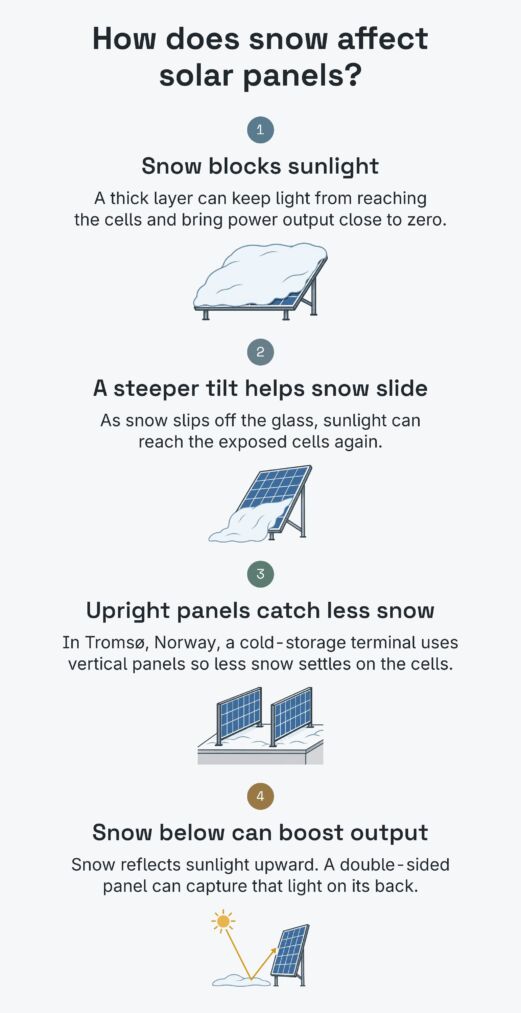
Thirdly, vertical panels stay clear of snow accumulation, which improves performance through the year. The fourth reason is that they remain easy to access, with space to move between rows.
All of these factors make for much more efficient solar panels for this location, which can operate much better.
Arne Christian Bredesen, the technical project manager at partner company Enøk Total, says this is the most optimal system for both snow and wind conditions.
He added that it also ensured good energy yield. The new units actually outperformed conventional systems by 54%.
The benefit of this vertical solar system
New units yielded 747 kWh/kWp a year, against 485 kWh/kWp for the conventional systems.
Part of this gain can be credited to roof albedo, where light is reflected from the roof. This has also been done really well in this successful Canadian project.
This effect is particularly useful in northerly regions, where conventional panels may end up covered in snow. They offer reliable clean energy, simpler maintenance, and better use of limited rooftop space.
This vertical project could become a model for other companies that want to produce power from flat northern rooftops. It is a practical solution that can deliver at scale.
The clear benefit is cheaper energy for the freezing terminal in Tromsø. This could be replicated across the northern parts of the world, so that more areas could see the same benefits. Slanted panels that are having issues with snow could also learn from this project.
Panels previously damaged like these ones could see major improvements with changes to vertical installation. The cost to change could be the only constraining factor.
Read the whole thing?
Get the week's signal, not the noise
Our sharpest reporting on energy, climate and nature — free, once a week.


