A fist sized chunk of broken turbine blade sits on a lab bench, gray and scarred at the edges.
Inside a small furnace nearby, a basket of the same material glows faint orange.
Nobody is melting it down for scrap metal.
They are after something almost invisible, the hairlike glass fibers buried inside the hardened resin.
Pull them out badly and they come back sooty, or brittle, or both.
So how little heat, and how little time, can actually do the job?
Why the heat that frees the fiber also ruins it
The glass inside a blade is locked into a hardened epoxy matrix that will not simply melt away. Heating the composite in an oxygen free atmosphere breaks the resin down, but it does not leave the fibers bare. Work on blade composites found that pyrolysis alone leaves carbon deposited on the surface.
That carbon layer creates defects and a significant drop in fiber tensile strength. Burning the residue off requires oxygen, which introduces the opposite danger.
Researchers note that mild oxidation can clear the char without wrecking the glass, while oxygen present at higher pyrolysis temperatures drives a sharp strength decline that fiber recycling has to avoid. A process hot enough to guarantee clean fibers is also hot enough to quietly degrade them, and the damage does not show up in a photograph.
The fix is to stop treating it as one bake. One short pass under nitrogen strips the bulk of the resin, then a cooler second pass in ordinary air targets only what is left.
Strands that came back white after 15 minutes
Fibers recovered through that split sequence came out visually clean and white, with mechanical properties still largely intact rather than one trait sacrificed for the other. Single filament tensile testing put the recovered fibers at 76 percent of their original tensile strength and 88 percent of their original Young’s modulus.
That combination is the whole point. A fiber that sheds its resin but tests brittle is only cheap filler.
The same review literature cited in the work notes that recovered glass fiber of adequate quality can substitute for up to about 20 percent of virgin fiber by weight in dough molding compounds, a real foothold for a material once destined for landfill.
Inside a reactor tuned to a 15 minute window
The experiment itself was modest and physical. Chunks of epoxy based wind blade composite went into a step batch reactor, paired with thermogravimetric mapping and kinetic modeling to locate where the resin actually breaks down, as described in the published study.
The fibers first saw 797 degrees Fahrenheit under nitrogen with no holding time at all, meaning the reactor barely paused before moving on. A second stage followed at 887 degrees Fahrenheit in open air, held for fifteen minutes.
Dwell times across the full test matrix ran from zero up to thirty minutes. The short combination was the one that produced mechanically sound, clean white fibers.
The reported activation energy for the decomposition fell between roughly 120 and 180 kilojoules per mole, which the authors treat as evidence that this is an energy lean route worth designing industrial equipment around.
A 45 percent strength loss in older methods
The paper set out to test one hypothesis, that separating pyrolysis from oxidation allows clean recovery at lower temperature and near zero isothermal dwell. Its comparison table places the result against earlier published runs.
A fixed bed pyrolysis route lost about half the tensile strength, and a steel semi batch route lost about 45 percent, against roughly 24 percent here. Those are different reactors working on different feedstock, so the contrast points to a promising direction rather than a controlled head to head test.
What the work does establish is that internal damage and surface cleanliness are separate problems, and only one of them is visible. Careful material recovery tends to look like this elsewhere too, the same way a dam project in the Pacific Northwest recently lifted a generator rotor for rebuilding rather than scrapping it.
43 million metric tons still waiting by 2050
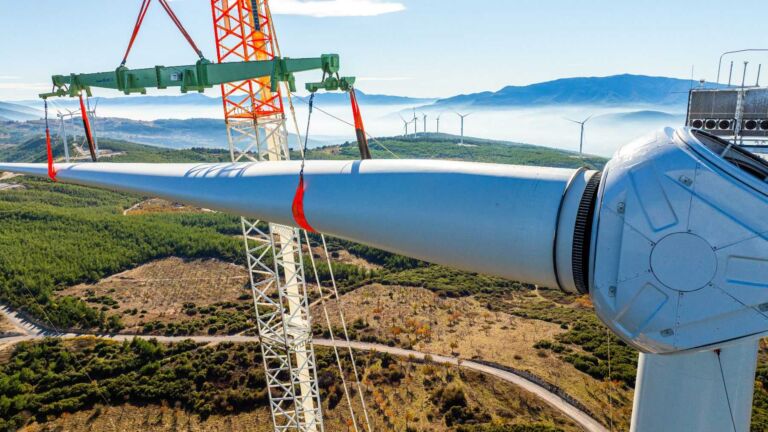
None of this solves the scale problem on its own. A single one megawatt turbine can yield more than 10 tons of blade waste at the end of its service life.
Cumulative waste blades may reach roughly 43 million metric tons, about 47 million US tons, by 2050, with around 40 percent of that total in China. A mild two step process proven on lab sized chunks still has to be scaled into something that can swallow a whole blade segment rather than a fist sized sample.
Other teams working on panel cleaning methods have reached a similar place, where a gentler physical approach outperforms a harsher one but still has to survive the jump to commercial equipment. The next real test is whether a factory sized version of this short, mild bake can turn a blade graveyard into a supply of fiber that manufacturers actually want to buy.
Read the whole thing?
Get the week's signal, not the noise
Our sharpest reporting on energy, climate and nature — free, once a week.