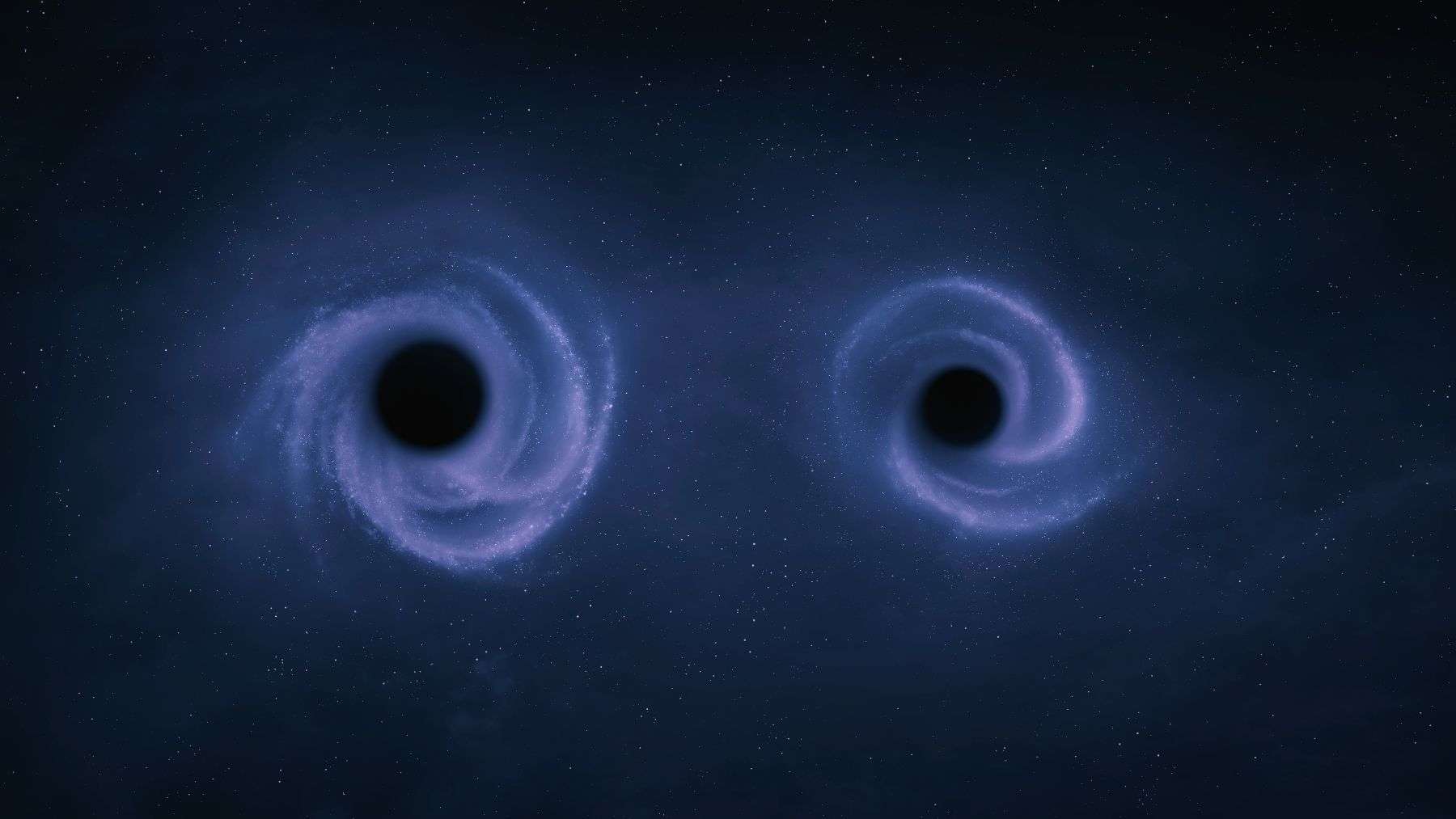
The universe was less than a billion years old when some of its black holes had already grown to billions of times the mass of our sun. That shouldn’t be possible — not at the growth rates physics has long considered standard.
Now, a new study may have found the missing piece. It involves some of the strangest objects the James Webb Space Telescope has ever captured: faint, compact smudges astronomers call “little red dots,” whose very existence deepens the puzzle of how these ancient giants got so big, so fast.
Black holes that shouldn’t exist yet
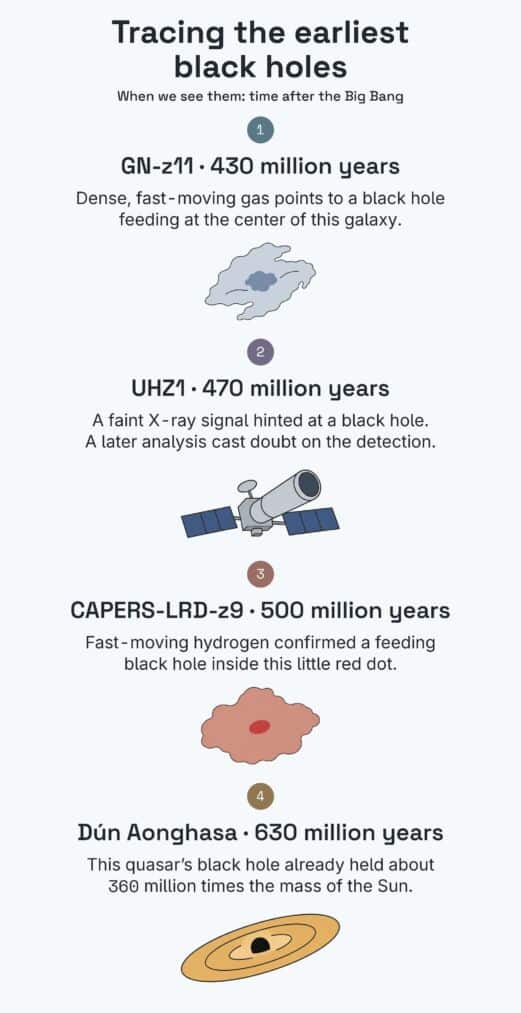
When astronomers look deep into the early universe, they find black holes that simply shouldn’t be there yet. Some exceed a billion solar masses — all packed in during the first 700 million years after the Big Bang. By conventional astrophysics, that timeline is nearly impossible.
The problem comes down to speed limits. Black holes grow by pulling in surrounding gas and dust, a process called accretion. As matter falls inward, it heats up and radiates energy outward. At a certain point, that outward radiation pressure pushes back against infalling material, capping the growth rate. This ceiling is called the Eddington limit — a cornerstone of standard black hole physics.
JWST complicated things further. Among its early discoveries were objects nicknamed “little red dots”: compact, reddish sources at very high redshift, many of which appear to host extremely massive black holes that are actively feeding. There are more of them, and they’re heavier, than standard models predict. One question becomes unavoidable: what physical process could allow black holes to reach such enormous masses so early in cosmic time?
What ‘free-fall growth’ actually means
The answer proposed by researchers centers on a concept called free-fall accretion. In this regime, matter collapses inward under gravity with minimal resistance. The radiation pressure that normally slows feeding is suppressed or bypassed entirely, allowing gas to pour into the black hole almost unimpeded.
This contrasts sharply with Eddington-limited accretion, where outward radiation pressure and inward gravity reach a rough balance, throttling growth. Standard models — even those allowing for some super-Eddington feeding — still assume significant resistance to infall, according to arXiv.
Think of it this way: standard accretion is like drinking through a straw. Free-fall growth is an open drain — gravity does the work, and very little pushes back. Under specific early-universe conditions, including extremely dense gas clouds, low metallicity, and minimal stellar activity, free-fall accretion becomes physically plausible.
What the new study found
The study, by Jeon and colleagues, published in The Open Journal of Astrophysics, goes beyond suggesting free-fall growth is possible. Its central finding is that this growth mode is required.
Using detailed modeling, the researchers showed that conventional growth scenarios — including those invoking super-Eddington accretion — fall short of reproducing the observed masses of the earliest supermassive black holes. The numbers don’t add up unless free-fall conditions are assumed.
This result doesn’t apply to just a handful of extreme outliers. It holds for the broader population of little red dots observed by JWST, whose masses and number densities together form a statistical constraint that any viable growth model must satisfy. Standard models fail that test. The math demands free-fall growth.
Why JWST’s ‘little red dots’ are central to this story
Little red dots share a few key observational signatures. They’re compact, they appear at high redshift, and many show broad emission lines — a hallmark of gas moving rapidly around an actively accreting black hole. That combination points to black holes feeding hard and fast in the early universe.
What makes them scientifically powerful is their statistical weight. Individual little red dots are surprisingly massive, but the larger issue is that there appear to be a lot of them. Their number density across the sky provides a population-level constraint that any growth model must explain.
JWST opened a window that simply didn’t exist before. Prior telescopes couldn’t detect objects this faint at this distance. Now that theorists can see the full population, they’re being pushed to revisit assumptions about black hole formation that had gone largely unchallenged for decades.
What this means for our understanding of the early universe
If free-fall growth is genuinely required, the implications reach beyond black hole physics. It tells us something about the early universe itself — extreme gas densities, rapid gravitational collapse, an environment where stellar feedback hadn’t yet disrupted infalling material.
Significant open questions remain. What seeded these black holes initially? Was free-fall growth widespread across cosmic history, or a brief early-universe phenomenon that faded as conditions changed? This study doesn’t fully resolve either.
What comes next will depend largely on continued JWST observations. Finding more little red dots, or better constraining their properties, could test whether free-fall growth predictions hold across a larger sample. What the study already makes clear is a meaningful shift: JWST isn’t just confirming existing models — it’s breaking them, pushing researchers toward explanations that would have seemed unnecessary just a few years ago.
Read the whole thing?
Get the week's signal, not the noise
Our sharpest reporting on energy, climate and nature — free, once a week.