Picture the most famous prison in America, alone on a rock in San Francisco Bay.
Cold water surrounds it, and the mainland glitters just over a mile away.
For most of its life, every light on this island burned imported fuel.
Look at its roof today and you would notice almost nothing.
Yet something is hidden up there, flat against the old stone.
And it has sharply cut the island’s diesel habit.
An island that had to make its own power
Alcatraz sits in the middle of San Francisco Bay, cut off from every wire on shore.
No power line has ever run out across that cold, deep channel.
For decades the prison made all its own electricity on the rock itself.
That meant a power house burning fuel brought in by boat.
Every gallon had to cross the bay on a barge or a ferry.
Storms could delay a fuel delivery for days at a stretch.
A backup meant a second boat and a second load of fuel.
Nothing about running this rock was ever cheap or easy.
Even after the prison closed in 1963, the island still needed power.
Today more than a million tourists visit the ruins every year.
Those crowds need lights, water pumps, and safety systems that never switch off.
And all of it still had to run without a grid.
Why the diesel generators kept running
The answer for years was simple and stubborn, a diesel generator.
Diesel is easy to ship and burns in almost any weather.
So barges kept hauling fuel across the bay to feed the machines.
The generators ran around the clock, loud and thirsty.
They filled the historic island with fumes and engine noise.
The sound carried across the water on still evenings.
Visitors came for the history and left with the smell of exhaust.
Moving that fuel by water was expensive and risky.
A single spill in the bay would have been a disaster.
Rising fuel prices only made the whole arrangement worse over the years.
But Alcatraz is a national landmark, frozen in time by strict rules.
You cannot simply bolt modern hardware onto its face.
Solar hidden on a landmark
In 2012, engineers finally found a way around that problem.
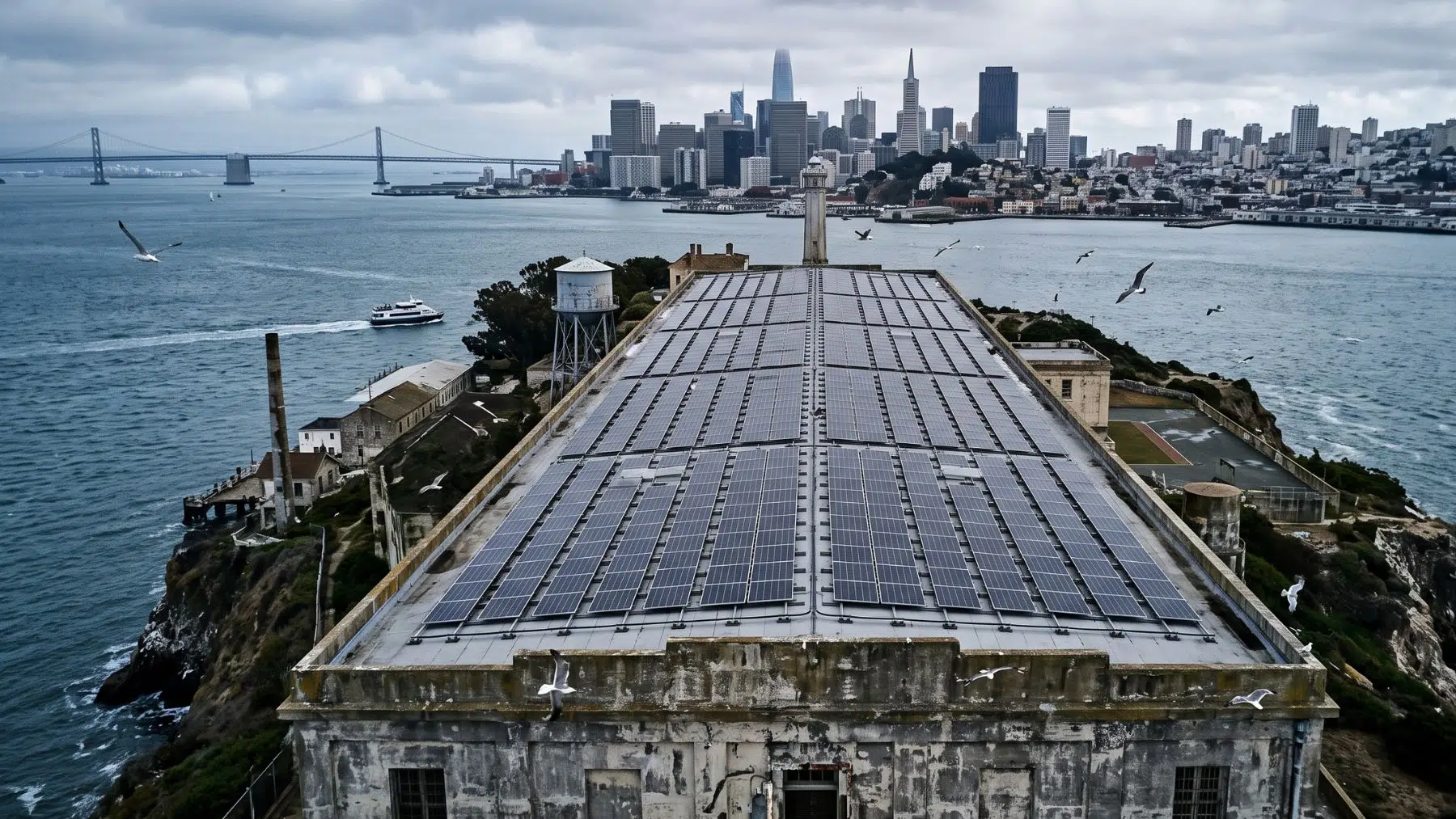
They covered the roof of the main cellhouse with solar panels.
There are 959 solar panels laid across the top of the building.
They were mounted almost completely flat, not tilted toward the sky.
Preservation officials watched every step of the work.
Nothing could change the silhouette the world knows from a hundred films.
That flat layout keeps them hidden from view across the water in San Francisco.
From the city and the ferries, the island looks exactly as it always has.
The panels feed a bank of batteries tucked inside the old structure.
A smart controller blends the sun, the batteries, and the old generators.
The whole system was threaded in without scarring the landmark.
How much the sun took over
Here is what that hidden roof actually achieved.
According to one report, the system cut the island’s diesel use by about 45 percent.
That saves more than 25,000 gallons of fuel every single year.
It also erases roughly 700,000 pounds of carbon dioxide annually.
That is about the yearly power emissions of 200 San Francisco homes.
The savings stack up steadily year after year.
On bright days the generators can sit idle for long stretches.
Before the panels, that fuel arrived one heavy barge at a time.
Much of it can stay on the mainland today, never burned.
At the time it was one of the largest microgrids in the entire country.
A prison built to cut people off from the world now runs largely on sunlight, on its own roof.
The birds took the island back
There is one more twist in the story of this rock.
Since the prison closed, wild seabirds have reclaimed Alcatraz completely.
Western gulls, cormorants, and night herons now nest across its cliffs.
The island is a protected rookery managed by the National Park Service.
According to one account, the hidden solar system sits easily beside the nesting colonies.
Cleaner air and less engine noise only help the birds raising chicks there.
Rangers guard the nests through the busy spring season.
The birds share the rock with the crowds and the panels alike.
The same mix of energy and wildlife shows up elsewhere, from a solar farm fox to panels shading an irrigation canal.
A place that once meant punishment now runs on light and shelters new life.
The most escape proof island in America finally let something break free, its own diesel chains.
Read the whole thing?
Get the week's signal, not the noise
Our sharpest reporting on energy, climate and nature — free, once a week.