

Sean Grasing wasn’t looking for anything extraordinary. The Earth scientist was combing through a lidar dataset — the kind that strips away vegetation to reveal bare topography — hunting for small moraines in New York. What he found instead stopped him cold: thousands of strange, elongated trenches etched across the landscape, stretching across six states and provinces, ranging from shallow grooves to pits nearly five meters deep.
No one had mapped them before. No one had explained them. And at more than 3,000 features strong, they were far too numerous to ignore.
Odd trenches hiding in plain sight
Grasing changed course entirely, spending years mapping every trench he could find. By the end, he had catalogued more than 3,000 features spread across Michigan, New York, Pennsylvania, Ohio, Ontario, and Quebec. The longest ran 11 kilometers. Most measured only a few hundred meters, and depths ranged from under a meter to roughly five meters — subtle enough to miss on foot, unmistakable from above.
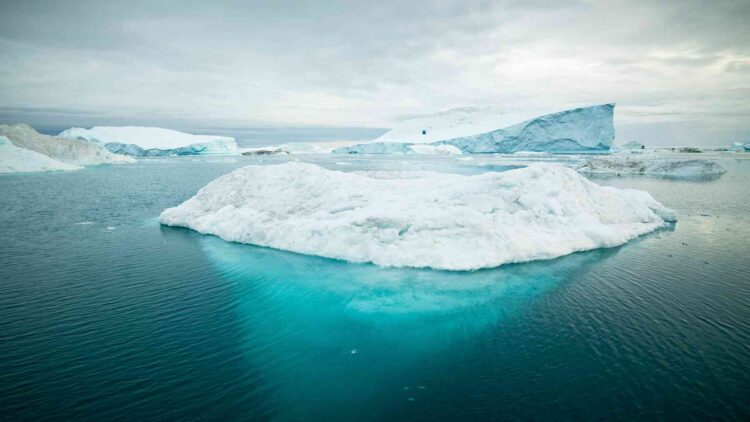
Working with geologist Jason Briner at the University at Buffalo, Grasing identified them as iceberg scour marks: grooves carved when icebergs dragged across the soft beds of ancient glacial lakes, leaving long, clean scratches in the sediment below.
Where did those icebergs come from?
The source was the Laurentide Ice Sheet — a massive frozen expanse that covered much of Canada and the northern United States during the late Pleistocene. As it retreated, it carved out enormous glacial lakes in the depressions it left behind and discharged icebergs into those same waters.
Those icebergs did not drift at random. Something was steering them, and Grasing and Briner concluded the most likely driver was the ice sheet itself.
How an ice sheet makes its own wind
Large ice sheets chill the air directly above them, creating a zone of high pressure. That air flows downslope and outward. Factor in Earth’s rotation, and the result is a clockwise, anticyclonic circulation — wind revolving around the ice mass in a slow, frigid pattern.
The Laurentide Ice Sheet produced exactly this kind of system. “In the late Pleistocene, the Laurentide Ice Sheet generated this colossal-sized anticyclonic wind pattern that influenced much of North America,” Grasing said.
The scour marks recorded that influence directly. On average, they aligned at roughly 260 degrees — a west-southwest orientation. Particularly well-preserved scours ended in a berm, where a grounded iceberg lifted back into a float, and that detail allowed the team to assign a travel direction: the icebergs were moving west, driven by winds from the east.
Corroborating clues in dunes and spits
Grasing and Briner did not rely on the scours alone. The landscape around the Great Lakes holds other wind records, and the team cross-referenced them carefully. Sand dunes along the New York–Ontario border align at roughly 240 degrees — consistent with easterly winds.
Spits in Michigan, documented in earlier research, also record sustained winds from the east and southeast. Each feature formed through a different process, yet all pointed in the same direction. “We’re lucky to have other indicators of winds,” Grasing noted, and that convergence of independent evidence made the team’s conclusions difficult to dismiss.
A wind record that held for thousands of years
To determine whether these winds were brief or sustained, Grasing and Briner sorted their scours into approximate age groups based on position within the Great Lakes basins. Different positions corresponded to different stages in the lakes’ histories, allowing a rough chronology.
The pattern held at every stage examined. “When we divide the scour marks by lake stage, in every single stage they were going in the same direction,” Grasing said. Easterly winds dominated for thousands of years without meaningful interruption. Climate models had long predicted that the Laurentide Ice Sheet sustained such long-lived anticyclonic circulation — but prediction and physical evidence are different things. These scours represent the first landscape-based confirmation of that forecast. “Now we have the evidence sculpted in the landscape,” Grasing said.
Why ancient winds still matter today
Paleowinds shaped temperature and precipitation across ancient North America in ways researchers are still working to reconstruct. Jessica Conroy, an Earth scientist at the University of Illinois Urbana-Champaign who was not involved in the study, called the finding “a really important data point.” Randy Schaetzl, a geomorphologist at Michigan State University, described the use of iceberg scours as wind vanes as a “fantastic application” — one that could be extended to other glaciated regions worldwide.
Today’s ice sheets are shrinking. The ways they alter atmospheric circulation as they retreat carry direct consequences for future weather patterns. The Laurentide Ice Sheet left its answer scratched into lake beds across six states and provinces, waiting for someone to read it.