
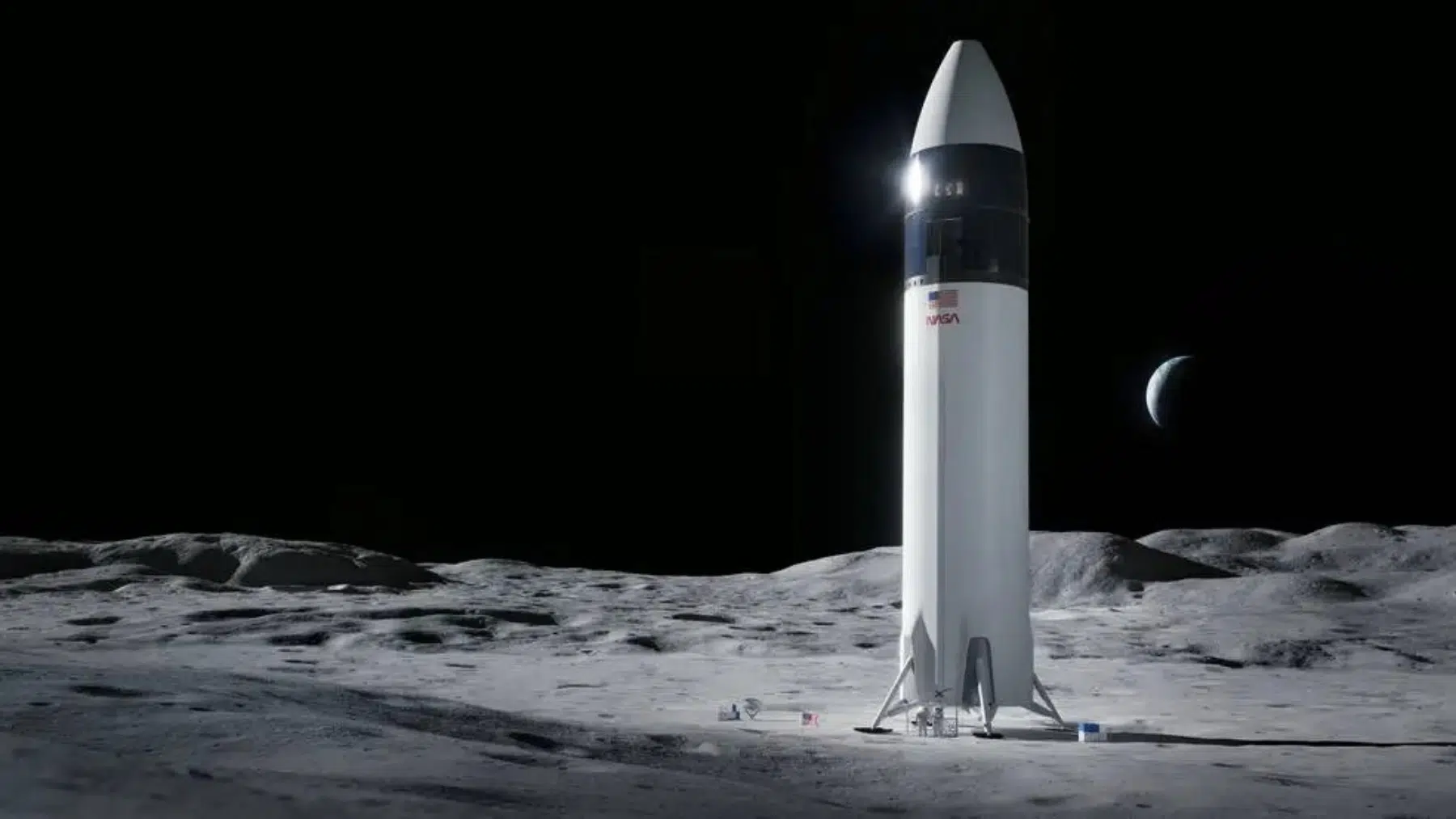
NASA’s long-awaited return to the Moon just changed course in a way few expected.
It was originally designed as the historic return to the lunar surface.
But it’s now been redesigned as a high-stakes orbital rehearsal.
Now, with Artemis 3 slipping into late 2027, the timeline is changing, once again.
The real question is no longer when the astronauts will land, but whether our new deep-space ‘taxis’ can even talk to each other in a vacuum.
What is the latest news on humanity’s mission to land on the Moon?
How a historic mission to land on the Moon has changed trajectory
For years, the Artemis III mission was meant to end a 50-year wait.
It was supposed to carry people to land on the Moon.
The first time to do so since the Apollo missions in the 70s.
The goal created significant pressure on NASA and its partners.
The mission depended heavily on new systems working perfectly together in space.
These systems weren’t just upgrades. They were entirely new technologies that NASA needed to work perfectly.
The pressure on NASA has reached a breaking point.
The mission’s success now hinges on propellant transfer technology and the Starship HLS V3. It only began its critical orbital engine relight tests in May 2026.
SpaceX and Blue Origin are still perfecting cryogenic refueling. NASA has opted for a more conservative ‘step-wise’ approach.
Instead of a direct descent, Artemis III will now act as a Low Earth Orbit (LEO) proving ground.
This will ensure that the Axiom AxEMU suits and docking adapters work at an altitude of 460 kilometers before we risk lives 400,000 km away.
Why the Artemis III launch now feels tighter than ever
Artemis II was a resounding success. Not just for NASA, but the entire human race.
It reached the dark side of the Moon and was the start of a new era.
However, Artemis III has now been delayed.
And the delay itself is not the only issue.
It’s what needs to happen after Artemis III that has created such urgency.
The mission must now carry a whole different kind of responsibility.
It will need to prove that every single system is working perfectly before landing.

These systems involve several vehicles constructed by different companies.
Each needs to operate perfectly in extremely harsh conditions.
Some technologies, such as orbital refueling, remain unproven at this point. That added pressure is affecting NASA and its partners.
If Artemis III is successful, it will lead us towards deeper space exploration.
That ambition represents a global collective dream.
But dreams can be shattered, as noted by NASA.
So what happens now?
What has changed for Artemis III, and will we still land people on the Moon
Will we still see boots on the Moon with this mission? In short: No.
NASA officially confirmed that Artemis III will not attempt a lunar landing.
Instead, the crew will launch aboard the Orion spacecraft to perform the first-ever crewed ‘handshake’ in Earth orbit. This will involve the the Starship and Blue Moon landers.
NASA is trading a ‘flags and footprints’ moment for the vital testing of life-support systems and orbital refueling.
These are the systems that will make a permanent Moon base possible.
During the previous mission, astronauts were subjected to several psychological tests.
But those only tested the people on the spacecraft.
Artemis III’s main purpose will be testing systems and technologies.
Big tech companies join the space race
If everything works the way it should, landing on the Moon may be possible.
The goal is to prove interoperability: a safety net where one company’s lander can act as a lifeboat for the other.
With the SpaceX Starship V3 now capable of 100-ton payloads to LEO, the hardware is finally catching up to the ambition.
NASA has shifted this goal to Artemis IV in 2028.
With SpaceX safely sending thousands of satellites into low orbit, hopes are high.
Can humanity come together to bring lunar landings to reality?
Read the whole thing?
Get the week's signal, not the noise
Our sharpest reporting on energy, climate and nature — free, once a week.


