
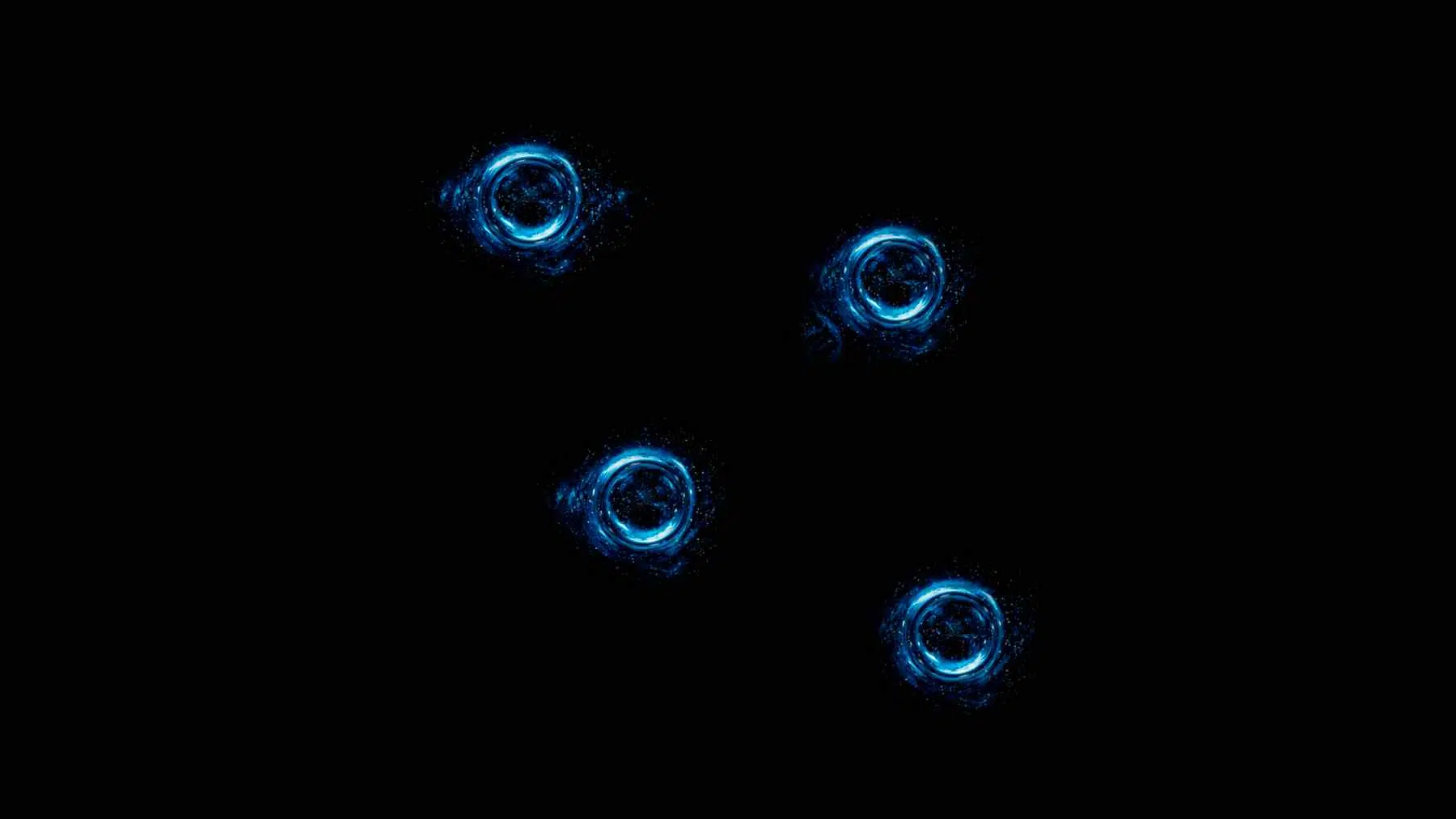
Astronomers detected four almost perfect points of light in a cross shape that really should not exist.
At first, it appeared to be a beautiful illusion in deep space. But they were an Einstein cross deep in space.
But these strange lights were hiding something far more strange.
The cross pointed to stars so old that they appear to predate the galaxy they emerged from.
That shouldn’t be possible under our current scientific models.
NASA has stated that the answer may lie in something Einstein himself predicted.
What are these hidden stars that simply should not exist in deep space?
Physics defied: How a perfect cross manifested in deepest space
Astronomers have captured an image that seems to defy the chaotic nature of the universe.
What appeared to be a standard survey suddenly revealed a geometric anomaly.
Four exceedingly bright lights arranged with haunting precision around a distant center.
This nearly perfect, square-like alignment looks far too intentional to be a natural accident. It appeared as if a single object were simply “copied and pasted” several times across the dark.
This startling symmetry was the first clue that something fundamental was shifting in our understanding of the deep sky.
The galaxy sitting at the very center of the formation was not actually creating the light itself.
Instead, it acted as a mysterious anchor for a pattern that shouldn’t logically exist in such a clean, geometric form.
Something was bending reality across enormous distances.
It revealed a hidden architecture that normally remains invisible to even our most powerful telescopes.
Einstein predicted that these types of events could be a reality in deep space
Einstein himself revolutionized space study by predicting that gravity can bend light.
His theories and formulas have changed humanity in astonishing ways.
He taught us that massive objects in space can warp the area around them.
That alters the path that light takes through them.
NASA states that it is like looking through a giant magnifying glass.
Except that the lens of the magnifying glass is an entire galaxy.
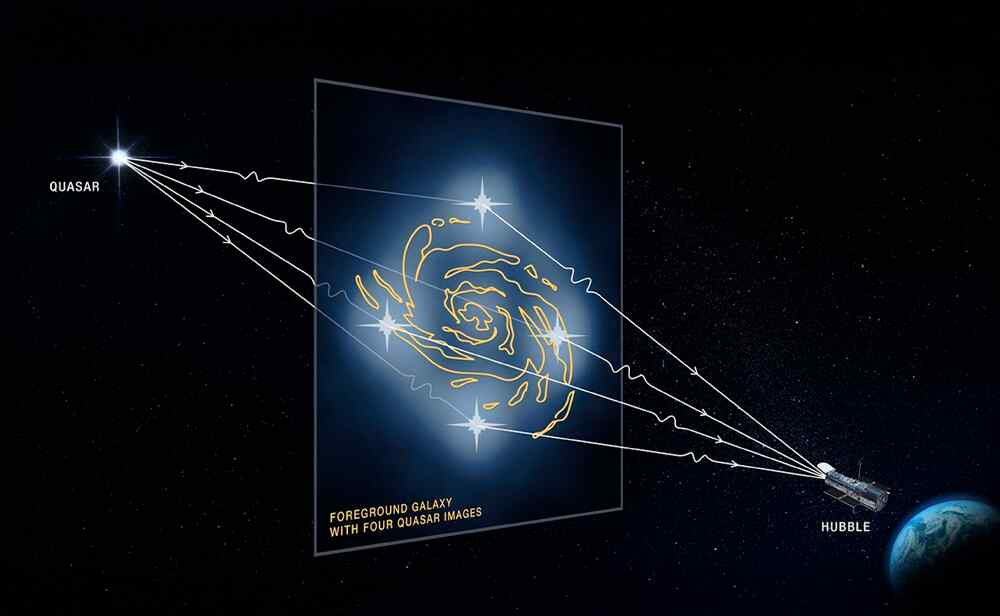
That is what is known as gravitational lensing.
It enables astronomers to study beyond the foreground of a particular galaxy.
This means we can study objects in space that otherwise would remain hidden.
At times, that alignment detected can seem almost perfect.
The alignment can create a world of cosmic shapes. Including rings, arcs, and even a cross shape.
However, it requires astonishing accuracy to study. Hubble has made this possible through its technology.
But even Hubble could not explain these odd four points of light.
That is where the real mystery began for NASA.
Einstein’s cross has revealed stars far older than their galaxy should allow
Einstein taught the world that distortions in space are no accident.
But this Einstein cross was not four individual stars.
It is actually one specific object whose light is being bent and split by gravity. The foreground galaxy is acting like a massive cosmic lens.
Its gravity is bending and magnifying the light behind it.
Which then splits to create the now-famous four-point cross shape in deep space.
This is important for astronomers as it allows them to study the hidden parts of space.
And some of what they found is remarkably old. Far older than the galaxy they are surrounded by.
A hundred-year-old formula that has changed the study of space forever
Most galaxies form over eons through several generations of stars. The oldest stars are exceedingly hard to detect, never mind study.
Yet Hubble’s gravitational lens revealed that some are surprisingly mature. This challenges our established expectations in space.
Einstein’s cross enabled astronomers to look beyond what we thought was possible. It turned a singular galaxy into a telescope.
Without the cross, the light from these stars would remain hidden. Their light would simply be too faint for us to detect.
Some stars are remarkably violent. And could end life altogether for anyone near them.
Thankfully, we have the formulas and theories to study them from afar. Thanks to Einstein.
Read the whole thing?
Get the week's signal, not the noise
Our sharpest reporting on energy, climate and nature — free, once a week.


