
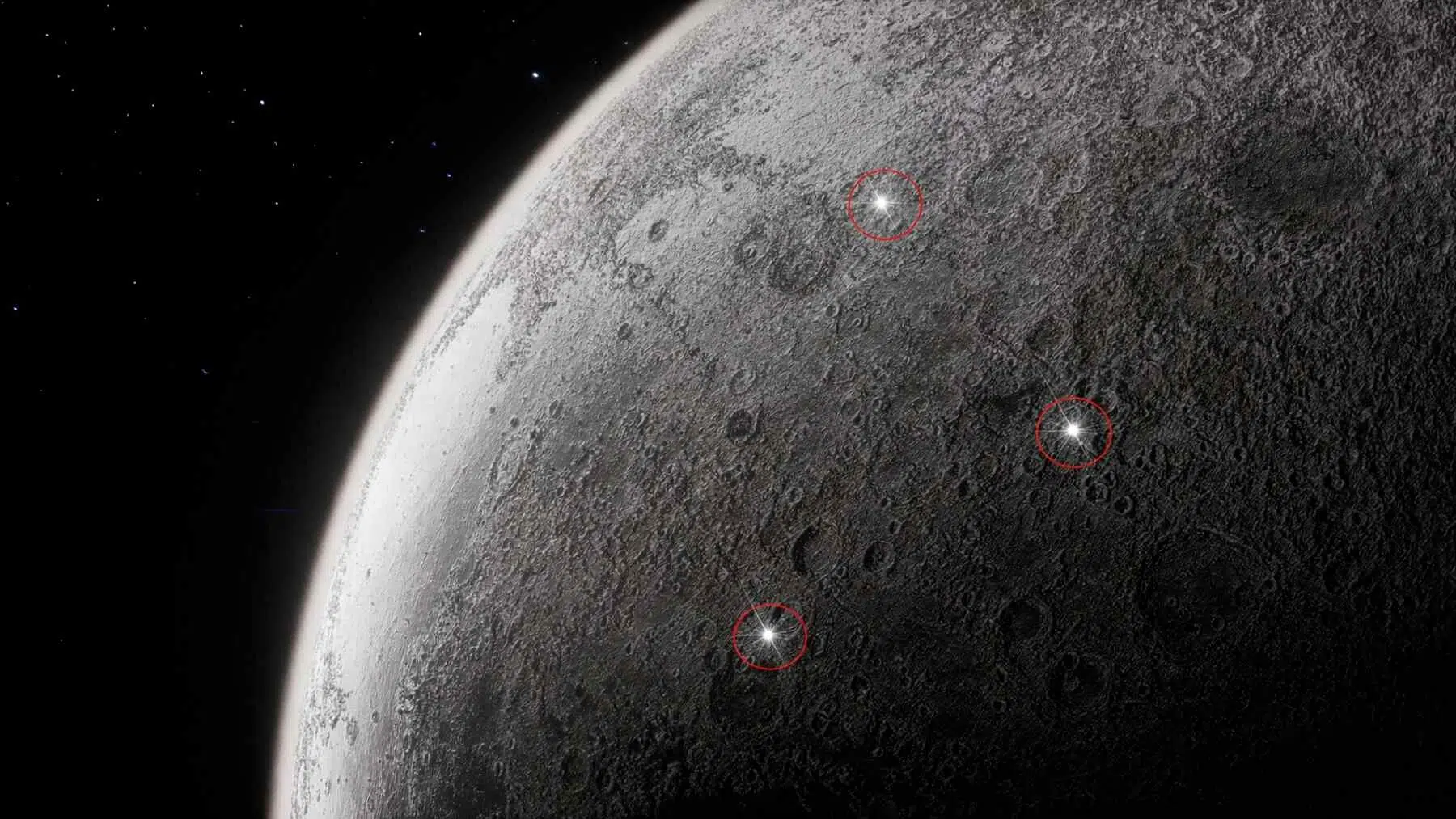
The Artemis II crew saw several brief flashes of light on the Moon’s surface during their mission.
We have now finally returned to the Moon for the first time in 50 years. However, when the crew aboard the Orion capsule passed by the dark side of the Moon, they observed several brief flashes of light on the surface of the cheese-like celestial body.
What caused these sudden flashes of light on the Moon’s surface?
How the Moon has mystified the scientific community for decades
The Artemis II mission has raised a few questions for science to answer.
While the crew reached the furthest point any human has been from Earth, when they passed by the dark side of the Moon, they were in for a shock. We have come to understand that the Moon is as mysterious as it is awe-inspiring.
Astronauts have become accustomed to the unexplained being just “part of the job”.
NASA was contemplating what exactly they might find when the crew passed by the hidden part of the Moon that humanity knows very little about. But seeing brief flashes of light on the surface of the Moon was never really on the cards at all.
Artemis II is the culmination of space study that took place over decades
The Artemis II mission has raised a few questions regarding strange anomalies for NASA to study.
The crew onboard the Orion capsule was subjected to several psychological and stress tests to lay the foundation for longer space travel missions in the near future. Which will benefit from NASA explaining the odd anomaly that the crew spotted while passing by the Moon.
The four-person crew has now become the only humans to gaze upon the dark side of the Moon in real time.
And what they saw has left many down here on Earth in a state of shock and awe as to the role that the Moon plays in protecting Earth. While our technological progress has enabled us to study nearly every corner of our solar system, the Artemis II crew observed something else entirely.
On day 6 of the Artemis II mission, the crew flew by the “side” of the Moon on its path around the celestial structure.
The slingshot effect allowed the astronauts to plot a safe path back to Earth. However, when they contacted home during a solar eclipse from the “dark side” of the Moon, even NASA was left in shock at what they observed.
Flight day 6 came with a few unexpected flashes of light for Artemis II
The Artemis II crew has now travelled farther than any humans in history and has gotten a glimpse of the hidden side of the Moon.
On Flight day 6, the crew passed by the Moon to slingshot around it. For approximately 54 minutes, while in the shadow of the Moon, the crew was subjected to a solar eclipse unlike anything we have seen before.
As the Moon completely blocked out the light from the Sun, the crew was able to spot several “pinpricks” of light on the lunar surface.
These flashes of light are normally invisible to the naked eye due to the Sun’s glare blocking our vision. But the question then became, what caused these momentary flashes of light on the Moon?
Commander Reid Wiseman described the six flashes of light on the Moon’s surface like a camera shutter quickly opening and closing.
The crew and NASA quickly determined that these “pinprick holes” on the lunar surface were actually meteoroid impacts. They even identified the craters left behind by these impacts and proposed names for them.
While some of us are lucky enough to get the occasional cosmic rock visitor in our homes, this development proves that we can track meteoroids with the naked eye, under the right conditions, of course.
Read the whole thing?
Get the week's signal, not the noise
Our sharpest reporting on energy, climate and nature — free, once a week.


