
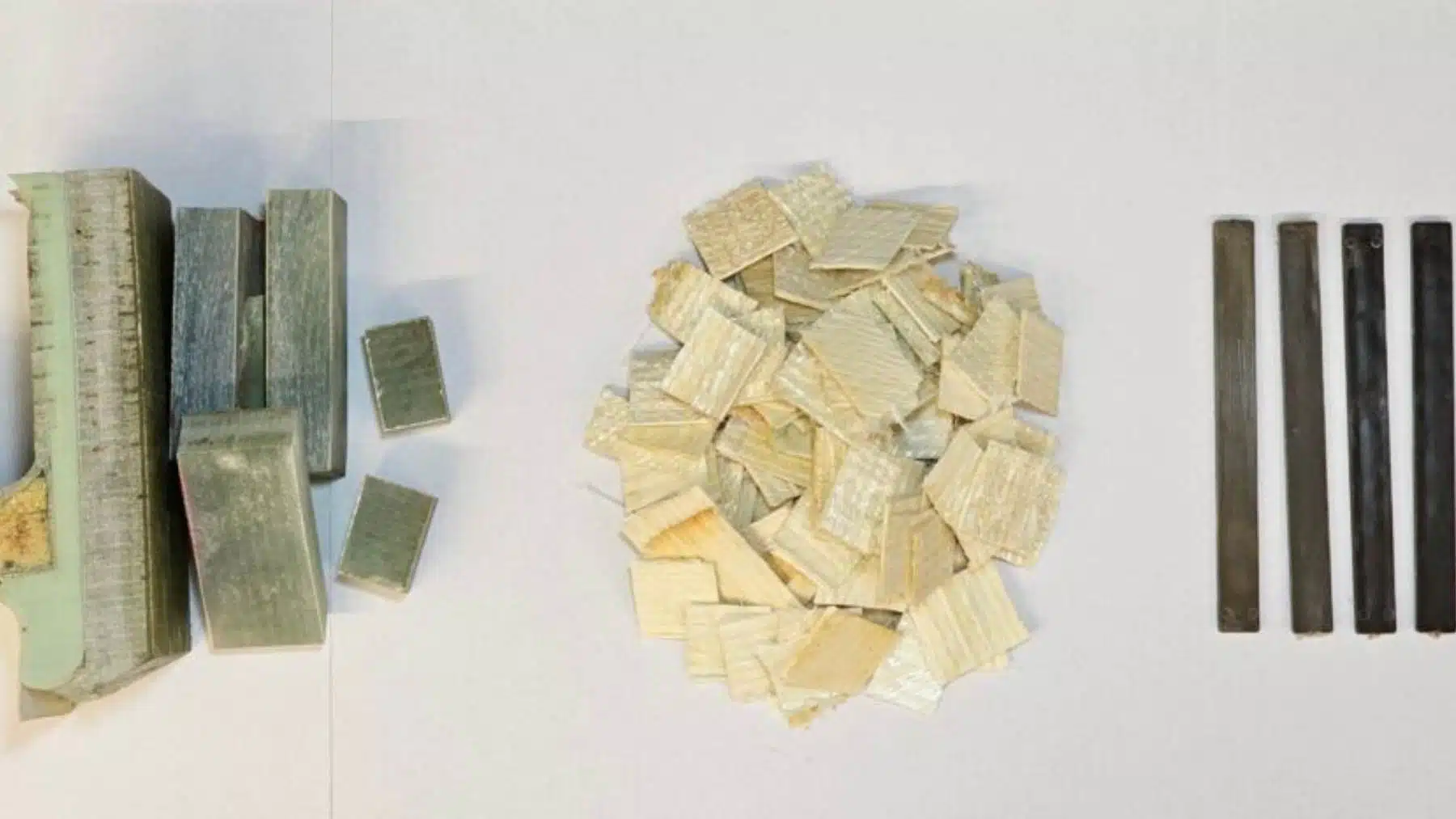
A block of wind turbine blade sits inside a sealed vessel of hot water, no bigger than a deck of cards.
It does not look like much.
It came off a blade built from glass fiber and hardened resin, material designed to survive decades outdoors.
Nothing about that material was ever supposed to come apart again.
Yet inside that vessel, it is unraveling fiber by fiber.
So what is actually pulling it loose?
What breaks a glue that was built to never break
Wind turbine blades are made from glass fiber reinforced polymer, a tough weave of glass strands locked inside a hardened resin. While thermoplastics, the type used in milk bottles, can be melted and reused, glass fiber composites are typically built on thermosets, cured materials that cannot easily be undone and returned to their original parts.
The first generation of modern turbines made from composites is now reaching the end of its lifetime, and the reinforced material makes up about two thirds of a blade’s total weight. The fix researchers at Washington State University landed on did not involve anything exotic. They soaked the blade material in a mild solution of zinc acetate, a salt used in medicines such as throat lozenges and in food additives.
The salt acts as a catalyst that selectively degrades the epoxy matrix, letting the fibers and the decomposed resin be recovered together with no separation step afterward. As co first author Baoming Zhao put it, the network only has to break into pieces small enough to be melt processable before it can be compounded with nylon into a new composite.
That shortcut turned out to be the whole trick.
Seventy percent recycled, and the catalyst comes back too
The number that matters sits in the finished product. The mild solution let the team recover glass fibers and resins in good condition, which they added directly to thermoplastics to produce strong composite materials with up to 70 percent recycled glass fiber material. That is a majority recycled plastic made from material that would otherwise sit buried for decades.
When the recovered material went into nylon, the extra fibers made it more than three times stronger and more than eight times stiffer, and the same recyclate also reinforced other plastics including polypropylene and the resins used in milk jugs and shampoo bottles. Those are ordinary workhorse plastics, not laboratory curiosities.
Even the catalyst gets a second life. Most of the zinc acetate solution can be recovered and reused through simple filtration, which Professor Jinwen Zhang, the corresponding author, has said improves the overall sustainability and cost effectiveness of the method.
Two inch blocks and a two hour soak
Picture the actual bench work. Reporting in the journal Resources, Conservation and Recycling, the team cut the glass fiber reinforced polymer into roughly two inch blocks, then soaked them in a bath of low toxicity organic salt in pressurized, superheated water for about two hours to break the material down. That is the entire mechanical step, with no grinding to powder and no open flame.
Mild is relative here. The paper describes moderate reaction conditions around 482 degrees Fahrenheit, hot and pressurized but far gentler than the furnaces and aggressive solvents that other composite recycling routes rely on. The waste blade material came from a commercial composites supplier and was glass fiber reinforced amine cured epoxy.
Co first author Cheng Hao, a former graduate student in the School of Mechanical and Materials Engineering, said: “It works very well, especially considering the mild conditions that we applied.” He added that the solvent is a green solvent and the temperature is acceptable for the purpose.
Where the shortcut still falls short
Because the method blends fiber and decomposed resin together rather than cleanly separating them, the product is aimed at reinforced thermoplastics and molded parts, not fresh turbine blades. It is a route to secondary products, a real market but a different one.
The work has so far been done at bench scale, on two inch blocks rather than entire blades. The team is still exploring chemical conditions that would cut the pressurization the process needs, and is also aiming at a new class of blades that are easier to recycle from the start. Blades still bonded to steel hardware and balsa cores remain a separate problem.
Other labs have reached for a plant sugar resin to attack the same stubborn bond from a different angle. Others skip chemistry altogether, such as the Iowa operation that grinds retired blades into concrete reinforcement.
What a blade’s second life could look like
None of this erases the scale of the problem. A federal end of service guide puts U.S. blade retirements at 3,000 to 9,000 per year through the second half of this decade, rising to 10,000 to 20,000 blades a year by 2040 as older turbines are repowered.
That gap between a working bench result and a national recycling supply chain is where most good ideas stall. A lab process, however promising, still needs factories willing to build around it.
Still, there is something almost modest about the image at the center of this story, a block of blade the size of a deck of cards giving way in a salt more often found soothing a sore throat. Zhang’s summary of the method is that it is “scalable, cost effective, and environmentally friendly, providing a sustainable solution for reusing large quantities of glass fiber reinforced waste.”
If that soak tank scales the way its inventors hope, the blades coming down off American ridgelines may eventually go back out as something sturdier than landfill fill.
Read the whole thing?
Get the week's signal, not the noise
Our sharpest reporting on energy, climate and nature — free, once a week.


