Somewhere between two wind farms far off the German coast, a shape was sliding just under the surface.
It was not a buoy and it was not a log.
It was white, rigid and longer than a tractor trailer.
The first boats sent after it could not get it out of the water.
By the time a patrol vessel hauled it aboard, it had been adrift for days.
What kind of object floats low and hidden like that, and why is it so hard to deal with?
A hollow blade rides just beneath the waves instead of on top of them
A wind turbine blade looks solid from shore, but inside it is mostly empty space wrapped in a fiberglass shell. Germany’s federal police said this fragment was drifting just below the water surface, which is precisely what made it so difficult to spot. Whether the piece was still trapping air, slowly flooding, or both, has not been explained publicly.
The object measured about 66 feet long and six and a half feet wide, built from glass fiber reinforced plastic. Officers said its size and composition made it a significant risk to shipping. A slab like that can injure a hull or a propeller while barely breaking the surface. That is why the first response was simply to move traffic away from it.
A blade broke free from a wind farm still under construction
The fragment is believed to have come from a turbine at the He Dreiht wind farm, a 960 megawatt project roughly 53 miles northwest of the island of Borkum that was still being built at the time. It was reported drifting in the gap between that unfinished site and Hohe See, a neighboring array already in operation. Both belong to the same utility.
Work boats already stationed at the site tried to recover the blade themselves. That attempt came up short. Only then were the federal police brought in, and the fragment stayed in water used by commercial shipping far longer than anyone wanted, drifting between one array already feeding the grid and one still waiting on its final commissioning steps.
Crews sawed the blade apart over two days at sea and ashore
The police were notified on a Friday in late July, after the on site recovery attempt failed. In coordination with Germany’s Waterways and Shipping Administration, a patrol vessel moved to the reported position to secure the fragment and route passing traffic around it, according to the federal police.
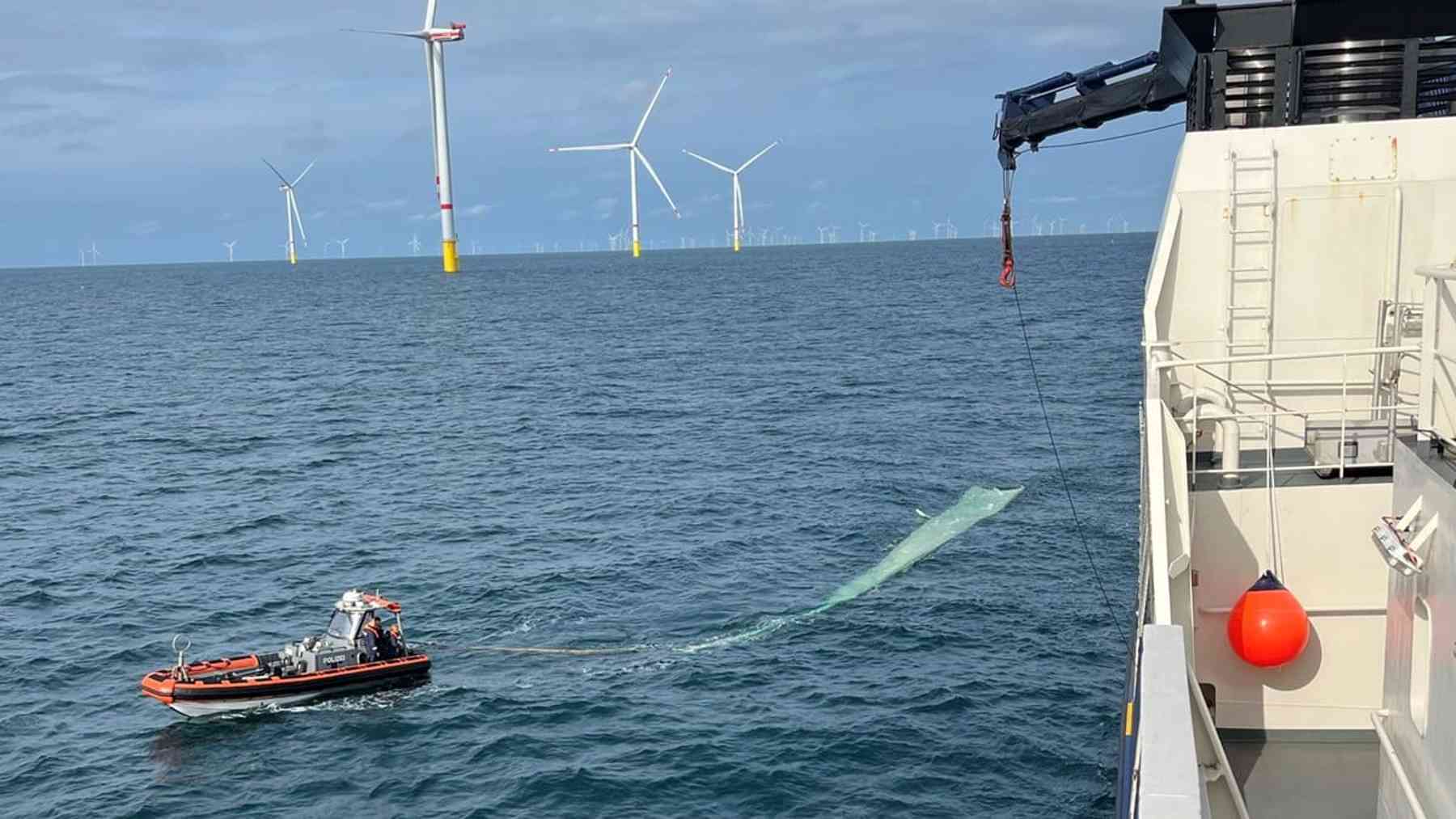
Recovery turned into its own small operation. A control boat towed the blade to the patrol ship, which then dragged it up the stern ramp. The fragment proved too big for the deck, so crews cut it into sections with a saw as it came over the ramp.
The pieces were lifted ashore by crane at the port of Cuxhaven two days later, closing out the recovery. Nothing was left floating at the reported position once the vessel pulled away.
Composite material resisted the usual open water fixes
A wind turbine blade is built from layers of fiberglass and resin bonded around a core, engineered to flex under decades of wind load without cracking. That same toughness becomes a problem once a piece is loose at sea, because it will not crumple, deflate or break apart the way simpler wreckage does.
Composite structures also hold much of their strength after long immersion in salt water. It is one reason recovered turbine blades get load tested to find out exactly what seawater aging costs them. Durability is an asset on a spinning rotor and a nuisance in a shipping lane.
Nobody was hurt in the failure or during the recovery, according to the operator and the turbine manufacturer. The manufacturer opened a root cause investigation into the blade damage, and no cause had been established when the pieces came ashore.
The gap between two wind farms still needs watching after one incident
The recovered sections now sit on land rather than drifting through open water, and the stretch between Hohe See and He Dreiht has gone back to its ordinary traffic. Turbine installation at the newer site was finished within weeks of the incident, with all 64 machines standing and full commissioning planned after further technical and electrical work.
Even so, the episode is a reminder that a wind farm’s risks do not end at the edge of its array. A piece of composite can travel some distance before anyone has eyes on it, and no system yet flags a barely buoyant object the moment it separates from a rotor.
The industry is meanwhile looking for second lives for worn blade sections, including a research blade in Germany studied for wear along its leading edge. Until detection catches up, the water between any two offshore wind farms is worth a second look.
Read the whole thing?
Get the week's signal, not the noise
Our sharpest reporting on energy, climate and nature — free, once a week.