On a July afternoon in 2023, a NOAA buoy anchored off the Florida Keys recorded something that stopped scientists cold: water temperature at 101.1 degrees Fahrenheit, in an ocean that normally sits in the mid 80s. Every reader already knows how this story is supposed to end, with a dead reef and a warning about the future. The truth turned out to be stranger, and the people watching the water were about to learn they had trusted the wrong thing.
The reef that cooked in place
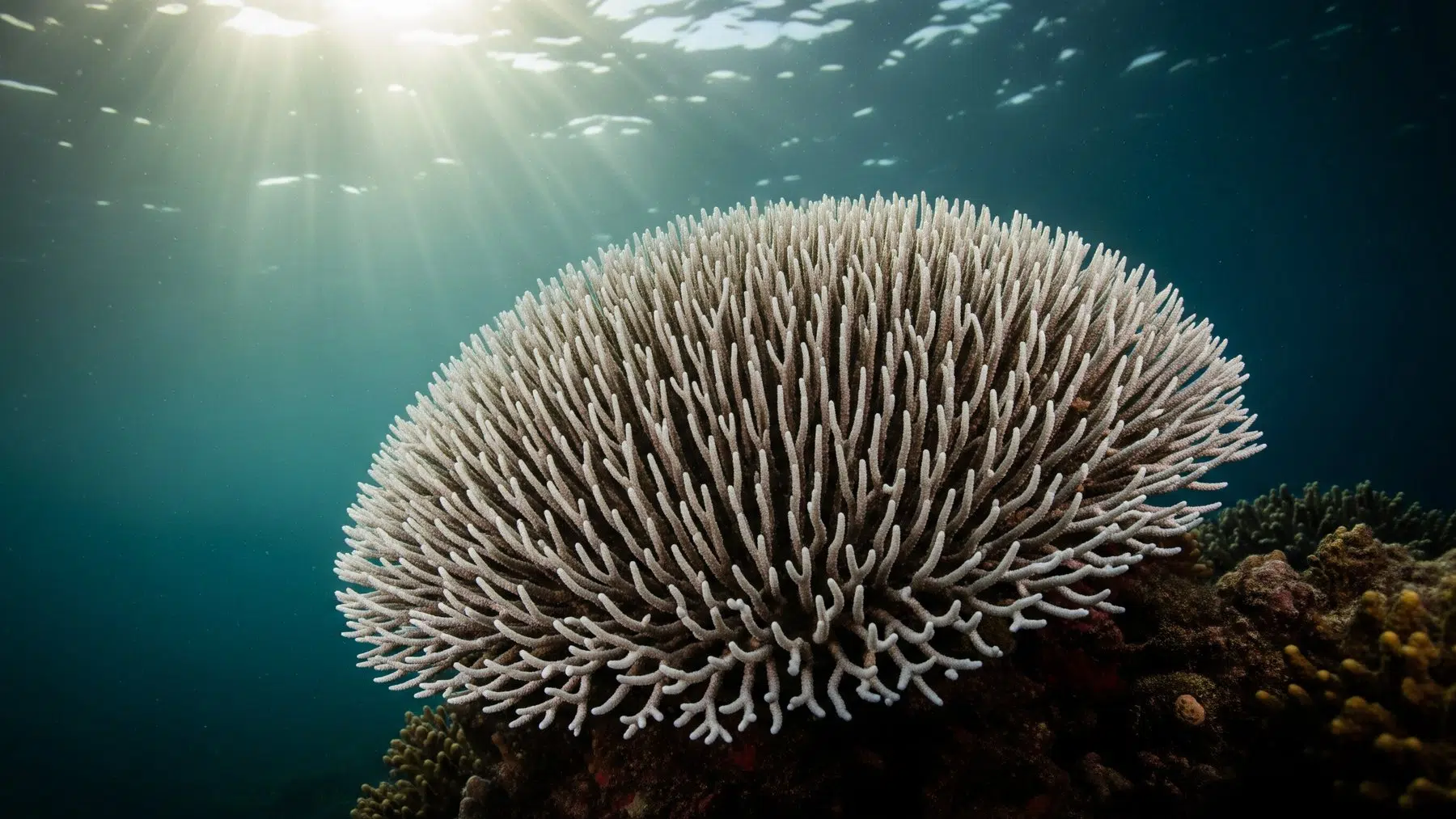
In mid July 2023, the corals of the southern Florida Keys began to bleach, expelling the partners that feed them, in the hottest water ever documented in the region across a satellite record reaching back to 1985.
Sea surface temperatures stayed at or above 87.8 degrees Fahrenheit for an average of 40.7 days along a 350 mile stretch of reef. That is not a brief fever. It is a slow broiling.
Some nursery sites reported total loss, with tissue damage showing the coral had died at once from the heat rather than fading slowly. Two of the region’s oldest and most important species were almost wiped out, colonies that had been building for centuries.
What bleaching actually does to a living animal
Most people picture coral as underwater rock. It is not. Coral is a tiny animal, and inside each polyp lives a microscopic golden alga that feeds it through photosynthesis.
When the water runs too hot for too long, the animal evicts that algal partner. The white you see is not the coral dying on cue. It is the coral stripped of its food source, holding on, with the clock now running against it.
That distinction matters more than it sounds. A bleached coral is not yet a dead coral. It is an animal gambling that the heat will break before its reserves do, and for weeks in 2023 the heat did not break.
When the old warning system broke
What happened in Florida was not a local disaster. It was the opening chapter of something far larger.
NOAA confirmed the fourth global bleaching event, and from early 2023 to mid 2025 bleaching level heat stress reached 84 percent of the world’s reef area, across all three ocean basins that hold coral. A reef off Honduras that held about 46 percent living coral in late 2023 had collapsed to 5 percent within months.
The forecasters ran out of language for it. Their bleaching alert scale had topped out at Level 2, the point of risk to the most sensitive corals. To describe 2023 they had to bolt on three new levels, up to a Level 5 that means most of a reef may die. The scale they had trusted no longer fit the ocean in front of them.
The corals that refused to die
Then the heat finally eased, and the scientists went back to count the dead. What they found rewrote their own expectations.
A program that had tracked the fate of more than 4,200 brain and boulder coral colonies across nine Florida reefs returned once the water cooled. Almost every reef had bleached to bone white. Yet at seven of the nine sites, only zero to two percent of those tracked colonies had actually died, researchers found. Most of the corals that looked like corpses had refilled with colour and lived.
The delicate branching species were lost, but the sturdy boulder and brain corals held on, and some carried heat tolerant algal partners that let them ride out water that should have killed them. The reef had not simply died. It had sorted itself into the survivors and the lost.
What the survivors are teaching us
That changes the question scientists are asking. Instead of only mourning what bleached, they are now hunting the survivors, mapping where each one sat, what genotype it carried, and why the heat passed it over.
During the worst of it, teams raced to gene bank the last elkhorn and staghorn individuals, storing fragments in tanks on land as a living ark. Others are moving nursery corals to deeper, cooler water and breeding from the colonies that proved they could take the heat.
The stakes reach far past the dive sites. For coastal communities from Louisiana to the Caribbean, near annual bleaching now threatens the livelihoods of nearly a billion people who lean on reefs, and with El Niño conditions building again NOAA already flags high risk for Hawaii, Florida and the Caribbean.
The white reef was real, and so is the grief. But it was never the whole story. Some corals, it turns out, know things about surviving heat that scientists are only beginning to learn.
Read the whole thing?
Get the week's signal, not the noise
Our sharpest reporting on energy, climate and nature — free, once a week.