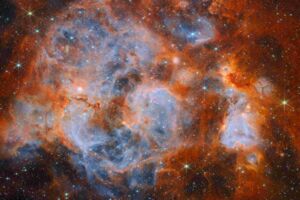
161,000 light-years from Earth, inside a small galaxy orbiting our own, the James Webb Space Telescope has captured something that looks almost nothing like the star-forming regions we know. Released on October 22, 2026, Webb’s new image of N159 reveals a churning, dense cauldron of gas and newborn stars — a cosmic environment so different from our galactic neighborhood that astronomers are treating it as a rare window into a much earlier universe.
N159 sits inside the Large Magellanic Cloud, one of the Milky Way’s closest companion galaxies. What makes it unusual runs deeper than its distance.
A stellar nursery unlike our own
N159 is not a quiet place. It’s a dense, turbulent region of active star formation packed with gas clumps still collapsing into new stars. Located 161,000 light-years away in the Large Magellanic Cloud (LMC), it’s close enough on cosmic scales to study in real detail — yet it looks almost alien compared to the star-forming regions astronomers know best inside the Milky Way.
The LMC is one of our galaxy’s satellite companions, which makes N159 a relatively accessible target. Webb’s infrared sensitivity is what unlocks it. By seeing through the thick curtains of gas and dust that block visible light, Webb can reveal structures that previous telescopes — including Hubble — simply couldn’t detect. The October 22, 2026 image shows dense gas clumps in extraordinary clarity, exposing the raw machinery of star birth.
Why low metallicity matters
Here’s the detail that turns N159 from a beautiful image into a scientific tool: its metallicity is significantly lower than that of star-forming regions in the Milky Way.
Metallicity measures the proportion of elements heavier than hydrogen and helium in a given region of space. In the early universe, shortly after the Big Bang, almost none of those heavier elements existed yet. Stars had barely begun the nuclear fusion processes that forge carbon, oxygen, iron, and everything else. Low-metallicity environments like N159 closely mirror those ancient conditions — which is exactly what makes them so useful.
That makes N159 a proxy for how the very first stars may have formed billions of years ago, without needing to peer across impossible distances to find a genuinely ancient galaxy.
Reading the chaos: what the image reveals
Webb’s image of N159 shows a complex, tangled network of dense gas clumps — the raw material from which stars are born, pockets of matter dense enough to collapse under their own gravity and ignite nuclear fusion.
The turbulent structure isn’t random. Stellar winds and radiation pressure from young massive stars already burning at the region’s core sculpt the surrounding gas, compressing some clumps while dispersing others. Astronomers can now study those mechanics in a low-metallicity setting, something that wasn’t achievable with previous space telescopes. The level of detail Webb provides here is genuinely new. Hubble could see N159, but not like this.
A time machine at the edge of the Milky Way
Because the LMC’s chemical composition resembles that of ancient, early-universe galaxies, N159 effectively functions as a local analog for conditions that no longer exist in our own galactic neighborhood. That proximity is enormously valuable.
Genuinely distant early-universe galaxies appear tiny and faint, even to Webb, and studying their internal structure in detail remains difficult. N159 offers something rare: primitive chemistry close enough to examine up close. Webb’s infrared capabilities make it uniquely suited to this work — dusty, embedded star-forming regions like N159 are largely opaque to visible light, but infrared passes through. The findings here could eventually reshape models of how Population III stars ignited and shaped the young universe around them.
What astronomers hope to learn next
The October 2026 image is a starting point, not a conclusion. Researchers plan to use this and future Webb observations to map the distribution and density of gas clumps across N159, building a more complete picture of how star clusters actually emerge from that raw material. Refining those timelines could have broad implications for our understanding of early cosmic star formation — when it began, how fast it proceeded, what conditions drove it.
The image carries credits from ESA/Webb, NASA, and CSA teams, a reminder that this science is the product of sustained international collaboration. N159 is expected to remain a priority target for Webb as that work continues. Each new observation adds another data point to a picture still coming into focus — one that may ultimately tell us how the universe lit up its very first stars.
Read the whole thing?
Get the week's signal, not the noise
Our sharpest reporting on energy, climate and nature — free, once a week.