Look down at the sidewalk under your feet and you are staring at one of the most important materials in human history.
Concrete built the Roman aqueducts, the Hoover Dam, the highways stitching this country together.
And it always cracks.
That is not a flaw someone forgot to fix.
It is baked in, a limit written into the material itself, and it has been waiting for a solution for centuries.
The invisible weakness hiding inside every building you have ever entered
Concrete is the second most used substance on Earth, bested only by water.
That sounds like strength.
But the material has a fatal flaw built into its chemistry.
Concrete has a low tensile strength, ranging from only 7 to 12 percent of its compressive strength.
It can handle enormous weight pressing down on it, but pull it sideways or bend it, and it gives up fast.
Cement and concrete are inherently brittle.
They do not deform much before snapping, which makes them vulnerable under impact, seismic activity, or long-term stress.
Every bridge, every skyscraper, every basement wall is carrying that same vulnerability right now.
Why a crack in your driveway is really a physics disaster in slow motion
When a crack starts in plain concrete, nothing slows it down.
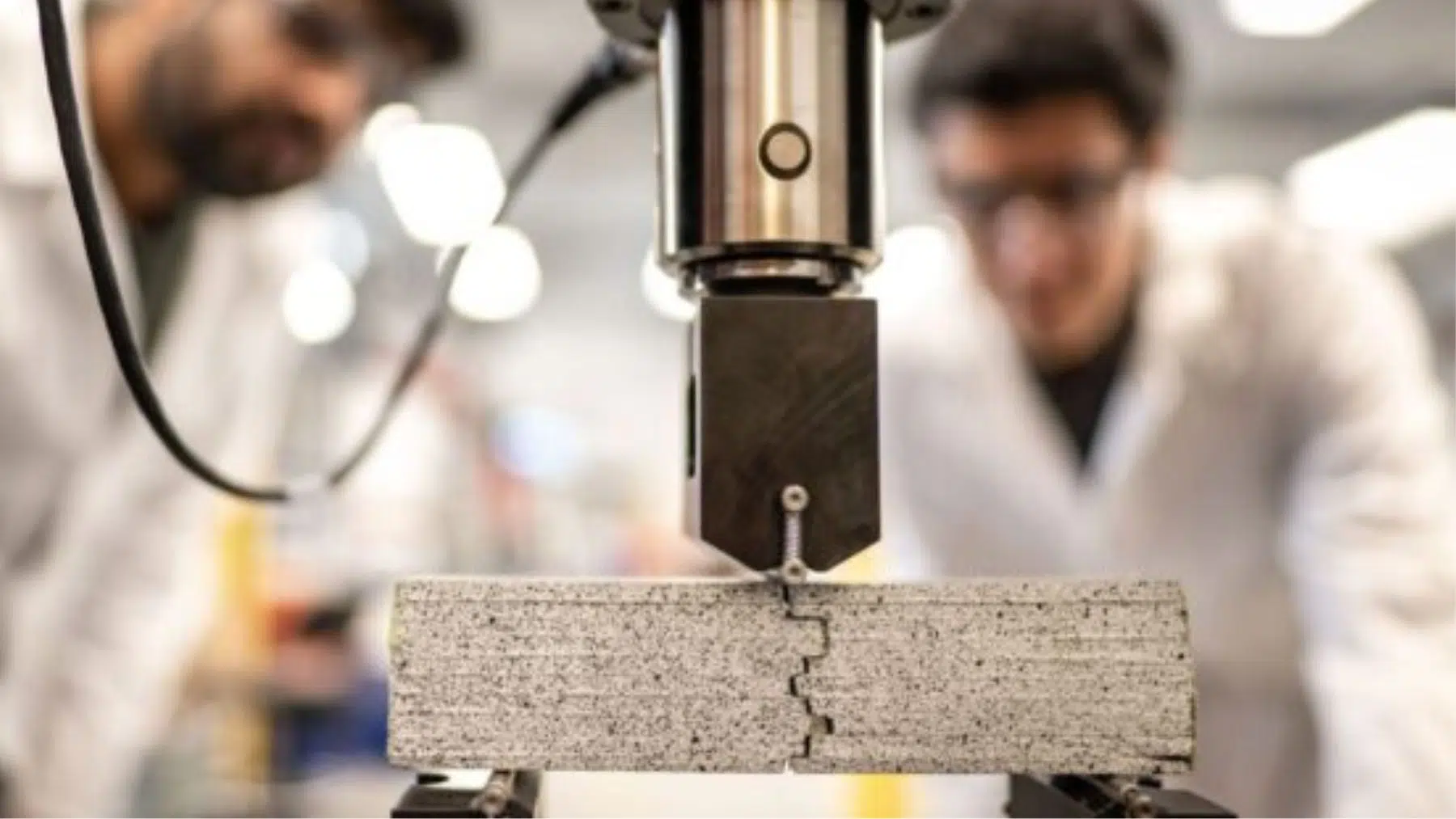
Standard cement beams fail suddenly, with one large fracture splitting the material.
The fracture does not negotiate. It does not take detours.
It simply drives straight through.
Concrete’s porous nature lets water, salts, and sulfates work their way inside, changing its composition and shrinking its tensile strength until tiny cracks form beneath the surface.
Small cracks become large, visible cracks, and the concrete eventually fails.
Engineers have tried adding steel, fibers, and special chemistry to fight this for decades.
Most attempts yield only modest gains.
The problem, it turns out, was that everyone was looking at the wrong model.
A creature that solved this problem before the first dinosaur ever walked the earth
Walk along a beach and you might step right past the answer.
Nacre, the iridescent material in seashells, uses hierarchical structures to achieve high strength and toughness from relatively weak constituents.
Mother of pearl. The shimmering lining inside an oyster or an abalone shell.
Despite being made of brittle calcium carbonate, the abalone shell is roughly 3,000 times more fracture resistant than a single crystal of calcium carbonate, the mineral that makes up most of its bulk , because of its layered, brick-and-mortar nanostructure.
The shell is not strong because of what it is made of.
It is strong because of how it is arranged.
Under loading, the brick-like layers slide relative to each other, spreading inelastic deformation across the material and multiplying toughness by orders of magnitude.
When a crack tries to move through nacre, the layers make it work for every millimeter, zigzagging and losing energy until it simply gives up.
The 17-times breakthrough that copies a seashell inside a block of cement
Engineers at Princeton University, drawing inspiration from the materials found in oyster and abalone shells, have developed a new cement composite.
This material is 17 times more resistant to cracking and 19 times more flexible without breaking compared to plain cement paste, the constituent material the composite is built from.
They did it without replacing concrete’s core ingredients.
The hard phase was Portland cement paste and the soft phase was a highly stretchable polymer called polyvinyl siloxane, placed in thin layers rather than mixed throughout.
The most significant results were observed in the beams with completely separated hexagonal tablets, which are similar to nacre. One design also featured hexagonal grooves cut into the cement paste.
The Princeton study, published in Advanced Functional Materials, showed that the structure alone makes the difference, with Portland cement itself remaining largely unchanged.
Just as the shell has done for 450 million years, the new cement forces a crack to take the long way around, bleeding off its energy at every turn.
What this means the next time you see a crack forming in the sidewalk
The researchers noted that the findings are based on lab conditions and that additional work is needed to develop the techniques for real-world use.
The beams tested were small, only centimeters in size, and scaling up will raise new questions about cost and weather resistance.
With more research, these nacre-like composites could be adapted for earthquake-resistant buildings or impact-resistant infrastructure.
The 3,000-times toughness advantage that nacre holds over pure calcium carbonate is a principle independently reported in the Princeton press release on EurekAlert and confirmed by researchers at Lawrence Berkeley National Laboratory, and it is precisely the principle the Princeton team translated into cement architecture.
Researchers also note that Pompeii’s ancient builders stumbled onto durable construction materials two millennia ago, a reminder that nature has always had something to teach engineers willing to look.
That driveway crack will still happen for now.
But somewhere in a lab, a seashell is showing concrete how to grow up.
The ocean figured out the answer long before we poured our first foundation, and it left the blueprint sitting on the beach the whole time.
Read the whole thing?
Get the week's signal, not the noise
Our sharpest reporting on energy, climate and nature — free, once a week.