
A yellow school bus idles at a crowded auction lot.
Its odometer is already deep into six figures.
Nobody here plans to scrap it.
A buyer from Guatemala peels off a stack of bills thinner than the price of a used sedan.
Days later, that same bus is rolling south through Mexico, bound for a new name painted across a hood built for American school routes.
So why pull a bus like this while its engine still has years of work in it?
Why these buses get pulled while the engine is still strong
American school buses mostly leave service on a schedule, not on a breakdown. Districts plan around age and mileage thresholds, often around a decade of service or roughly 150,000 miles. Common fleet guidance puts a school bus’s working life closer to 12 to 15 years and 150,000 to 250,000 miles, which means a bus leaving at the low end of that band still has real service left.
That gap exists because replacement is tied as much to funding rules as to engine wear. State purchase programs typically release money only after a bus crosses a set line: under Maine’s school bus purchase program, a conventional Type C bus must have at least ten years of useful life and 125,000 accumulated miles before a district can apply to replace it, while the larger transit-style Type D buses must reach fourteen years and 245,000 miles.
It helps that a school bus is built like a delivery truck wearing a disguise. The same heavy truck frame and diesel engine meant to survive years of stop-and-go routes leaves a retired bus with plenty of hauling still in it, long after a US district has moved on to a newer model.
That distance between a bus’s paperwork age and its mechanical age is the whole business. It is exactly what a buyer flying in from Central America is paying for at auction.
Picture the drive itself, a thousand miles before the paint job
Buyers travel to auction lots scattered across the United States, inspect rows of near-identical yellow buses, and then drive the ones they win south themselves. The route runs the length of Mexico before the bus ever carries a paying passenger.
The bus crosses the border, threads traffic through cities it was never designed for, and climbs toward the Guatemalan highlands on switchbacks far steeper than anything in its old district. The brakes and the heavy frame earn their keep here.
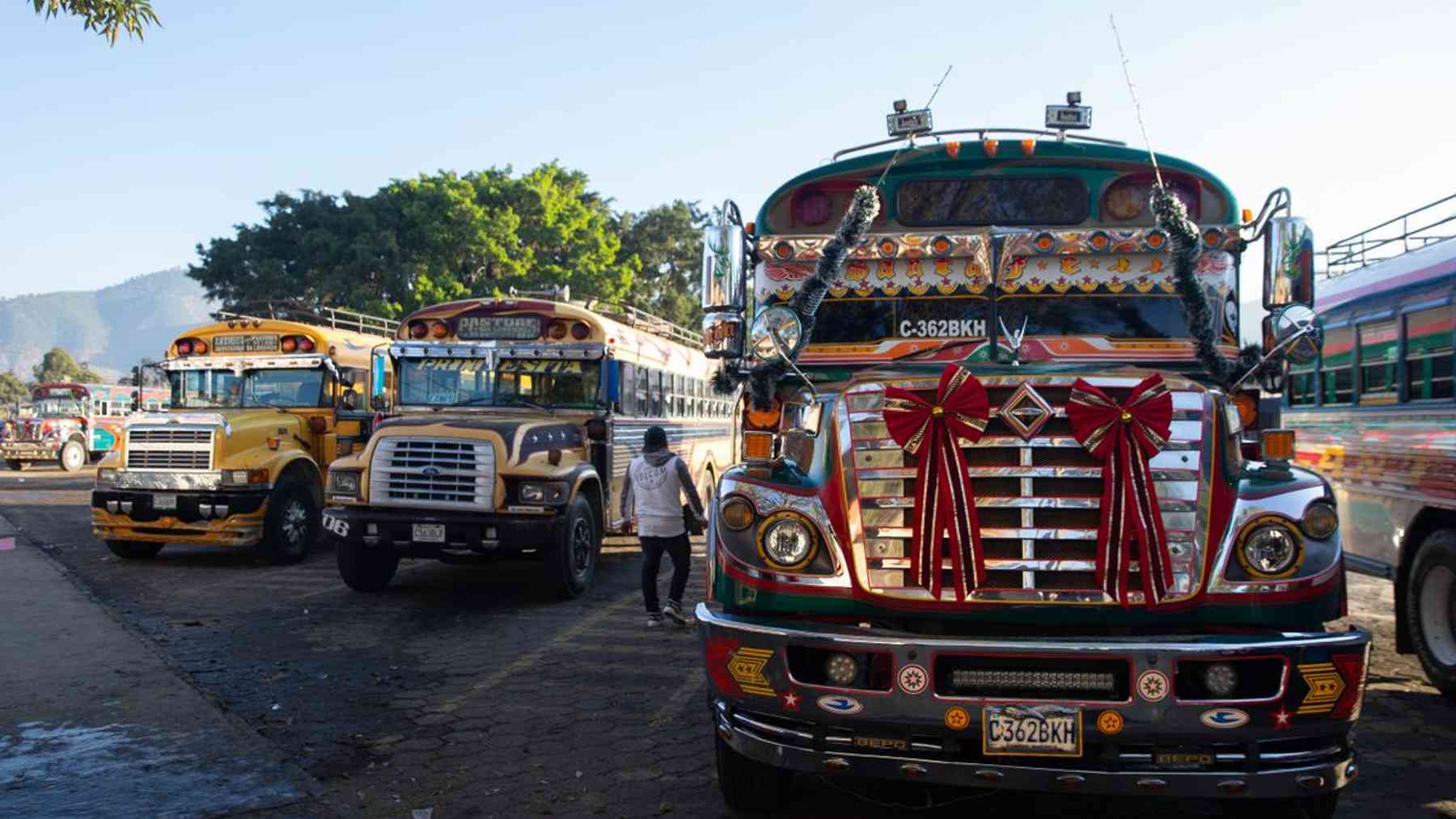
Then come the workshop towns. In places such as Ciudad Vieja and San Miguel Dueñas, shops strip the school colors, fit a more powerful truck engine for the climbs, and add chrome, lights and a roof rack. A new name is lettered across the windshield, and the bus is assigned a route.
What the numbers and the people who drive them actually show
Reporting from Antigua for Atlas Obscura sets out the history these vehicles share: each started life as a school bus in the United States, each reached 10 years or 150,000 miles of service, and each was then auctioned off for less than $2,000 and driven south for a new life. Thousands of them now move through Guatemalan cities and countryside, where they are the region’s main form of public transport, hauling passengers rather than children in a second career.
The same reporting describes what that looks like from the driver’s seat. One owner, Elsimiro Gomez Sosa, bought his bus with his family and painted it himself in a design he calls “Power Ranger,” though more than a quarter of his earnings goes to gangs controlling the area.
Another driver, Carlos Santos, works buses still in plain school bus yellow, which he says costs him riders, because brighter buses draw more passengers. “It’s a way of calling people’s attention,” he says. None of the paperwork that ended these buses’ first careers matters much once a second country decides what they are worth.
The complications that come with a thousand mile second act
Not every mile goes smoothly. Mountain grades, packed loads and roof racks stacked with produce put far more strain on these vehicles than an American school route ever did, and workshop conversion is a substantial job before a bus carries a single fare.
Moving oversized vehicles long distances carries its own hazards on either side of the border, as one oversized load showed when it met a structure it could not clear. A bus that clears customs and crosses a mountain pass still has to hold together afterward, with its original brakes and frame doing work no district route demanded of them.
Why a discarded vehicle’s second life is worth watching
A machine engineered for one narrow job, hauling children a few miles on local pavement, keeps finding an entirely different use once it leaves the country that built it. That pattern is not unique to school buses.
Newer, software-driven vehicles make the same point from the other end. A fleet of driverless cars recalled over a software flaw needed a fix before it could keep working, a reminder that a vehicle’s service life rarely tracks the plan its designers drew.
What is still open is how long the supply lasts, since replacement thresholds vary widely by state and some sit far above 150,000 miles. For now, a bus retired from a quiet American route can still be climbing a Guatemalan mountain years later, loaded with passengers, chrome, and a name nobody back home would recognize.
Read the whole thing?
Get the week's signal, not the noise
Our sharpest reporting on energy, climate and nature — free, once a week.


