
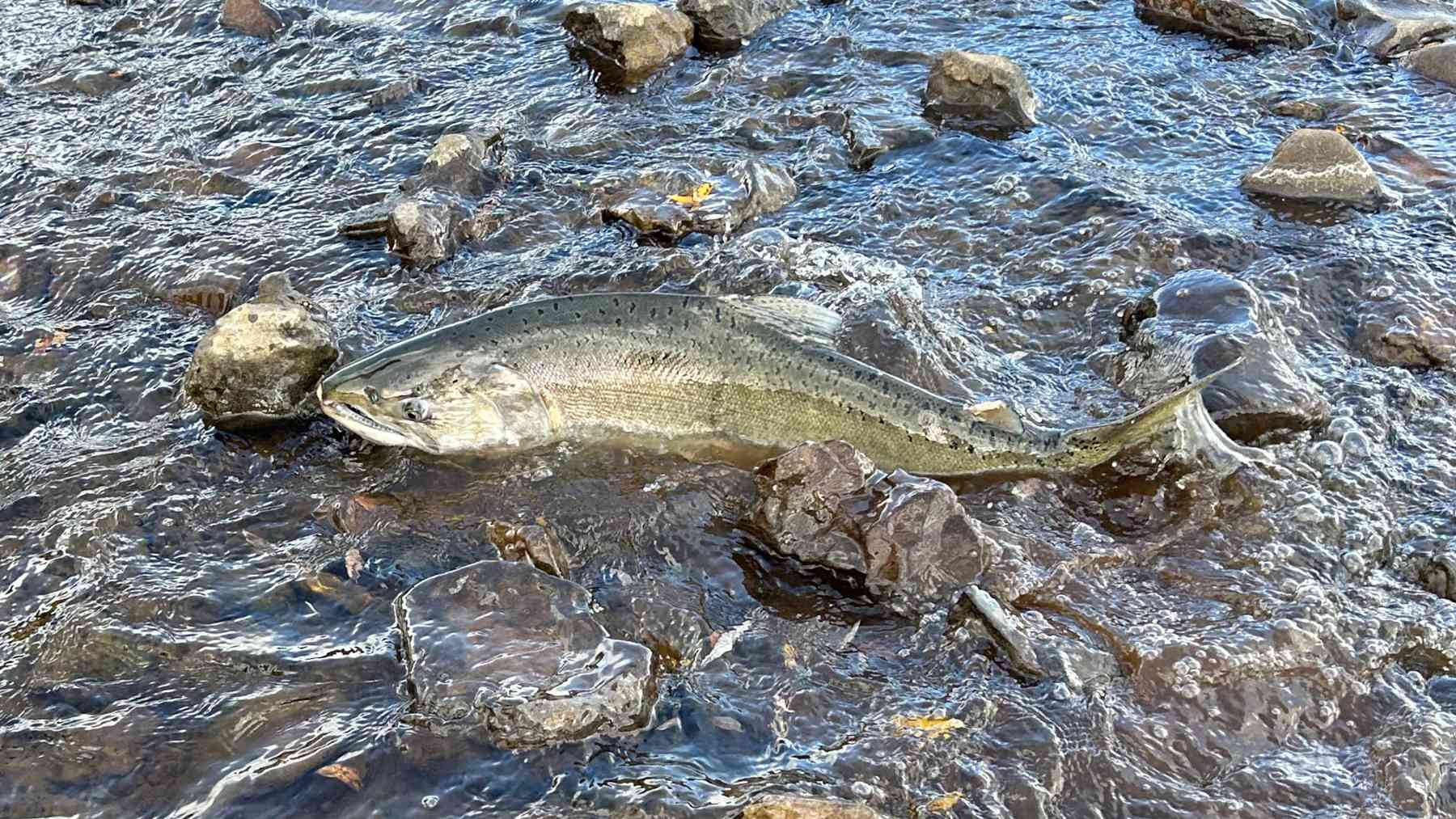
The concrete was gone, and the river was moving again.
Four dams had blocked the Klamath River in California and Oregon for nearly a century.
When the last one came down, scientists set up sonar to watch what happened next.
Nobody knew how fast the salmon would find the opening.
The answer came back in a single autumn.
And that was only year one.
What the sonar actually picked up
Stationary multibeam imaging sonar sat fixed in the current near the former Iron Gate Dam site, counting fish as they pushed upstream with no netting, no tagging. The equipment logged an estimated 7,742 Chinook salmon migrating upstream in the first season and 13,310 in the second, representing 18 to 19 percent of the fish returning to the Klamath River basin. Those reaches had been reservoir bottoms less than a year before the first fish arrived.
Within those two seasons, Chinook salmon recolonized 88 percent of their documented historical distribution, expanding into approximately 214 miles of reconnected habitat and reaching elevations of up to about 4,100 feet. Getting there required fish to move through dam removal sites, complex hydraulic corridors and engineered fishways.
The speed surprised the people who built the monitoring program. Damon Goodman, who led the work for California Trout, said “the rivers seem to come alive almost instantly after dam removal,” and that fish came back in greater numbers than expected.
How far upstream the fish actually went
Fish reached as far as Beatty Gap on the Sprague River, more than 360 river miles from the ocean at an elevation of 4,101 feet. To get there, they crossed the full span of Upper Klamath Lake and climbed ladders at the Keno and Link River dams, which still stand upstream.
The sharpest single season gain came at Keno Dam. No fall run Chinook were confirmed passing that structure in the first season. In the second, counts recorded 2,497 moving through, along with 210 fish passing Link River Dam into Upper Klamath Lake.
From zero to nearly 2,500 in twelve months is the kind of number that makes a monitoring network worth building.
The monitoring program behind the numbers
The counting was not done by one outfit. The work was led by California Trout alongside the Karuk Tribe, the Klamath Tribes, the Yurok Tribe, the Oregon Department of Fish and Wildlife, the California Department of Fish and Wildlife, NOAA, the US Geological Survey, Cal Poly Humboldt and independent researchers. It is the first published quantitative assessment of how salmon responded to the removal of the J.C. Boyle, Copco 1, Copco 2 and Iron Gate dams, and the results appeared in Scientific Reports in August 2026.
Sonar units, underwater video cameras and in person surveys were placed at multiple points along the river. Monitoring that began years before removal has since documented advances in water quality and temperature as well as fish returns. The reservoirs had been warm, shallow and prone to algae blooms; the free flowing channel behaves differently.
Salmon were not the only animals noticed. Scientists reported bald eagles flying overhead and increased bear, beaver, otter and osprey activity. Each returning salmon carries ocean nutrients into the watershed, and birds and mammals read that signal quickly.
The complications nobody is hiding
Dam removal reconnected cold tributaries where fish can survive, but low snowpack, drought and higher river temperatures hit the river hard. A river opened to fish is not automatically a river flush with water, and Goodman put it plainly: “Removing the dams did not remove climate risk.”
A parasite outbreak followed. Ceratonova shasta spread through juvenile Chinook in the upper river, and the majority of infected fish were hatchery salmon from the Fall Creek Fish Hatchery. State monitoring indicated most wild juveniles had already moved downstream ahead of the elevated parasite levels.
Much as glyphosate shows how effects ripple through living systems, this research captures only the earliest stages of recovery. Chinook spend years at sea before returning, so the first generation hatched in the reopened river has not come home yet.
What 88 percent actually means for a river
A fish kill in 2002, driven by low flows, warm water and disease in crowded pools, killed roughly 34,000 adult Chinook in the largest recorded salmon die off in the western United States. Against that starting point, 88 percent recolonization in two seasons is not a small number.
Researchers also detected coho salmon, steelhead and Pacific lamprey using the newly reopened habitat. The whitefish crisis in the Great Lakes shows how quickly a food web can unravel when a keystone fish disappears. The Klamath is now running the experiment in the other direction, with four migratory species using the reconnected water in their own way.
Whether restored connectivity produces a self sustaining population will take years of counting to answer. The sonar stays in the water, the cameras keep recording, and the next generation of Klamath Chinook will be the first to grow up in a river without those four dams. That generation has not been counted yet, but the river is already full of their parents.
Read the whole thing?
Get the week's signal, not the noise
Our sharpest reporting on energy, climate and nature — free, once a week.


