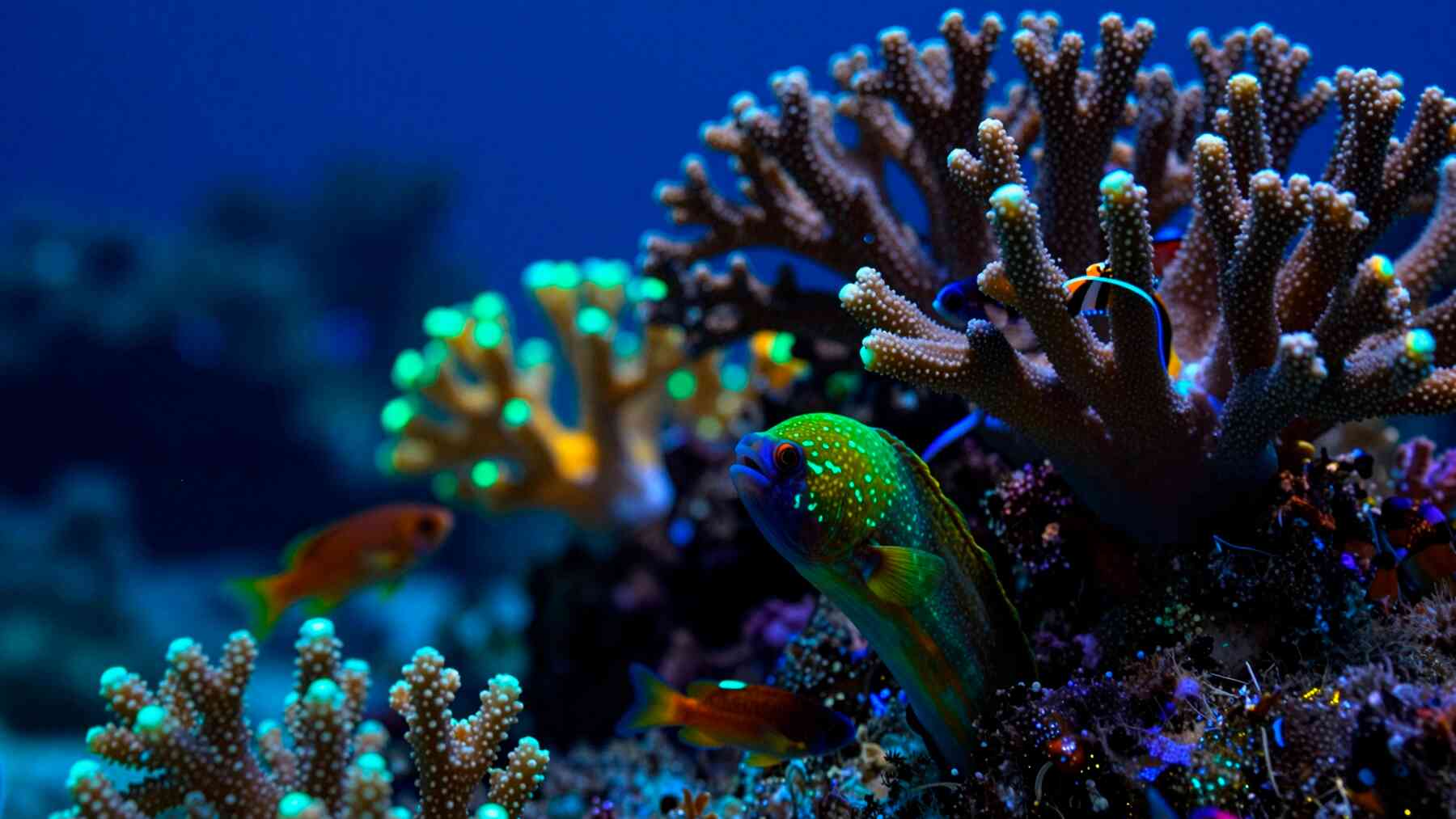
Beneath the surface of a coral reef, hundreds of fish are glowing — absorbing blue light and re-emitting it in greens, yellows, oranges, and reds that human eyes, unaided, simply cannot see. It’s a silent, vivid light show that has been playing out in the ocean for far longer, and in far more colors, than scientists ever suspected.
Two new studies from the American Museum of Natural History are now rewriting the story of this phenomenon — tracing its origins, mapping its spread across hundreds of species, and revealing a spectrum of fluorescent colors that no one had fully documented before.
A phenomenon older than the dinosaurs’ extinction
Fish biofluorescence is not a recent evolutionary development. According to the Nature Communications study, the trait dates back at least 112 million years, with eels representing the earliest known instance. To put that in perspective, this glow predates the mass extinction that wiped out non-avian dinosaurs by roughly 46 million years.
What makes the finding particularly significant is how many times the trait emerged independently. Biofluorescence evolved on its own more than 100 times across marine teleosts — the bony fish that make up the largest group of vertebrates on Earth today.
Lead researcher Emily Carr, a Ph.D. student at the American Museum of Natural History, laid out the core motivation plainly: understanding the evolutionary history of the trait is essential to understanding why and how fish actually use it — whether for camouflage, predation, or reproduction. The two complementary studies, published in Nature Communications and PLOS One, were designed to answer exactly that kind of foundational question.
How coral reefs became the engine of fluorescent evolution
The data points to coral reefs as the single biggest driver of fluorescent diversity. Fish species associated with reefs evolve biofluorescence at roughly 10 times the rate of non-reef species — a gap too wide to be coincidental.
The timeline adds another dimension. Following the Cretaceous-Paleogene (K-Pg) extinction 66 million years ago, modern coral-dominated reefs began expanding rapidly. Fish colonized those reefs in large numbers, and Carr notes that this period coincides directly with a spike in fluorescent species — suggesting the reef environment itself may have encouraged the trait to spread and diversify.
The K-Pg event also caused significant coral diversity loss. The rebuilding that followed, and the fish that moved in alongside it, appears to have created favorable conditions for fluorescence to take hold more broadly. Of the 459 biofluorescent teleost species identified in the study, the majority are coral reef-associated.
More colors than science had ever seen
The PLOS One study approached the question differently — not through evolutionary trees, but through light itself. Carr and colleagues used ultraviolet and blue excitation lights paired with emission filters to analyze museum specimens collected during expeditions to the Solomon Islands, Greenland, and Thailand. These fish had been previously observed fluorescing, but the full range of their emissions had never been systematically measured.
The results were notable. Some fish families show at least six distinct fluorescent emission peaks, spanning green, yellow, orange, and red wavelengths — far more color diversity than earlier research had captured. Forty-eight species were newly identified as fluorescent, bringing the confirmed total to 459.
Museum Curator John Sparks, Carr’s advisor and a co-author on both studies, described the variation as evidence of “incredibly diverse and elaborate signaling systems” based on species-specific emission patterns. Each species, in other words, may be broadcasting on its own distinct channel.
What all this glowing might actually be for
Despite the scope of these findings, the function of biofluorescence in fish remains an open question. The leading hypotheses — camouflage, predation, and reproductive signaling — have not been conclusively confirmed for most species.
The species-specific emission patterns do suggest something purposeful. If each species glows on a slightly different wavelength, fluorescence could serve as a private communication channel — one invisible to most predators that typically lack the visual sensitivity to detect it. Sparks noted that the team would like to better understand fluorescence as a mechanism, not just as a trait to catalogue.
There is also a practical dimension worth noting. The wide variety of fluorescent molecules identified in these studies could point toward novel compounds with real-world applications. Fluorescent molecules are already used in biomedical contexts, including fluorescence-guided disease diagnosis and therapy, and new ones discovered in reef fish could expand that toolkit considerably.
As coral reefs face mounting pressure from climate change and ocean warming, research like this carries additional weight. Understanding what reefs have made possible — including over 100 million years of species-specific light — may ultimately strengthen the case for protecting them.
Read the whole thing?
Get the week's signal, not the noise
Our sharpest reporting on energy, climate and nature — free, once a week.