The call came in around four in the morning, radios crackling over the Bering Sea.
Nine crewmen stood crowded on an open deck.
Below them, their boat was taking on water.
Winds were running near 50 knots, the seas about 10 feet.
Behind the boat rose a wall of dark cliffs holding the largest colony of murres in Alaska.
The wreck would still be sitting there when the birds came back.
A steering failure in a gale left the boat with nowhere to go
The Arctic Sea was a 134 foot crab boat working north of St. George Island when it ran into trouble in a winter storm. Federal investigators say the vessel lost steering, flooded and then grounded along the island’s northern shoreline early on January 5. In 50 knot winds and 10 foot seas, there was no fighting the push toward the rocks, and the cause remains under investigation.
What makes a grounding like this different from most is the terrain it lands on. St. George rises almost straight out of the sea in bluffs, so there is no gentle beach to cushion an impact.
Those same cliffs hold the largest murre colony in the state. A Coast Guard helicopter crew reached the vessel late that morning and hoisted all nine fishermen off the deck, flying them to St. Paul Island. Nobody was hurt, but the boat was left wedged against the rocks with the sea working on it.
A six mile sheen followed 50,000 gallons of fuel aboard
Within two days a sheen appeared on the water, described by observers as roughly six to eight miles long and 200 yards offshore. The vessel had gone aground carrying an estimated 50,000 gallons of diesel plus about 2,000 gallons of hydraulic fluid and lube oil, a quantity the Coast Guard later confirmed.
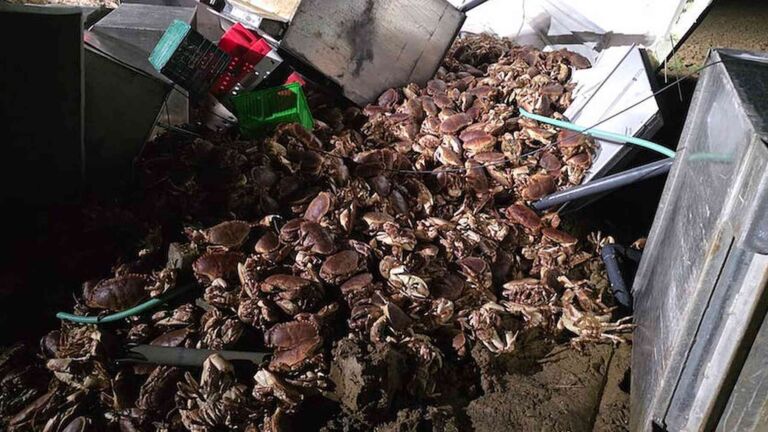
It also carried a working catch, an estimated 7,000 Tanner crab, roughly 11,000 pounds, trapped inside a flooding hull. That cargo became its own small problem sitting just below a shoreline that belongs to a national wildlife refuge.
The sheen was reported by crews aboard the response vessel Makushin Bay and by St. George residents looking down from the bluff above. Weather kept beating the situation before anyone could act on it.
Six months of storms stood between crews and the hull
Bering Sea winter made the simplest task impossible. Deteriorating conditions kept the salvage vessel from working alongside the wreck, and rough seas repeatedly prevented launching the small boat needed to inspect the hull up close.
A salvage team was on scene and making assessments within weeks of the grounding, but a full pollution survey aboard was not completed until June 1, when a crew from Global Diving & Salvage got onto the hull.
They found that ten of the eleven fuel tanks had emptied into the sea, roughly 45,000 gallons of diesel in all, along with the full 2,000 gallons of lube oil and hydraulic fluid. The eleventh tank, rated at 5,821 gallons, still held diesel, and the team sealed its vent and standpipe to stop further loss.
By then the hull had been pounded by half a year of storms, with a crack running across the main deck and the fish holds open to the sea. The oil had gone into the water through sea state damage, leaving a bent steel hull fixed to the rocks where seabirds nest every summer.
A million nesting murres sat above the stranded hull
What raised this grounding above an ordinary fuel spill was what lived above it. Alaska’s spill responders flagged the danger plainly in their situation report, noting the site sits in an important and high density nesting area, home to the largest colony of murres in Alaska, numbering about 1 million birds. Migratory birds begin arriving in large numbers in March.
The worry went beyond oil on feathers. St. George is a rat free island, and officials warned that introduced rodents would pose a serious predation threat to nesting birds and marine mammals, an impact that would likely exceed the oiling itself.
Prevention kits already on the island could be moved closer to the site if that risk became real, the kind of hazard that recurs whenever a stranded vessel sits for months near wildlife, much like the fox that rode a car carrier for 3,400 miles of winter ocean and arrived carrying a parasite of its own.
Removal began in August after a six month delay
The state closed out its spill response in late July and set wreck removal to begin in early August, with the work expected to finish before winter returned. Drone surveys at that point showed heavy bird use on all the cliffs near the site, with no sheen observed in the area.
That delay is not unusual for this corner of Alaska. A remote stretch of coastline like the Pribilofs offers few safe harbors and even fewer weather windows, the same conditions that once stranded an expedition ship on a reef elsewhere in the Pacific before help could arrive.
Even so, nobody was hurt, and no adverse impact on marine life or wildlife had been reported as the removal was planned. Mussel samples were collected at three sites to set a baseline before the heavy work began.
The removal was meant to clear the last steel off a shoreline that, come summer, belongs to the murres again.
Read the whole thing?
Get the week's signal, not the noise
Our sharpest reporting on energy, climate and nature — free, once a week.