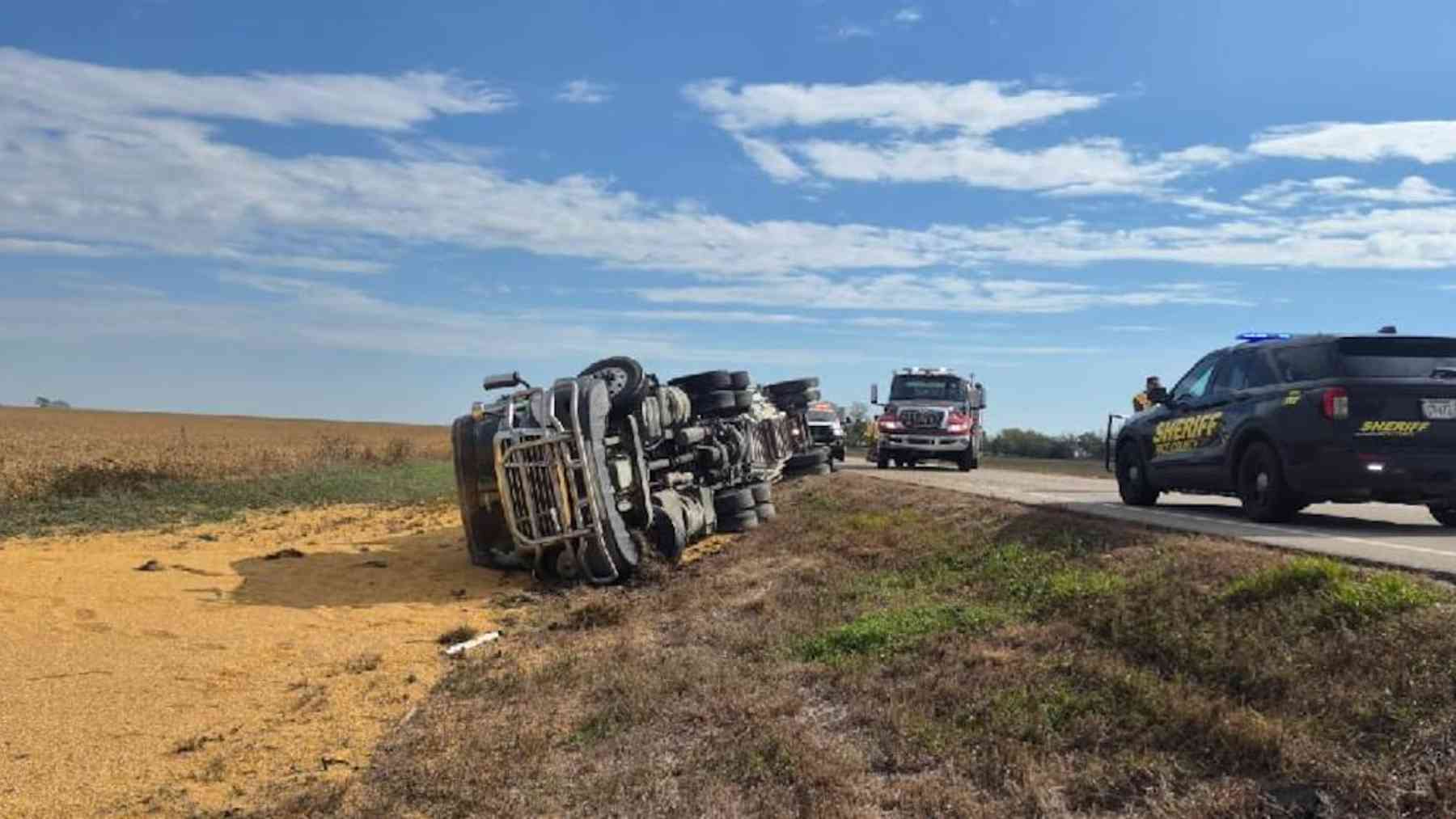
A semi lies on its side at a rural crossroads in central Kansas.
Corn spills out of it, down into the ditch grass along the shoulder.
Crews work the scene in broad daylight, keeping traffic moving past.
But the sheriff’s office is not only thinking about the wreck itself.
It is thinking about what the grain might draw in after dark.
The scattered grain along this stretch of road is an unplanned food pile in open farm country, and nobody intended it.
Why loose corn reads as a dinner bell once the fields go bare
Corn is dense, easy calories, and whitetails take to it readily once standing crops come down and natural forage thins out. A load dumped into a ditch concentrates that food in one place, at ground level, a few feet from a lane of traffic. Deer that would otherwise spread out across stubble have a reason to gather in one narrow strip instead.
The timing sharpens it. Late fall is the rut in Kansas, and state wildlife officials say deer move more during it. Crops are out of the fields and leaves are off the trees, leaving animals fewer places to stay hidden. Dawn and dusk are when that movement overlaps hardest with headlights.
So the mechanism is simple. Concentrated food beside the pavement, plus animals already on the move, raises the odds of something stepping into traffic. That is an expectation, not a tally. No one has counted deer at this particular spill yet.
The 11:30 a.m. wreck at a central Kansas crossroads
Rice County sits in central Kansas, farm country stitched together by section line roads that run straight for miles. K-4 is one of those arteries, carrying farm trucks and commuters past fields typically picked clean by the end of October. Which is why a ditch full of intact kernels stands out so sharply against the stubble.
At approximately 11:30 a.m. on Monday, Oct. 26, the Rice County Sheriff’s Office responded to a rollover injury crash involving a semi at K-4 and 23rd Road. Sheriff Nicholas Sowers said the truck was fully loaded with corn, which spilled into the ditch as a result of the crash.
Minor injuries were reported, and the Kansas Highway Patrol is investigating. Crews worked to manage traffic and clear the scene. Kernels scatter wider than broken glass ever does.
A road advisory meant to cover days, not just one evening
The telling detail is not the crash report but the advisory that came after it. Drivers traveling through the area, the sheriff’s office said, should be aware that the spilled corn may attract deer and other wildlife closer to the roadway, “potentially increasing animal activity in the area for a period of time.” Motorists were urged to use extra caution during the early morning and evening hours and to watch closely for deer entering or crossing the road.
That is a specific thing to say about a traffic accident. It treats the spill less like debris and more like a standing food source, one that could keep pulling animals toward the pavement well after the visible mess is gone.
What it is not, notably, is a report of deer already gathered at the ditch.
A pattern that follows grain trucks almost everywhere they spill
This is not the first grain spill to come with a wildlife caution attached. When a truck hauling corn crashed on a runaway ramp on Rockfish Gap Turnpike in Albemarle County, Virginia, police there warned motorists that the spill might attract animals and asked drivers to proceed with caution. First responders were photographed standing ankle deep in kernels.
What varies is scale and setting. A full truckload of sugar beets dumped across a county road is mostly a nuisance and a cleanup bill. Grain left along an active rail corridor can be considerably worse, because animals drawn to it end up standing on tracks.
On a lightly traveled rural highway like K-4, the risk sits closer to the first case, and it comes down largely to speed and attention after dark.
Why a single sweep rarely finishes the cleanup job
Even after the visible pile is scooped away, loose kernels keep working their way out of gravel and grass for days. Larger cleanups show how hard total recovery really is. After a freight train derailed and spilled hundreds of tons of soybeans on the southern edge of Glacier National Park in Montana, the railroad said bear fencing, game cameras and noisemakers were being installed at the site.
Grain left in the open ferments, and that smell pulls bears onto the right of way long after the spill itself is cleared.
A Kansas ditch is a far smaller version of the same problem, and it tends to resolve on its own. Deer move on once the easy calories run out, and rain and traffic grind the remaining kernels into the shoulder. For now, Rice County drivers have one more reason to watch the ditch grass at dawn and dusk, where a truckload of unplanned feed is still settling into the gravel.
Read the whole thing?
Get the week's signal, not the noise
Our sharpest reporting on energy, climate and nature — free, once a week.