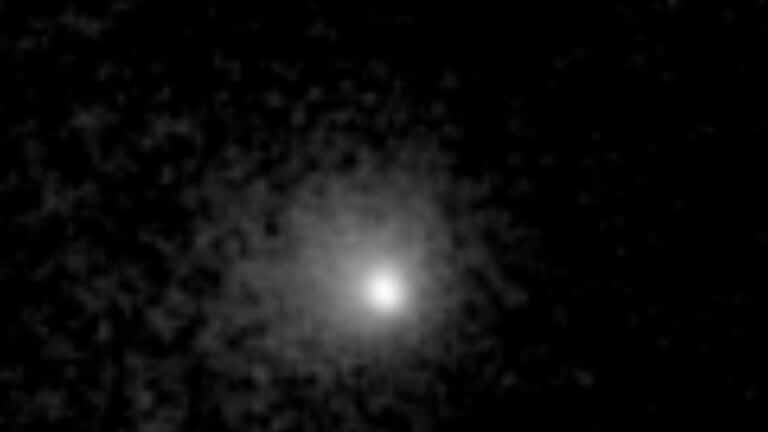
At the center of the Milky Way, something glows faintly in gamma rays — and nobody can agree on what it is. For years, scientists have debated whether this excess of high-energy light is the long-sought fingerprint of dark matter particles annihilating each other, or simply the combined hum of ordinary astrophysical sources too faint to resolve individually.
Now, a fresh reanalysis of data from some of the smallest, dimmest galaxies orbiting our own is adding a new layer to that debate. The signals coming from these dwarf galaxies are sharper than before — and, for the first time, they appear to be telling a more consistent story.
A faint glow that refuses to go away
The Galactic center excess has occupied astrophysicists for more than a decade. Detected by NASA’s Fermi Large Area Telescope (Fermi-LAT), it appears as a diffuse glow of gamma rays emanating from the heart of the Milky Way — brighter than conventional astrophysical models predict. The leading explanations fall into two broad camps: an unresolved population of rapidly spinning neutron stars called millisecond pulsars, or something far more exotic — dark matter annihilation.
The dark matter hypothesis works like this: if dark matter is made of particles, two of them colliding in a dense region of space should occasionally annihilate each other, releasing energy as gamma rays within a predictable energy range. The Galactic center, packed with dark matter according to most models, would be a logical place to look.
The trouble is that the Galactic center is also an extraordinarily messy environment. Gas, dust, magnetic fields, and countless astrophysical processes all produce their own radiation, and disentangling a potential dark matter signal from that noise has proven maddeningly difficult. Earlier analyses of dwarf satellite galaxies did find small excesses at the 2–3 sigma level, but those signals were inconsistent with each other and largely evaporated once researchers corrected for the number of statistical trials performed.
Why dwarf galaxies are the ideal dark matter laboratories
Dwarf spheroidal satellite galaxies, or dSphs, are ancient, gravitationally bound systems orbiting the Milky Way at varying distances. They’re among the smallest known galaxies — some containing only a few thousand stars — yet their internal motions suggest they’re dominated by dark matter. The ratio of dark matter to ordinary matter in these systems is extraordinarily high, making them some of the most dark matter-dense environments accessible to observation.
Crucially, dSphs are quiet. Unlike the Galactic center, they contain very little gas, dust, or active star formation — the processes that generate astrophysical background noise and complicate dark matter searches. Any gamma-ray signal emerging from a dwarf galaxy is far easier to interpret for that reason.
Fermi-LAT is well suited to study them. The telescope’s sensitivity in the GeV-to-TeV energy range aligns directly with the mass range of the most theoretically motivated dark matter candidates. If particles in that range are annihilating inside dwarf galaxies, Fermi-LAT should, in principle, detect the resulting gamma rays — provided the analysis is clean enough.
A sharper analysis with better tools
The new study, posted to the arXiv preprint server, applies several methodological improvements to the Fermi-LAT dwarf galaxy dataset. The researchers applied stricter quality cuts to the data itself, reducing contamination from poorly reconstructed gamma-ray events. They also implemented an adaptive background modeling method that adjusts to local conditions rather than relying on a one-size-fits-all template, and adopted an updated theoretical framework for modeling dark matter annihilation.
The background modeling improvement proved especially consequential. By more accurately characterizing gamma-ray emission unrelated to dark matter, the team achieved better overall agreement between their model and the observed data — and that tighter fit made any residual excess stand out more clearly. The result was a measurable increase in both the local and global statistical significance of the dwarf galaxy excess compared to previous studies. The signal didn’t disappear under scrutiny. It grew slightly stronger.
Signals that now agree with each other
Perhaps the most scientifically meaningful result is the new analysis’s internal consistency. In previous studies, the inferred properties of the dark matter candidate — its mass and annihilation rate — varied depending on which specific subset of dwarf galaxies was included. That variability was a red flag, suggesting the signal might be a statistical artifact rather than a genuine physical phenomenon.
The updated analysis shows that the inferred dark matter properties are now far less sensitive to which dwarfs are included. That robustness is a meaningful sign the signal may be real. More striking still, the dark matter properties suggested by the dwarf galaxy analysis are consistent with those inferred from two independent lines of evidence: the Galactic center excess observed by Fermi-LAT, and an antiproton excess measured by the Alpha Magnetic Spectrometer (AMS-02) aboard the International Space Station. When three separate instruments converge on similar candidate dark matter properties, scientists take notice — even if none of the individual signals yet meets the bar for a confirmed discovery.
What comes next: more dwarfs, clearer answers
That bar remains high. Physics requires a 5-sigma significance level before a discovery can be claimed — a threshold that essentially rules out a one-in-a-million chance of a false positive. The current excess falls short of that mark.
The researchers are direct about what it would take to change that. A significant increase in the number of known dwarf galaxies included in future analyses could push the signal toward either definitive confirmation or definitive exclusion of the dark matter interpretation.
That prospect is closer than it might seem. The Vera C. Rubin Observatory, currently completing commissioning in Chile, is designed to conduct the Legacy Survey of Space and Time (LSST) — a decade-long sky survey expected to discover many new dwarf satellite galaxies currently too faint to detect. Each new dwarf added to the sample is another data point, another vote for or against the dark matter hypothesis.
The faint glow at the center of the Milky Way has been waiting for an answer for over a decade. The tools to find one may finally be arriving.
Read the whole thing?
Get the week's signal, not the noise
Our sharpest reporting on energy, climate and nature — free, once a week.