On a July night in 2025, a telescope on a hillside in Chile did what it does every night without fail.
It swept the sky, hunting for moving dots of light that might one day threaten Earth.
The system flagged a fast-moving object and sent it to astronomers for a closer look.
What came back was not a warning about a dangerous rock hurtling toward us.
It was something far stranger, and far older than anyone expected.
The machine that never sleeps
The telescope belongs to ATLAS, the Asteroid Terrestrial-impact Last Alert System.
The ATLAS project, developed by the University of Hawaii and funded by NASA, is an asteroid impact early warning system with telescopes in Hawaii, Chile, and South Africa.
Think of it as a tireless night watchman, checking every corner of the yard over and over until sunrise.
The system is built around one brutal, simple idea: the earlier you spot something heading your way, the more time you have to act.
Small and medium-sized asteroids are more common and can still do great damage, but a few days’ warning can be enough for local authorities to alert the public or evacuate an area.
That July night, the Chilean station caught a moving point it had never seen before.
The coordinates were logged, the motion measured, and the file dropped into the inbox of astronomers who had been expecting an ordinary night.
When the alarm went off, the answer was wrong
Automated systems like ATLAS work by measuring motion against the fixed backdrop of stars.
Anything that shifts from one frame to the next is a candidate.
Most turn out to be known asteroids, already catalogued and tracked, their orbits mapped years in advance.
This object matched none of the known catalogues.
Its speed was the first sign that something was deeply unusual.
It was moving far too fast to belong to our solar system at all.
Objects gravitationally bound to the Sun follow predictable curves; this one sliced through on a hyperbolic arc, no return trip built into its trajectory.
The numbers kept pointing to the same unsettling conclusion, and the astronomers kept checking them anyway.
A visitor from another star system
Astronomers quickly confirmed what the data were suggesting.
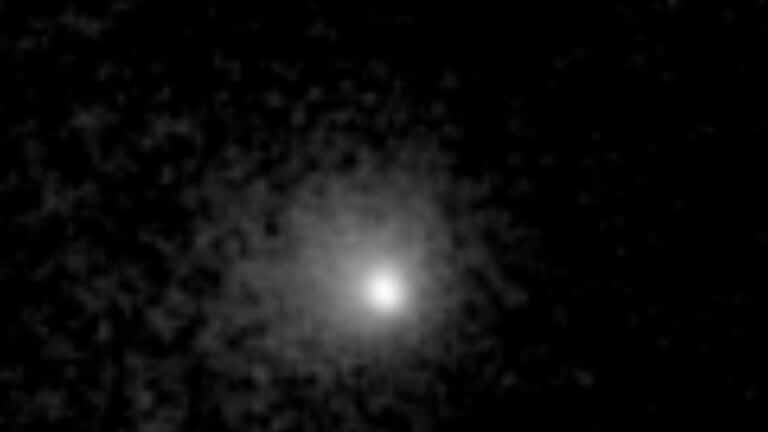
The object, now named 3I/ATLAS, was not a local rock.
It became only the third interstellar object ever detected passing through our solar system, following ‘Oumuamua in 2017 and comet Borisov in 2019.
Planetary defence networks and observatories worldwide made 3I/ATLAS a priority target, mobilising coordinated campaigns within days of the announcement.
The object was a comet, trailing a dusty tail as it swung around the Sun on a path it will never repeat.
Once it leaves, it will vanish into the dark between the stars forever.
Every observatory that could pivot toward it did so within days of the announcement, and the flood of new observations turned a single moving dot into a full portrait of something truly alien.
Older than the Sun itself
Here is where the story turns from remarkable to genuinely staggering.
Scientists began modelling where 3I/ATLAS came from and how long it had been travelling.
In a 2025 paper, Matthew Hopkins and colleagues used the Ōtautahi-Oxford population model, drawing on Gaia data along with planet-formation chemistry and galactic dynamics to estimate the object’s age.
The modelling returned a lower confidence bound of more than 7.6 billion years, with the full estimated range running to more than 10 billion years, older than the solar system by at least three billion years.
This comet may have been drifting through the galaxy since before our Sun existed, formed around another star in another solar system long since dead.
Picture it tumbling through cold interstellar space for longer than Earth has been a planet, carrying the frozen chemistry of a world we will never name.
The Gaia data used in that modelling came from ESA’s star-mapping observatory, which has helped decode faint objects crossing our sky for years.
ESA powered down Gaia on 27 March 2025, but its archived data lived on to help trace this ancient traveller back through galactic time.
The gift no one planned for
The scientists who built ATLAS never intended to catch an interstellar comet.
They built it to keep Earth safe from rocks within our own cosmic neighbourhood.
That overlap between danger-watching and cosmic discovery is what makes planetary defence science so alive right now.
NASA turned Hubble and Webb toward 3I/ATLAS within weeks, joining a host of other missions in one of the most extraordinary observing campaigns of the decade.
The honest caveat is that the age estimate rests on population models that carry real uncertainty: a second independent analysis placed the range at 3 to 11 billion years, and the precise origin is still being refined.
Researchers hope that Webb’s spectral data will eventually reveal which star-forming region forged it, narrowing the answer from a whole galaxy to a single corner of the sky.
But even in the most conservative reading, a warning system handed science a window into the universe that no planned mission could have opened.
Something older than the Sun swept through our neighbourhood, and a patient, watchful machine in the Chilean desert was the one that noticed it.
Read the whole thing?
Get the week's signal, not the noise
Our sharpest reporting on energy, climate and nature — free, once a week.