

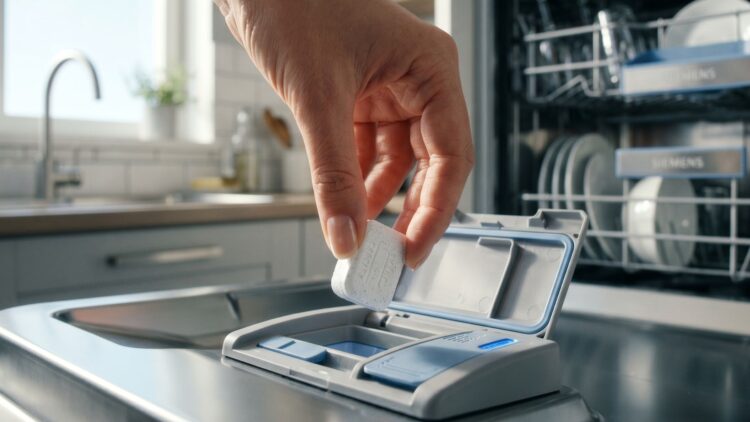
It is one of the small miracles of modern life. You drop a single tablet into the machine, press a button, and walk away.
An hour later the plates come out spotless and dry, the glasses gleaming without a single streak. No scrubbing, no drying, no thinking about it. The all in one tablet did everything at once.
It feels like effortless perfection. And yet, when scientists looked very closely at those gleaming dishes, they found that something invisible had been left behind on them.
The promise of the perfect, effortless clean
It is easy to see why these tablets took over the kitchen.
A modern all in one tablet bundles the detergent, the rinse aid and the shine into one little capsule you never have to measure or think about. The result is dishes that come out clean, dry and streak free, every single time. It was sold as the smartest, most modern way to wash up, and it made every other method feel like hard work.
For a busy household, that is close to magic. You stopped having to do anything at all, and the machine simply handed back perfection.
The question almost no one asked was what gives that perfect shine in the first place.
What makes them shine, and what it leaves behind
The secret to spotless, streak free dishes is the rinse aid.
Rinse aid is a blend of surfactants, including a group of chemicals called alcohol ethoxylates, that break the surface tension of water so it sheets straight off the dishes instead of drying into spots. It is the reason your glasses come out clear instead of cloudy. That quiet sheeting action is what turns an ordinary wash into a showroom shine.
But here is the catch. On a fast, water saving cycle, especially one without a thorough final rinse, a thin and completely invisible film of that rinse aid can dry in place on the dishes. It joins the long list of everyday chemicals that quietly slip into our bodies without us ever noticing.
The surprise scientists found in the lab
A research team at the Swiss Institute of Allergy and Asthma Research, linked to the University of Zurich, decided to test exactly that residue.
Using human intestinal cells and tiny lab models that mimic the human gut, they exposed them to the amount of detergent and rinse aid that can remain on ready to use dishware. The result, published in a leading immunology journal, was striking. One ingredient, alcohol ethoxylates, damaged the delicate lining of the gut, making it leakier and switching on genes tied to inflammation. Even at low doses, far too small to kill the cells outright, the residue quietly changed how they behaved.
The residue that made the dishes shine, in other words, was quietly toxic to the very cells that line our insides.
Why that thin invisible film matters
The lining they damaged is called the epithelial barrier, and it does a quietly heroic job.
It is the protective shield of the gut, deciding what is allowed to pass into the body and what is kept out. When that barrier is weakened, researchers have linked the disruption to a long list of chronic problems, from allergies to inflammatory conditions. A healthy barrier usually repairs itself, but a steady trickle of irritation gives it little chance to recover.
The worry the scientists raised is simple. The film dries onto a clean plate, sits there invisibly, and then meets your next meal, ending up inside you a little at a time.
The honest catch, and what actually helps
Now for the part that keeps this in proportion, because the panic version of this story is wrong.
The strongest damage appeared with professional dishwashers, the kind used in restaurants and schools, which run blisteringly fast cycles and often skip a proper final rinse. At the far greater dilution of a normal home dishwasher cycle, the same lab study did not find that damage, and this was research on cells and lab models, not proof of harm in living people.
So there is no need to fear your kitchen. There is just an easy way to settle it. Make sure your machine finishes with a real rinse, avoid overdosing the rinse aid or skip it entirely, and choose a rinse aid free or gentler tablet if you want extra peace of mind. An additional rinse washes the worry away completely. The researchers themselves stress that the fix is cheap and within everyone’s reach, not a reason to give up the machine at all.
The spotless shine was never the enemy. It only ever asked that you let the water have the last word.