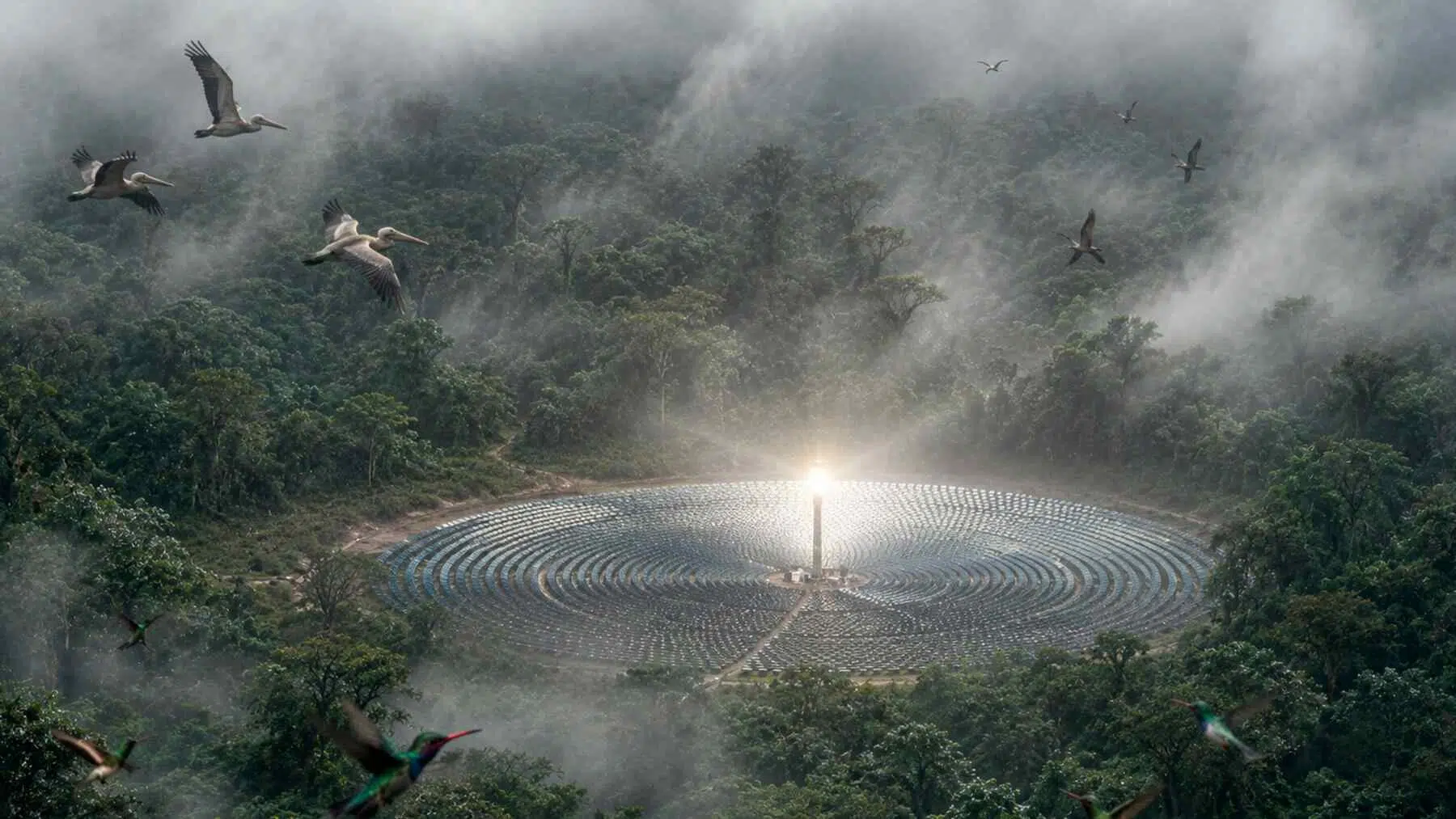
Hundreds of birds are falling from the sky at solar farms across the American Southwest.
Pelicans, hummingbirds, grebes, and other species suddenly dive toward the panels below.
Impacts often prove fatal or leave birds stranded on the scorching desert floor.
Researchers initially struggled to explain why water birds targeted dry desert facilities.
Then the deaths started spreading across dozens of species.
Research confirms panels trigger a lethal optical illusion called the ‘Lake Effect.’
How the solar farms became deadly traps for some species of birds
Facilities like the Ivanpah Solar Electric Generating System cover 3,500 acres with shimmering mirrors.
Bird deaths began drawing attention at projects like the Genesis Solar Energy Project in California’s Mojave Desert.
Workers started finding dead birds beneath the panels regularly.
Desert workers found ‘water birds’ like Yuma Ridgway’s Rails, miles from any wetland.
That confused researchers immediately.
Over 138 bird species are now documented victims of solar infrastructure collisions.
Scientists noticed another pattern quickly.
The majority of fatalities are ‘obligate’ waterbirds that require water surfaces for takeoff.
The deaths increased during migration seasons.
That clue became extremely important later.
Researchers eventually started investigating how birds visually detect lakes and rivers from the sky.
That led them toward a phenomenon called the “lake effect.”
Why birds keep flying toward the panels in some parts of the country
Birds do not locate water exactly like humans do.
Many species rely heavily on polarized light reflections.
Horizontal surfaces polarize light. To a bird’s eye, this signal identifies deep water.
PV panels reflect highly polarized light, often more intensely than actual water.
From high above the desert, massive solar farms may resemble lakes or wetlands.
That illusion becomes especially dangerous during migration.
Tired birds searching for water suddenly descend toward what looks like a safe landing zone.
Instead, they hit glass, steel, or surrounding infrastructure.
Some species face an even more serious problem afterward.
Grebes and loons have legs positioned far back on their bodies. This makes land takeoffs physically impossible.
Their bodies evolved for swimming and water takeoffs instead.
Seabirds are also being impacted by the new era of renewable energy.
Researchers studying facilities tracked unusual bird behavior directly above solar arrays.
Some birds circled repeatedly before descending suddenly.
Others attempted full landing motions toward the panels themselves.
The problem has been studied extensively by the California Energy Commission.
This is backed by the study, “Utility-scale solar impacts on volant wildlife,” published in The Wildlife Society.
What is really causing the odd behavior among some birds
The phenomenon is known as the “lake effect” by experts.
Dark solar panels reflect polarized light in the same way as lakes, rivers, and wetlands.
Birds flying overhead interpret those reflections as safe landing areas.
That explains why some diving birds keep approaching desert solar facilities.
Many descend rapidly toward the panels, expecting water below.
Instead, they collide with hard surfaces or become trapped nearby.
Experts note that more than 71 bird species have been affected by this “lake effect”.
The issue is not limited to one location and could happen almost anywhere
Scientists documented similar behavior across multiple sites. Solar plants are creating new habitats for wildlife.
But at these solar facilities, that “artificial habitat” is having an adverse effect.
Facilities using large reflective surfaces appear especially risky during migration periods.
Now, researchers are testing possible solutions.
Engineers are testing UV-reflective patterns and ‘anti-polarization’ white grids to break the illusion.
Others focus on changing panel textures or adding visual markers.
Scientists stress that renewable energy remains important.
But the discoveries revealed something unexpected about how wildlife experiences human technology.
To migrating birds high above the desert, some solar farms do not look like power plants at all.
They see a shimmering oasis where there is only glass, confusing the birds in the process.
Will the technological advances we’re seeing in recent photovoltaic innovations take this issue into consideration?
Read the whole thing?
Get the week's signal, not the noise
Our sharpest reporting on energy, climate and nature — free, once a week.