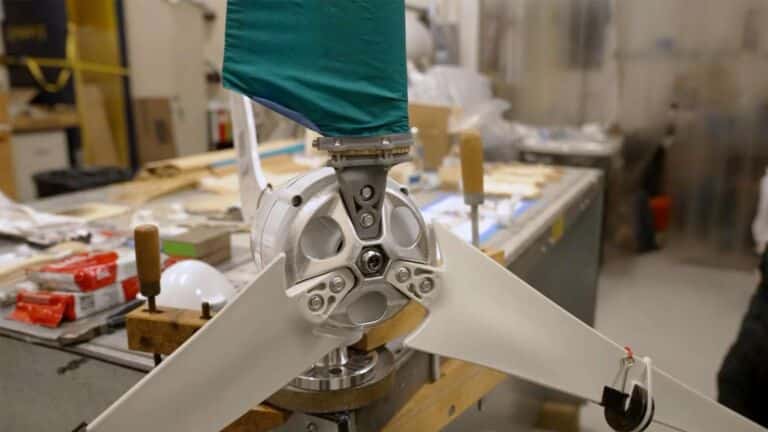
Scientists in China created a floating device to harness energy from an unexpected source. This system was developed by researchers at the Nanjing University of Aeronautics and Astronautics, and looks like a typical lightweight and water-integrated generator. However, the implications of this invention are enormous – so significant that headlines are estimating the potential coverage of the electricity needs of nearly a billion American homes.
This may have seemed unbelievable, almost outrageous, until you understand the context
Over the last few years, China’s national electricity consumption has exceeded the 10 trillion kilowatt-hour mark, a 5% increase year-on-year, making it the first nation to hit this milestone. That number is so huge that if we combine the electricity use of the United States, the European Union, Russia, India, and Japan, it is still less than China’s total electricity consumption.
The size of this number is so big that most analysts convert it to a measure that we all understand – the household level. If we use the average electricity use per household in the US, then 10 trillion kilowatt-hours translates to about 952 million homes powered for one year. Thus, the title’s reference to American households was not intended to focus on the US, but simply to provide a familiar example to help convey an otherwise incomprehensible amount of energy in a way that everyone can relate to.
This floating electricity generator uses rain and is significantly more sophisticated than previous devices that harnessed the energy of raindrops.
Previous devices were made of rigid materials and had heavy metal electrodes
Previous devices were also fixed to land, which limited both the portability and scalability of these devices. The Chinese version of the device used the water it floated upon as both structural support and a conductive electrode, resulting in a very significant reduction in weight and cost while retaining the capacity to generate a great deal of electrical energy.
Each raindrop creates a high voltage pulse when it hits the surface of the device because of the natural properties of water, including surface tension, incompressibility, and the presence of charge-carrying ions.
Field tests show the device’s surprising resilience
As seen in field tests on Donghua Lake, the device functioned well and demonstrated a surprising resilience. The device performed well in a variety of conditions, including changing temperatures, variable salinity levels, and the biological growth (biofouling) from lake organisms.
Why do people continue to find it difficult to fathom the idea of collecting energy from rain?
The researchers found that the device was able to rapidly charge capacitors and showed considerable promise for powering sensors, remote electronic equipment, and other off-grid distributed systems. For improved storm performance, the designers added drainage channels to the device, allowing water to drain downward while keeping the upper portion of the device free from splashing during heavy rains.
The idea seems counterintuitive. Storms are chaotic and unpredictable, and individual raindrops appear to be too small to contribute anything of significance. But the technology shows that the combined kinetic force of the countless numbers of droplets falling continuously across the oceans, lakes, and coastlines is an overlooked renewable resource. Its lightweight structure, low material costs, and lack of need for land occupation make this device a pioneer in hydrovoltaic power.
The “sleeping dragon” mentioned in the title refers to the previously underestimated energy contained in Earth’s rainfall and not to the device itself. Although the device has not produced electricity on a grid-scale, it represents a tremendous step forward in possible solutions to our clean-energy needs. This is a reminder that even the smallest forces in nature, when engineered correctly, can show us the way to the future of clean energy systems.
Read the whole thing?
Get the week's signal, not the noise
Our sharpest reporting on energy, climate and nature — free, once a week.