

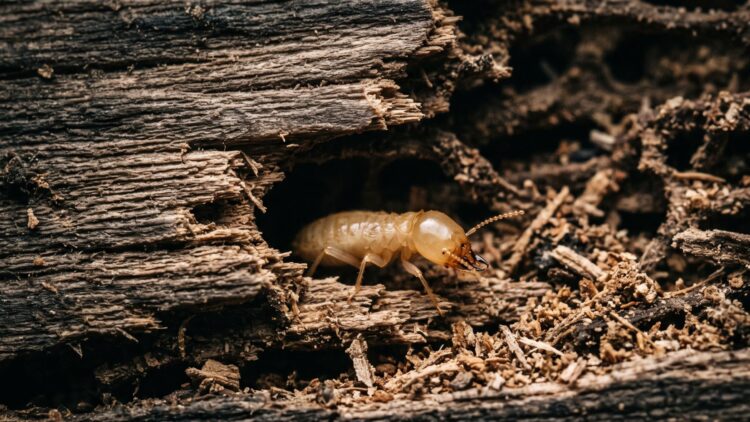
They show up without warning, and by the time most homeowners find them, the damage is already done.
A termite colony can work through a structural beam for years undetected, hidden inside the very wood that holds a house up.
Americans spend around $5 billion every year treating and repairing termite damage, making the insect one of the most expensive pests on the continent.
But inside that tiny, pale body, something extraordinary is happening, something so efficient that engineers are now racing to copy it.
That is more than the damage from fire and floods combined, according to the National Pest Management Association.
The pest almost everyone has called an exterminator about
Walk into any hardware store in the American South and you will find an entire aisle devoted to stopping them.
Termites are a fixture of homeownership anxiety, the subject of more dread than nearly any other backyard creature.
Most people picture them as simple destroyers: mandibles grinding, timber vanishing, repair bills climbing.
What they picture is accurate, as far as it goes.
But the creature doing all that chewing is also running one of the most sophisticated chemical processes found anywhere in the natural world, right there inside its abdomen.
That hidden process is centuries ahead of anything human engineers have managed to build at the same scale.
Why wood is almost impossible to eat
Wood is essentially locked energy.
It is built from cellulose and lignin, two compounds so tough and tightly bound that almost nothing on Earth can break them apart and extract useful fuel from them.
Humans cannot digest wood at all, and even most microbes fail at the job.
The challenge is not just mechanical but chemical: the bonds holding cellulose together resist almost every enzyme that nature has developed over millions of years.
Yet a termite the size of a grain of rice cracks this problem every single day.
It does it with startling efficiency, on a diet of nothing but dead timber and fallen leaves.
A living laboratory sealed inside an abdomen
Termites evolved into wood-eating specialists about 150 million years ago, relying on microbes living inside their guts to digest cellulose.
They pass those microbes to their offspring through a remarkable social behavior, keeping the colony’s chemical workforce alive across generations.
The gut is not one simple chamber: a foregut, a midgut, and a hindgut work in sequence, each handling a different stage of breakdown.
Approximately 250 bacterial species crowd the pinhead volume of a higher termite’s hindgut alone.
That hindgut is a pressurized fermentation vessel, smaller than a sesame seed, running a process no human engineer has yet replicated at scale.
Within hours, termites digest 74 to 99 percent of cellulose and 65 to 87 percent of hemicelluloses through their symbiotic gut communities.
The termite gut is a hydrogen factory
Here is the part that stopped scientists cold.
Termites are theoretically capable of producing two litres of hydrogen from a single sheet of paper.
The roughly 250 bacterial species in the hindgut release hydrogen trapped inside the wood, breaking cellulose into sugars and transforming them into fuel.
Hydrogen is the cleanest fuel known, producing only water when burned, and the termite makes it from scrap wood and dead plant matter.
A Caltech-led team, working with the DOE Joint Genome Institute, sequenced the genes encoded by the hindgut bacterial community to find the exact blueprints behind this process, publishing the results in the journal Nature.
Hydrogen is produced at concentrations far exceeding what the termite itself needs for energy, which is why termites have been seriously explored for biofuel production, a finding the DOE Joint Genome Institute has highlighted as a key motivation for studying termite gut microbes.
What a hated pest might do for the planet
The irony is almost too sharp to believe.
The same creature that costs American homeowners billions is pointing engineers toward one of the most promising clean energy pathways of the century.
Genetic engineering may one day enable hydrogen to be generated in bioreactors from woody biomass, guided by the termite’s own biological blueprint.
There is a caveat worth holding: the science is still early, and scaling a termite gut into an industrial reactor has proven far harder than the initial numbers suggested.
But researchers studying wood as an engineering material keep bumping into the same humbling truth: nature solved problems that humans are only just learning to ask.
Meanwhile, every carbon source turned into clean fuel instead of waste matters, even if the idea started inside a creature most people call an exterminator to destroy.
The tiny insect in your walls may be the most unwelcome houseguest in America, and it may also, improbably, be carrying a piece of the answer.