Somebody has to stand a mast in the corn and leave it there all summer.
Cups spinning, a sonic head above them, cables to a box on a tripod, and a laser at the field edge reading the air from the ground past the blade tips.
Two summers of that, in rows of corn and beans laid out between the turbine lines.
The readings came back with a difference between the fields upwind and the fields downwind.
The difference was real and small, which is the interesting part.
And it did not point the same direction after dark.
What a rotor does to the air above a field
On a still hot afternoon a crop field builds a layer of stagnant air over itself.
Heat radiates off the leaves into that layer and sits there. Water vapor sits there. The carbon dioxide the plants pull in gets drawn down locally and is slow to replace.
A rotor breaks that arrangement.
Passing blades leave a wake of turbulence behind them, and that turbulence drags faster moving air from up at hub height down into the canopy.
The still layer is stirred out. Heat leaves faster, moisture leaves faster, and gases exchange with the atmosphere faster in both directions.
The rotor is not cooling anything. It is mixing, and mixing moves whatever is there toward the average.
Which is why the answer flips when the sun goes down and the field is the cold thing rather than the hot thing.
The field where they measured it
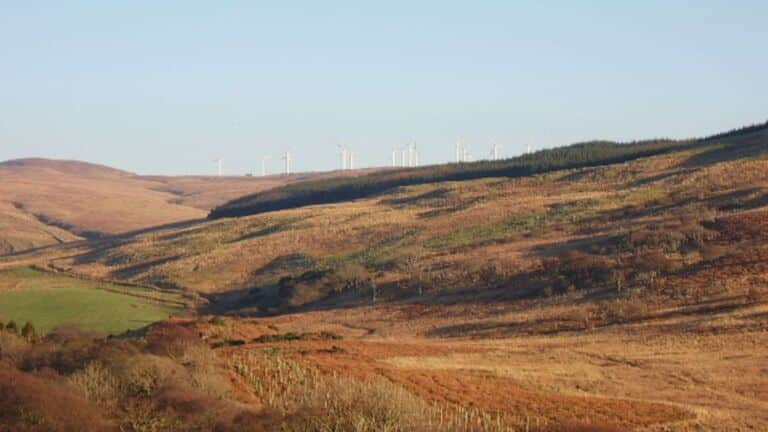
The site was a central Iowa array of 200 wind turbines, ordinary utility machines rated at a megawatt and a half apiece.
The southern hundred stood on hubs about 262 feet up with rotors around 243 feet across.
Underneath, the ground was doing what it always does, corn and soybeans in rotation.
Teams from a national laboratory in Ames and a university in Colorado ran two campaigns, late June through mid August, in consecutive years.
Lidar read the wind profile from the surface up past blade tip height. Anemometers took the turbulence. Flux towers measured the exchange of heat, water vapor and carbon dioxide over the crop.
Upwind stations gave them the field with no turbine in front of it, the only way any of this becomes a number rather than an impression.
What the two summers actually returned
Daytime cooling downwind came in at 1.4 degrees at most.
Nighttime warming at the far wake stations, under stable air, ran from about two degrees to nearly three.
Wind speed in the near wake dropped by a tenth to four tenths, and the wake stayed measurable past ten rotor diameters, close to half a mile.
During daylight the towers recorded more water vapor going up off the crop and more carbon dioxide going down into it, both consistent with a canopy being ventilated rather than left to sit.
That faster drying is the part farmers hear first, because dew hanging on a leaf into mid morning is what mold and leaf disease wait for, and wet grain costs money to dry after harvest.
But a degree and a half is a degree and a half. It is not a shield against a hundred degree afternoon, and nobody who took the readings called it one.
The half of the result that is not good news
Warmer nights sound like frost protection, and in spring and fall they are.
In July they are the opposite.
Corn respires through the night, burning sugar it made during the day, and it burns more when the air stays warm. Rising night temperatures across the Midwest have been flagged for years as a limiting factor on yield, and the lead agronomist on this work has said so himself.
The larger of the two measured effects is therefore the unhelpful one, in the season when the crop is filling grain.
The team was blunt about the rest. Soil varies within a field, management varies between fields, and pinning a season of yield on turbines carries, in their own words, large uncertainties.
Nobody in the work has ever claimed a measured yield gain. They measured air, not bushels.
Why the finding keeps showing up anyway
The day and night flip is not an Iowa peculiarity.
A large California wind farm produced the same signature, cooler by day and warmer by night, and satellite work over other arrays has found the same shape.
That consistency is what makes it worth taking seriously. A signal that shows up on three continents in different crops is a mechanism, not an artifact.
What is still missing is the number everyone actually wants, which is what all of it does to a harvest across a full season.
Getting it means yield data field by field over years, matched to which rows sat in a wake and which did not.
Until somebody publishes that, what stands is a documented change in the air over a cornfield.
Which is not nothing. It is just not a harvest.
Read the whole thing?
Get the week's signal, not the noise
Our sharpest reporting on energy, climate and nature — free, once a week.