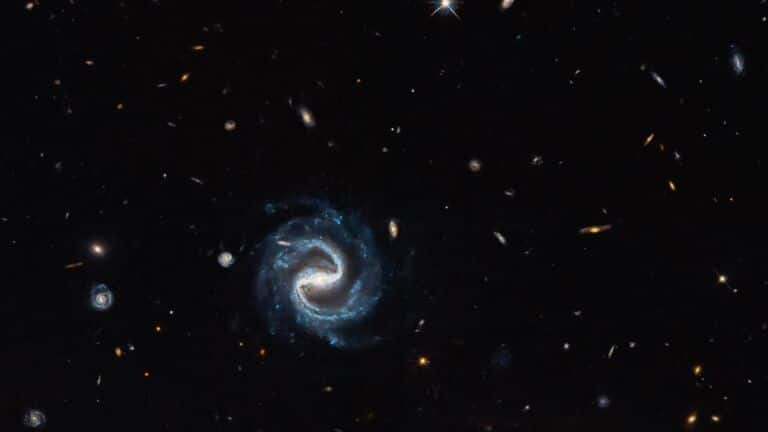
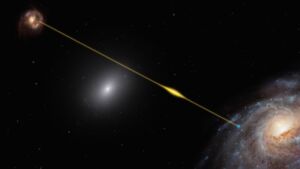
Many of the world’s biggest mysteries have traveled further than the Fast Radio Burst (FRB) 20240304B. The fast radio burst traveled over 11 billion light-years to reach Earth.
Before tracking the signal back to its source, scientists expected to find a relatively large galaxy based on previous fast radio burst observations.
Instead of seeing a giant galaxy, researchers found a small one using the James Webb Space Telescope.
The burst occurred approximately 3 billion years after the beginning of time. That gave astronomers a view into an incredibly early period of cosmic history.
Astronomers expected to find a giant galaxy
Fast radio bursts are among the highest-energy events in the universe.
Identifying the galaxy responsible for creating a fast radio burst will assist scientists in identifying why that specific type of phenomenon happened.
When scientists analyzed the position of FRB 20240304B, they expected to find a relatively large galaxy based on previous fast radio burst observations.
This particular fast radio burst was the most distant ever localized at the time of the discovery. The environment surrounding the burst was supposed to be just as large.
Nothing appeared where the burst originated
With their ground-based telescopes, astronomers studied the area. Unfortunately, there was no observable evidence or indication of anything significant.
Observations from the NASA James Webb Space Telescope revealed what ground-based telescopes could not.
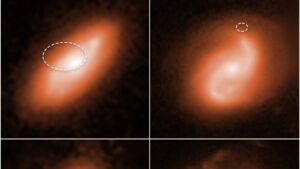
Their findings were unexpected. The host galaxy turned out to be an active star-forming compact dwarf galaxy.
Researchers from the University of California, Santa Cruz determined through the study that the galaxy was roughly 1,000 times less massive than anticipated by astronomers.
Attention gradually shifted from the fast radio burst itself to the galaxy, which had become part of the mystery.
One of the most distant fast radio bursts we know of appeared to originate from a remarkably small galaxy.
A dwarf galaxy pointed toward a magnetar
The solution might involve some of the most extreme objects in the universe. Magnetars are neutron stars with magnetic fields thousands of times stronger than those observed in other neutron stars.
Evidence from the newly discovered host galaxy supports this theory. Because the galaxy is still developing stars, it creates an environment where young magnetars can form.
This provides additional support for the magnetar theory of fast radio bursts.
The finding does not provide a complete resolution to the fast radio burst mystery. It does add yet another crucial piece of evidence supporting what galaxies at least some fast radio bursts appear to originate from.
The burst revealed more than its source
Fast radio bursts have been used as cosmic probes of the intergalactic medium. Radio waves generated by fast radio bursts travel through space and encounter various types of material.
Signs were detected from a previously unknown galaxy cluster and from the nearby Virgo Cluster.
Thus, while astronomers were studying a signal related to its origin, they obtained knowledge about large distances separating our planet and its source.
One tiny galaxy changed the story
Astronomers wanted to learn about a record-breaking signal coming from far in space. Ultimately, what they found was a galaxy much smaller than expected.
That discovery strengthened one of the leading explanations for fast radio bursts. It also highlighted how much remains unknown about the environments capable of producing them.
The host galaxy was not a massive system visible to every observatory. It was a compact dwarf galaxy that remained hidden until the James Webb Space Telescope examined the location more closely.
Researchers began their investigation by following a burst that had traveled more than 11 billion light-years across the universe.
In the end, one of the most important discoveries was not the signal itself. It was the unexpectedly small galaxy waiting at its source.
Read the whole thing?
Get the week's signal, not the noise
Our sharpest reporting on energy, climate and nature — free, once a week.