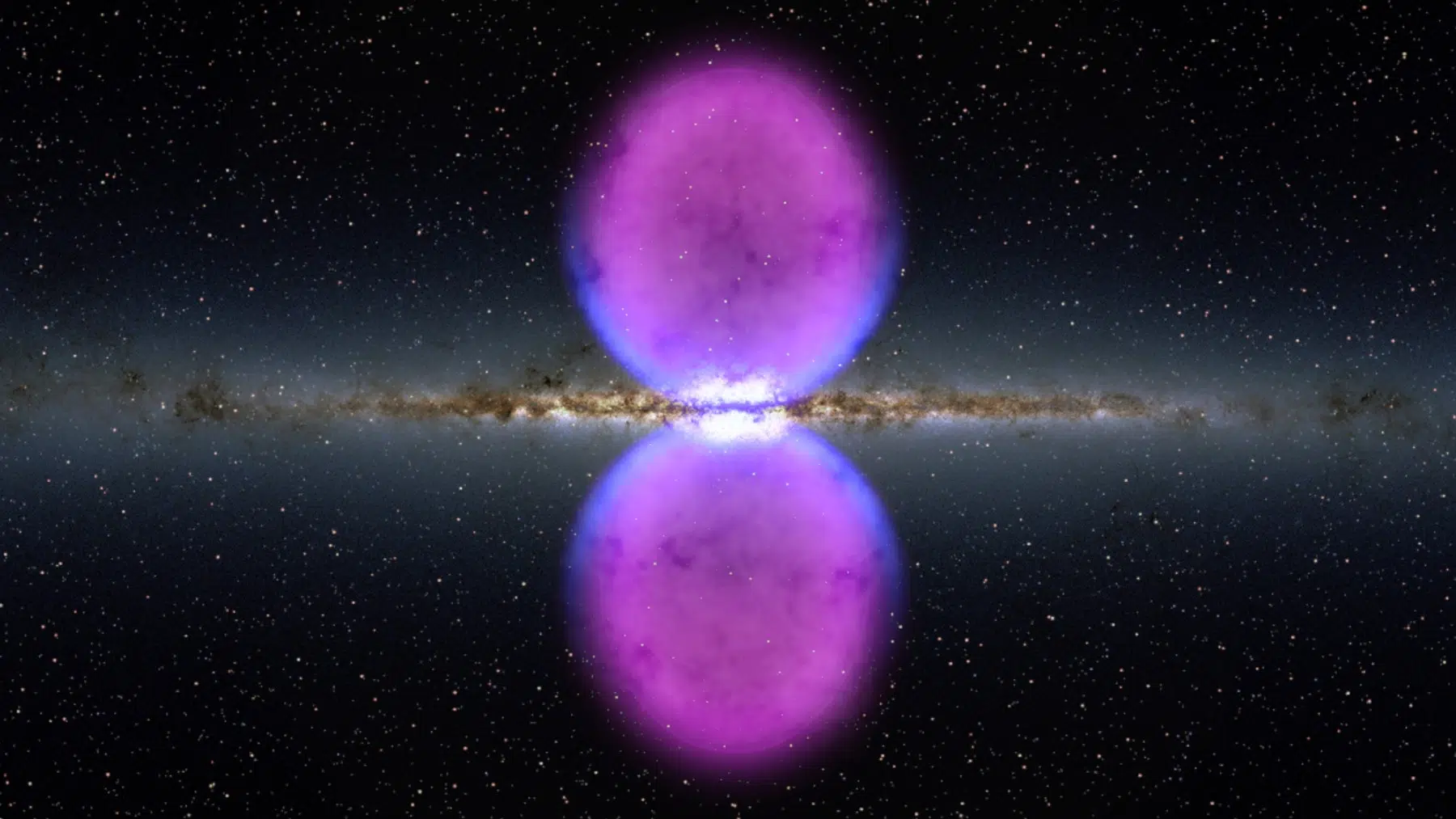
In cosmology, Fermi balls are theoretical objects thought to have formed early in the universe’s history through a process called spontaneous symmetry breaking. They’ve been described as “charged SLAC-bag type structures” and can be seen as a kind of non-topological soliton—quantum objects that hold themselves together in stable formations without having a hard surface. The term “Fermi ball” honors the physicist Enrico Fermi, linked to the fermions—the fundamental particles these balls would be made of.
The impact of Fermi balls
Scientists are still studying what happens when Fermi balls collapse. The main idea is that once they become unstable, they may shrink and turn into primordial black holes. This process likely begins when the Yukawa potential starts affecting the particles inside.
Two of the biggest mysteries of the cosmos are dark matter and dark energy. Dark matter is this invisible substance that pulls on galaxies with gravity, but never shows itself through light. One fresh theory suggests that dark matter might be made up of tiny black holes scattered throughout the universe. These black holes could have formed from Fermi balls—quantum “bags” where fermions got tightly packed in dense pockets during the universe’s earliest moments.
Fermi Balls and the mystery of dark matter
Dark matter remains a mystery because, while it makes up a significant portion of the mass in galaxies and the vast cosmic web, it emits no light and doesn’t interact in ways we can easily detect. Black holes, being dark and compact objects, seem like natural candidates. But the known black holes formed from dying stars—stellar-mass black holes—aren’t enough to explain all of dark matter. Not enough stars have formed to create the sheer number of black holes needed.
Researchers at the Center for Theoretical Physics in Seoul, Ke-Pan Xie and Kiyoharu Kawana, proposed a new theory. They suggest that within the universe’s first second, dense groups of Fermi Balls collapsed into black holes. These small black holes could have spread throughout the cosmos and might explain the dark matter that influences the formation of galaxies and other cosmic structures we see today.
The mystery behind a matter we can’t see
Dark energy remains one of the biggest mysteries in cosmology. It’s believed to be the force behind the accelerating expansion of the universe. While dark matter pulls objects together through gravity, dark energy works in the opposite direction—pushing things apart. Its exact nature is still unknown, but it plays a major role in how the universe evolves on a large scale.
That’s why the early universe’s exotic conditions matter. Back then, the laws of physics allowed things to happen that we don’t see today. It’s possible that trillions of tiny black holes formed right after the Big Bang and have persisted ever since, quietly shaping the cosmos. To back up their idea, Xie and Kawana built a model, described in a paper posted on arXiv earlier this year. It begins with the universe as a young, hot, and extremely dense place—conditions that allow unique physical processes.
The early stages of the universe had Fermi Balls
An important element in their theory is a scalar field, a quantum field that fills all space—similar to the Higgs field, which gives particles mass. As the universe cooled, this field changed through a phase transition, moving into a new state. The change didn’t happen everywhere at once. Instead, it started in separate spots and spread as these areas grew and joined together. When enough of these regions connected, the transition was complete across the universe. A couple of new theories about the early stages of the universe are coming up, and these might change everything we know about the cosmos.
Read the whole thing?
Get the week's signal, not the noise
Our sharpest reporting on energy, climate and nature — free, once a week.